Conlangs/Dahur: Difference between revisions
(→Verbs) |
|||
| (21 intermediate revisions by the same user not shown) | |||
| Line 4: | Line 4: | ||
==Vowels== | ==Vowels== | ||
Dahur vowels are usually short. Double vowels (ex.: aa, ee &c.) may happen, but they are considered as simple vowel sequences. | Dahur vowels are usually short. Double vowels (ex.: aa, ee &c.) may happen, but they are considered as simple vowel sequences. | ||
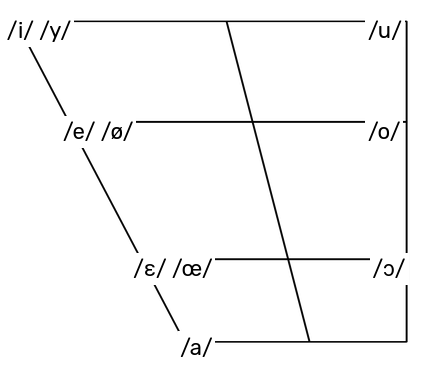
The following vowels qualities are distinguished: | |||
'''a''' '''e''' '''ɛ''' '''i''' '''o''' '''ɔ''' '''ø''' '''œ''' '''u''' '''y''' | |||
The diagram below shows the 10 vowels of Dahur. | The diagram below shows the 10 vowels of Dahur. | ||
| Line 12: | Line 17: | ||
In practice, the vowel /a/ may actually vary between /a/, /ä/ and /ɑ/. | In practice, the vowel /a/ may actually vary between /a/, /ä/ and /ɑ/. | ||
Merging of /ø/ and /œ/ is fairly common, especially in more informal contexts, as these two vowels mostly don't occur as minimal pair (except in a couple cases). | |||
==Consonants== | ==Consonants== | ||
| Line 77: | Line 35: | ||
|- | |- | ||
!Nasal | !Nasal | ||
|style="text-align:center;font-family:mono"| | |style="text-align:center;font-family:mono"|'''m''' | ||
| | | | ||
|style="text-align:center;font-family:mono"| | |style="text-align:center;font-family:mono"|'''n''' | ||
| | | | ||
| | | | ||
| Line 86: | Line 44: | ||
|- | |- | ||
!Plosive | !Plosive | ||
|style="text-align:center;font-family:mono"| | |style="text-align:center;font-family:mono"|'''p''' '''b''' | ||
| | | | ||
|style="text-align:center;font-family:mono"| | |style="text-align:center;font-family:mono"|'''t''' '''d''' | ||
| | | | ||
| | | | ||
|style="text-align:center;font-family:mono"| | |style="text-align:center;font-family:mono"|'''k''' '''g''' | ||
| | | | ||
|- | |- | ||
| Line 97: | Line 55: | ||
| | | | ||
| | | | ||
|style="text-align:center;font-family:mono"| | |style="text-align:center;font-family:mono"|'''s''' '''z''' | ||
|style="text-align:center;font-family:mono"| | |style="text-align:center;font-family:mono"|'''ʃ''' '''ʒ''' | ||
| | | | ||
| | | | ||
| Line 105: | Line 63: | ||
!Non-sibilant fricative | !Non-sibilant fricative | ||
| | | | ||
|style="text-align:center;font-family:mono"| | |style="text-align:center;font-family:mono"|'''f''' '''v''' | ||
| | | | ||
| | | | ||
| | | | ||
| | | | ||
|style="text-align:center;font-family:mono"| | |style="text-align:center;font-family:mono"|'''h''' | ||
|- | |- | ||
!Approximant | !Approximant | ||
| Line 117: | Line 75: | ||
| | | | ||
| | | | ||
|style="text-align:center;font-family:mono"| | |style="text-align:center;font-family:mono"|'''j''' | ||
| | | | ||
| | | | ||
| Line 124: | Line 82: | ||
| | | | ||
| | | | ||
|style="text-align:center;font-family:mono"| | |style="text-align:center;font-family:mono"|'''ɾ''' '''r''' | ||
| | | | ||
| | | | ||
| Line 133: | Line 91: | ||
| | | | ||
| | | | ||
|style="text-align:center;font-family:mono"| | |style="text-align:center;font-family:mono"|'''l''' | ||
| | | | ||
| | | | ||
| Line 140: | Line 98: | ||
|} | |} | ||
The rhotic consonant ( | The rhotic consonant ('''r''') is in free variation and may be realised either as a tap, a flap or a trill. The trill pronunciation (/r/) is more common at the beginning of a syllable, and even more so at the beginning of a word. The tap/flap pronunciation (/ɾ/) is more common in consonant clusters, especially after a plosive. | ||
In Dahur phonology, the combinations | In Dahur phonology, the combinations '''tr''' and '''kʃ''' count as single, independent consonants. | ||
==Phonotactics== | |||
A syllable in Dahur must contain one vowel, which may be preceded and/or followed by any number of consonants. In practice, consonant clusters don't usually go beyond four consonants. For that account, '''kʃ''' and '''tɾ''' are always considered as single consonants. | |||
All consonant sequences are possible. However, in practice, some consonant combinations (ex. '''-hm-''', '''-tɾkʃ-''' &c.) are rare. | |||
Some studies consider the existence of a glottal stop when a proper consonant is absent. This view is reflected in the writing, which has a special sign for the glottal stop / lack of a consonant. The last consonant of a syllable can be doubled. | Some studies consider the existence of a glottal stop when a proper consonant is absent. This view is reflected in the writing, which has a special sign for the glottal stop / lack of a consonant. The last consonant of a syllable can be doubled. | ||
Examples of valid syllables: | Examples of valid syllables: | ||
| Line 258: | Line 118: | ||
| '''wi''' | | '''wi''' | ||
| '''koj''' | | '''koj''' | ||
| ''' | | '''gjɔ''' | ||
| ''' | | '''pɾujn''' | ||
| ''' | | '''kʃtɾa''' | ||
| ''' | | '''fʃtlœmbz''' | ||
|} | |} | ||
==Stress== | ==Stress== | ||
In the | In the standard pronunciation, words are stressed on the next-to-last syllable. However, if the last syllable contains the consonant /tɾ/, it will be stressed. | ||
Ex.: | Ex.: | ||
| Line 271: | Line 131: | ||
{| class="wikitable" | {| class="wikitable" | ||
|- | |- | ||
| ''' | | '''<u>ka</u>nar''' | ||
<tt>/ˈka.nar/</tt> | <tt>/ˈka.nar/</tt> | ||
| ''' | | '''os<u>trøn</u>dɛl''' | ||
<tt>/os.ˈtɾøn.dɛl/</tt> | <tt>/os.ˈtɾøn.dɛl/</tt> | ||
| ''' | | '''<u>tef</u>ʃiv''' | ||
<tt>/ˈtef.ʃiv/</tt> | <tt>/ˈtef.ʃiv/</tt> | ||
| ''' | | '''da<u>sutɾ</u>''' | ||
<tt>/daˈsutɾ/</tt> | <tt>/daˈsutɾ/</tt> | ||
| ''' | | '''maʃkin<u>tɾod</u>''' | ||
<tt>/maʃ.kinˈtɾod/</tt> | <tt>/maʃ.kinˈtɾod/</tt> | ||
|} | |||
Doubled vowels in the last syllable may sound as a long, stressed vowel; however, they are actually two separate vowels, each one in a different syllable, with stress falling on the first one (or on the last, in case that syllable contains the consonant '''tr'''). It is not uncommon to hear an epenthetic '''h''', '''j''' or '''w''' between the two vowels. | |||
Ex.: | |||
{| class="wikitable" | |||
|- | |||
| '''kaj<u>na</u>ar''' | |||
<tt>/kaj.ˈna.ar/</tt>, <br/> | |||
<tt>/kaj.ˈna.har/</tt> <br/> | |||
| '''pakisa<u>atr</u>''' | |||
<tt>/pa.ki.sa.ˈatr/</tt>, <br/> | |||
<tt>/pa.ki.sa.ˈhatr/</tt> <br/> | |||
| '''tøndel<u>li</u>in''' | |||
<tt>/tøn.del.ˈli.in/</tt>, <br/> | |||
<tt>/tøn.del.ˈli.jin/</tt>, <br/> | |||
<tt>/tøn.del.ˈli.hin/</tt> | |||
| '''talde<u>sy</u>ys''' | |||
<tt>/tal.de.ˈsy.ys/</tt>, <br/> | |||
<tt>/tal.de.ˈsy.hys/</tt> <br/> | |||
|} | |} | ||
=Writing= | =Writing= | ||
[[Dahur script]] consists in an alphasyllabary consisting in | [[Dahur script]] consists in an alphasyllabary consisting in separate letters indicating consonants, a combination of separate letters and diacritics to indicate vowels, as well as certain special letters for individual syllables. | ||
=Morphology= | =Morphology= | ||
| Line 330: | Line 212: | ||
=== Number === | === Number === | ||
Nouns in Dahur have a singular and a plural. The plural ending varies according to noun class and to case. There is also a dual number, which is valid only for nouns normally occurring in pairs. Mass or collective nouns have a singulative inflection. | Nouns in Dahur have a singular and a plural. The plural ending varies according to noun class and to case. There is also a dual number, which is valid only for nouns normally occurring in pairs. Mass or collective nouns have a singulative inflection, but this is not very systematically indicated. | ||
| Line 345: | Line 227: | ||
|- | |- | ||
|class 1 | |class 1 | ||
|''' | |'''grats''' | ||
"boy" | "boy" | ||
|''' | |'''gratsen''' | ||
"boys" | "boys" | ||
| - | | - | ||
| Line 357: | Line 239: | ||
|'''kɛʃevlin''' | |'''kɛʃevlin''' | ||
"hammers" | "hammers" | ||
|''' | |'''kɛʃevs''' | ||
"pair of hammers" (traditionally used by blacksmiths) | "pair of hammers" (traditionally used by blacksmiths) | ||
| - | | - | ||
|- | |- | ||
|class 3 | |class 3 | ||
|''' | |'''halajn''' | ||
"water" | "water" | ||
|''' | |'''halejnn''' | ||
"waters" (i.e. in a flood) | "waters" (i.e. in a flood) | ||
|''' | |'''halajns''' | ||
"The Two Waters" (the river Okanuma and the lake Kassanjas) | "The Two Waters" (the river Okanuma and the lake Kassanjas) | ||
|''' | |'''halajny''' | ||
"a drop of water" | "a drop of water" | ||
|- | |- | ||
| Line 394: | Line 276: | ||
|'''astrønɛljan''' | |'''astrønɛljan''' | ||
"ideas" | "ideas" | ||
|''' | |'''astrønɛls''' | ||
"a couple ideas" | "a couple ideas" | ||
| - | | - | ||
| Line 411: | Line 293: | ||
|- | |- | ||
|rowspan="3"|class 1 | |rowspan="3"|class 1 | ||
|''' | |'''katlaj''' | ||
"girlfriend" | "girlfriend" | ||
|''' | |'''katlajen''' | ||
|- | |- | ||
|'''dukʃatr''' | |'''dukʃatr''' | ||
| Line 428: | Line 310: | ||
|'''takojlin''' | |'''takojlin''' | ||
|- | |- | ||
|''' | |'''uhpsan''' | ||
"paper" | "paper" | ||
|''' | |'''uhpsanlin''' | ||
|- | |- | ||
|'''dasutr''' | |'''dasutr''' | ||
| Line 474: | Line 356: | ||
|'''tʃeptal''' | |'''tʃeptal''' | ||
"cloud" | "cloud" | ||
|'''tʃapatlin''' | |'''tʃapatlin''', '''tʃaptlin''' | ||
|- | |- | ||
|rowspan="3"|class 4 | |rowspan="3"|class 4 | ||
|'''kraus''' | |'''kraus''' | ||
"ear" | "ear" | ||
|''' | |'''krojsni''' | ||
|- | |- | ||
|''' | |'''ɛmblew''' | ||
"hat" | "hat" | ||
|'''ɛmbalni''' | |'''ɛmbalni''' | ||
| Line 487: | Line 369: | ||
|'''krikter''' | |'''krikter''' | ||
"helmet" | "helmet" | ||
|''' | |'''kruktni''' | ||
|- | |- | ||
|} | |} | ||
=== Case === | |||
Dahur nouns inflect for the following cases: | |||
* '''nominative''' (subject, predicative) | |||
* '''accusative''' (direct object, motion towards) | |||
* '''dative''' (indirect object) | |||
* '''genitive''' (possession, partitive, origin) | |||
* '''locative''' (location, placement) | |||
* '''instrumental''' (instrument, means, company) | |||
* '''ablative''' (adverbial) | |||
* '''ergative''' (agent of the passive voice) | |||
All cases except the nominative and the ergative can be used with prepositions. | |||
Certain nouns, mostly nouns indicating human beings, also show a vocative form, mostly formed with the ending '''-e''', but usually irregular. | |||
Certain nouns, for example nouns indicating mass or food, show a partitive case, usually formed with the ending '''-(i)t'''. | |||
=== Inflection === | === Inflection === | ||
| Line 496: | Line 396: | ||
{| class="wikitable" | |||
|- | |||
| | |||
!colspan="3"|Class 1 | |||
| | |||
!colspan="3"|Class 2 | |||
| | |||
!colspan="3"|Class 3 | |||
| | |||
!colspan="3"|Class 4 | |||
| | |||
!colspan="3"|Class 5 | |||
|- | |||
| | |||
!Sing. | |||
!Dual | |||
!Pl. | |||
| | |||
!Sing. | |||
!Dual | |||
!Pl. | |||
| | |||
!Sing. | |||
!Dual | |||
!Pl. | |||
| | |||
!Sing. | |||
!Dual | |||
!Pl. | |||
| | |||
!Sing. | |||
!Dual | |||
!Pl. | |||
|- | |||
!Nominative | |||
|'''-''' | |||
|'''-s''' | |||
|'''-en''' | |||
| | |||
| - | |||
|'''-s''' | |||
|'''-lin''' | |||
| | |||
| - | |||
|'''-s''' | |||
|'''-n''' | |||
| | |||
| - | |||
|'''-is''' | |||
|'''-ni''' | |||
| | |||
| - | |||
|'''-s''' | |||
|'''-jan''' | |||
|- | |||
!Accusative | |||
|'''-a''' | |||
|'''-as''' | |||
|'''-an''' | |||
| | |||
|'''-a''' | |||
|'''-as''' | |||
|'''-lajn''' | |||
| | |||
|'''-a''' | |||
|'''-as''' | |||
|'''-an''' | |||
| | |||
|'''-a''' | |||
|'''-jas''' | |||
|'''-nja''' | |||
| | |||
|'''-a''' | |||
|'''-as''' | |||
|'''-jan''' | |||
|- | |||
!Dative | |||
|'''-u''' | |||
|'''-us''' | |||
|'''-un''' | |||
| | |||
|'''-u''' | |||
|'''-us''' | |||
|'''-lun''' | |||
| | |||
|'''-u''' | |||
|'''-us''' | |||
|'''-wan''' | |||
| | |||
|'''-u''' | |||
|'''-ujs''' | |||
|'''-nu''' | |||
| | |||
|'''-u''' | |||
|'''-us''' | |||
|'''-ujn''' | |||
|- | |||
!Genitive | |||
|'''-ak''' | |||
|'''-ask''' | |||
|'''-ken''' | |||
| | |||
|'''-ik''' | |||
|'''-isk''' | |||
|'''-link''' | |||
| | |||
|'''-aʃ''' | |||
|'''-ʃas''' | |||
|'''-ʃan''' | |||
| | |||
|'''-iʃ''' | |||
|'''-siʃ''' | |||
|'''-niʃ''' | |||
| | |||
|'''-ik''' | |||
|'''-isk''' | |||
|'''-jank''' | |||
|- | |||
!Locative | |||
|'''-ebb''' | |||
|'''-eps''' | |||
|'''-emb''' | |||
| | |||
|'''-ebb''' | |||
|'''-eps''' | |||
|'''-limb''' | |||
| | |||
|'''-ebb''' | |||
|'''-eps''' | |||
|'''-emb''' | |||
| | |||
|'''-ebb''' | |||
|'''-bis''' | |||
|'''-nibb''' | |||
| | |||
|'''-ebb''' | |||
|'''-eps''' | |||
|'''-jamb''' | |||
|- | |||
!Instrumental | |||
|'''-om''' | |||
|'''-oms''' | |||
|'''-nom''' | |||
| | |||
|'''-om''' | |||
|'''-oms''' | |||
|'''-lom''' | |||
| | |||
|'''-om''' | |||
|'''-oms''' | |||
|'''-nom''' | |||
| | |||
|'''-om''' | |||
|'''-joms''' | |||
|'''-njom''' | |||
| | |||
|'''-om''' | |||
|'''-oms''' | |||
|'''-njom''' | |||
|- | |||
!Ablative | |||
|'''-ɛv''' | |||
|'''-ɛfs''' | |||
|'''-nɛv''' | |||
| | |||
|'''-ɛv''' | |||
|'''-ɛfs''' | |||
|'''-lɛnv''', '''-lɛv''' | |||
| | |||
|'''-ɛv''' | |||
|'''-ɛfs''' | |||
|'''-nɛv''' | |||
| | |||
|'''-ɛv''' | |||
|'''-jɛfs''' | |||
|'''-njɛv''' | |||
| | |||
|'''-ɛv''' | |||
|'''-ɛfs''' | |||
|'''-njɛv''' | |||
|- | |||
!Ergative | |||
|'''-øtr''' | |||
|'''-søtr''' | |||
|'''-trøn''' | |||
| | |||
|'''-øtr''' | |||
|'''-søtr''' | |||
|'''-løtr''' | |||
| | |||
|'''-øtr''' | |||
|'''-søtr''' | |||
|'''-trøn''' | |||
| | |||
|'''-øtr''' | |||
|'''-sjøtr''' | |||
|'''-trøjn''' | |||
| | |||
|'''-øtr''' | |||
|'''-søtr''' | |||
|'''-trøjn''' | |||
|} | |||
<!--- | |||
* The '''nominative''' case is the basic form of nouns. | * The '''nominative''' case is the basic form of nouns. | ||
* The '''accusative''' case is indicated by the enging '''-a'''. | * The '''accusative''' case is indicated by the enging '''-a'''. | ||
| Line 504: | Line 608: | ||
* The '''ergative''' case is indicated by the enging '''-øtr'''. | * The '''ergative''' case is indicated by the enging '''-øtr'''. | ||
* The '''ablative''' case is indicated by the enging '''-ɛv'''. | * The '''ablative''' case is indicated by the enging '''-ɛv'''. | ||
--> | |||
When an ending starting with a vowel is applied, a final '''-i''' becomes '''-j-''', and a final '''-u''' becomes '''-w-'''; otherwise, an '''-h-''' is added. Ex.: | When an ending starting with a vowel is applied, a final '''-i''' becomes '''-j-''', and a final '''-u''' becomes '''-w-'''; otherwise, an '''-h-''' is added. Ex.: | ||
| Line 509: | Line 614: | ||
* '''dula''' "babysitter", '''dulahen''' "babysitters" | * '''dula''' "babysitter", '''dulahen''' "babysitters" | ||
* '''agdari''' "prisoner", '''agdarjen''' "prisoners" | * '''agdari''' "prisoner", '''agdarjen''' "prisoners" | ||
* '''pakpaki''' "louse", '''pakpakja''' "louse (accus.)", '''pakpakjaʃ''' "of a louse", '''pakpakjom''' "by a louse" | |||
* '''pakpaki''' "louse", '''pakpakja''' "louse (accus.)", ''' | |||
In the following tables, you have some examples of nouns of the various classes, fully inflected for number and case. | In the following tables, you have some examples of nouns of the various classes, fully inflected for number and case. | ||
* Class 1: '''grats''' "boy" | |||
* Class 2: '''kɛʃev''' "hammer" | |||
* Class 3: '''tʃeptal''' "cloud" | |||
* Class 4: '''kraus''' "ear" | |||
* Class 5: '''astrønɛl''' "idea" | |||
{| class="wikitable" | {| class="wikitable" | ||
|- | |- | ||
|colspan=" | |colspan="4"|Class 1: '''grats''' "boy" | ||
|- | |- | ||
! | ! | ||
!Singular | !Singular | ||
!Dual | |||
!Plural | !Plural | ||
|- | |- | ||
!Nominative | !Nominative | ||
|''' | |'''grats''' | ||
|''' | |'''gratss''' | ||
|'''gratsen''' | |||
|- | |- | ||
!Accusative | !Accusative | ||
|''' | |'''gratsa''' | ||
|''' | |'''gratsas''' | ||
|'''gratsan''' | |||
|- | |- | ||
!Dative | !Dative | ||
|''' | |'''gratsu''' | ||
|''' | |'''gratsus''' | ||
|'''gratsun''' | |||
|- | |- | ||
!Genitive | !Genitive | ||
|''' | |'''gratsak''' | ||
|''' | |'''gratsask''' | ||
|'''gratsken''' | |||
|- | |- | ||
!Locative | !Locative | ||
|''' | |'''gratsebb''' | ||
|''' | |'''gratseps''' | ||
|'''gratsemb''' | |||
|- | |- | ||
!Instrumental | !Instrumental | ||
|''' | |'''gratsom''' | ||
|''' | |'''gratsoms''' | ||
|'''gratsnom''' | |||
|- | |||
!Ablative | |||
|'''gratsɛv''' | |||
|'''gratsɛfs''' | |||
|'''gratsnɛv''' | |||
|- | |- | ||
!Ergative | !Ergative | ||
|''' | |'''gratsøtr''' | ||
|''' | |'''gratssøtr''' | ||
|'''gratsetrøn''' | |||
|- | |- | ||
! | !Vocative | ||
|''' | |'''gratse''' | ||
|''' | |'''gratses''' | ||
|'''gratsen''' | |||
|} | |} | ||
| Line 561: | Line 687: | ||
{| class="wikitable" | {| class="wikitable" | ||
|- | |- | ||
|colspan=" | |colspan="4"|Class 2: '''kɛʃev''' "hammer" | ||
|- | |- | ||
! | ! | ||
!Singular | !Singular | ||
!Dual | |||
!Plural | !Plural | ||
|- | |- | ||
!Nominative | !Nominative | ||
|'''kɛʃev''' | |'''kɛʃev''' | ||
|'''kɛʃevs''' | |||
|'''kɛʃevlin''' | |'''kɛʃevlin''' | ||
|- | |- | ||
!Accusative | !Accusative | ||
|'''kɛʃeva''' | |'''kɛʃeva''' | ||
|''' | |'''kɛʃevas''' | ||
|'''kɛʃevlajn''' | |||
|- | |- | ||
!Dative | !Dative | ||
|''' | |'''kɛʃevu''' | ||
|''' | |'''kɛʃevus''' | ||
|'''kɛʃevlun''' | |||
|- | |- | ||
!Genitive | !Genitive | ||
|''' | |'''kɛʃevik''' | ||
|''' | |'''kɛʃevisk''' | ||
|'''kɛʃevlink''' | |||
|- | |- | ||
!Locative | !Locative | ||
|''' | |'''kɛʃevebb''' | ||
|''' | |'''kɛʃeveps''' | ||
|'''kɛʃevlimb''' | |||
|- | |- | ||
!Instrumental | !Instrumental | ||
|''' | |'''kɛʃevom''' | ||
|''' | |'''kɛʃevoms''' | ||
|'''kɛʃevlom''' | |||
|- | |||
!Ablative | |||
|'''kɛʃevɛv''' | |||
|'''kɛʃevɛfs''' | |||
|'''kɛʃevlɛnv''', '''kɛʃevlɛv''' | |||
|- | |- | ||
!Ergative | !Ergative | ||
|'''kɛʃevøtr''' | |'''kɛʃevøtr''' | ||
|''' | |'''kɛʃevsøtr''' | ||
|'''kɛʃevløtr''' | |||
|''' | |||
|} | |} | ||
| Line 603: | Line 738: | ||
{| class="wikitable" | {| class="wikitable" | ||
|- | |- | ||
|colspan=" | |colspan="4"|Class 3: '''tʃeptal''' "cloud" | ||
|- | |- | ||
! | ! | ||
!Singular | !Singular | ||
!Dual | |||
!Plural | !Plural | ||
|- | |- | ||
!Nominative | !Nominative | ||
|'''tʃeptal''' | |'''tʃeptal''' | ||
|''' | |'''tʃeptals''' | ||
|'''tʃaptlin''' | |||
|- | |- | ||
!Accusative | !Accusative | ||
|'''tʃeptala''' | |'''tʃeptala''' | ||
|''' | |'''tʃeptalas''' | ||
|'''tʃaptlijan''', '''tʃaptljan''' | |||
|- | |- | ||
!Dative | !Dative | ||
|''' | |'''tʃeptalu''' | ||
|''' | |'''tʃeptalus''' | ||
|'''tʃaptliwan''' | |||
|- | |- | ||
!Genitive | !Genitive | ||
|''' | |'''tʃeptalaʃ''' | ||
|''' | |'''tʃeptalʃas''' | ||
|'''tʃaptliʃan''' | |||
|- | |- | ||
!Locative | !Locative | ||
|''' | |'''tʃeptalebb''' | ||
|''' | |'''tʃeptaleps''' | ||
|'''tʃaptlijemb''', '''tʃaptljemb''' | |||
|- | |- | ||
!Instrumental | !Instrumental | ||
|''' | |'''tʃeptalom''' | ||
|''' | |'''tʃeptaloms''' | ||
|'''tʃaptlinom''' | |||
|- | |||
!Ablative | |||
|'''tʃeptalɛv''' | |||
|'''tʃeptalɛfs''' | |||
|'''tʃaptlinɛv''' | |||
|- | |- | ||
!Ergative | !Ergative | ||
|'''tʃeptaløtr''' | |'''tʃeptaløtr''' | ||
|''' | |'''tʃeptalsøtr''' | ||
|'''tʃaptlitrøn''' | |||
|- | |- | ||
! | !Partitive | ||
|''' | |'''tʃeptalt''' | ||
|''' | |'''tʃeptalts''' | ||
|'''tʃaptlint''' | |||
|} | |} | ||
| Line 645: | Line 794: | ||
{| class="wikitable" | {| class="wikitable" | ||
|- | |- | ||
|colspan=" | |colspan="4"|Class 4: '''kraus''' "ear" | ||
|- | |- | ||
! | ! | ||
!Singular | !Singular | ||
!Dual | |||
!Plural | !Plural | ||
|- | |- | ||
!Nominative | !Nominative | ||
|'''kraus''' | |'''kraus''' | ||
|''' | |'''krausis''' | ||
|'''krojsni''' | |||
|- | |- | ||
!Accusative | !Accusative | ||
|'''krausa''' | |'''krausa''' | ||
|''' | |'''krausjas''' | ||
|'''krojsnja''' | |||
|- | |- | ||
!Dative | !Dative | ||
|''' | |'''krausu''' | ||
|''' | |'''krausujs''' | ||
|'''krojsnu''' | |||
|- | |- | ||
!Genitive | !Genitive | ||
|''' | |'''krausiʃ''' | ||
|''' | |'''kraussiʃ''' | ||
|'''krojsniʃ''' | |||
|- | |- | ||
!Locative | !Locative | ||
|''' | |'''krausebb''' | ||
|''' | |'''krauseps''' | ||
|'''krojsnibb''' | |||
|- | |- | ||
!Instrumental | !Instrumental | ||
|''' | |'''krausom''' | ||
|''' | |'''krausoms''' | ||
|'''krojsnjom''' | |||
|- | |||
!Ablative | |||
|'''krausɛv''' | |||
|'''krausɛfs''' | |||
|'''krojsnjɛv''' | |||
|- | |- | ||
!Ergative | !Ergative | ||
|'''krausøtr''' | |'''krausøtr''' | ||
|''' | |'''krausjøtr''' | ||
|'''krojstrøjn''' | |||
|} | |||
{| class="wikitable" | |||
|- | |||
|colspan="4"|Class 5: '''astrønɛl''' "idea" | |||
|- | |||
! | |||
!Singular | |||
!Dual | |||
!Plural | |||
|- | |||
!Nominative | |||
|'''astrønɛl''' | |||
|'''astrønɛls''' | |||
|'''astrønɛljan''' | |||
|- | |||
!Accusative | |||
|'''astrønɛla''' | |||
|'''astrønɛlas''' | |||
|'''astrønɛljan''' | |||
|- | |||
!Dative | |||
|'''astrønɛlu''' | |||
|'''astrønɛlus''' | |||
|'''astrønɛlujn''' | |||
|- | |||
!Genitive | |||
|'''astrønɛlik''' | |||
|'''astrønɛlisk''' | |||
|'''astrønɛljank''' | |||
|- | |||
!Locative | |||
|'''astrønɛlebb''' | |||
|'''astrønɛleps''' | |||
|'''astrønɛljamb''' | |||
|- | |||
!Instrumental | |||
|'''astrønɛlom''' | |||
|'''astrønɛloms''' | |||
|'''astrønɛlnjom''' | |||
|- | |- | ||
!Ablative | !Ablative | ||
|''' | |'''astrønɛlɛv''' | ||
|''' | |'''astrønɛlɛfs''' | ||
|'''astrønɛlnjɛv''' | |||
|- | |||
!Ergative | |||
|'''astrønɛløtr''' | |||
|'''astrønɛlsøtr''' | |||
|'''astrønɛltrøjn''' | |||
|- | |||
!Partitive | |||
|'''astrønɛlt''' | |||
|'''astrønɛlts''' | |||
|'''astrønɛljant''' | |||
|} | |} | ||
| Line 693: | Line 908: | ||
| | | | ||
!Singular | !Singular | ||
!Dual | |||
!Plural | !Plural | ||
!Singulative | !Singulative | ||
|- | |- | ||
!Nominative | !Nominative | ||
|'''tru''' | |'''tru''' | ||
|'''gas''' | |||
|'''tann''' | |'''tann''' | ||
|'''try''' | |'''try''' | ||
|- | |- | ||
!Accusative | !Accusative | ||
|'''na''' | |'''na''' | ||
|'''ga''' | |||
|'''ta''' | |'''ta''' | ||
|'''ny''' | |'''ny''' | ||
|- | |- | ||
!Dative | !Dative | ||
|''' | |'''kʃu''' | ||
|''' | |'''gu''' | ||
|''' | |'''tu''' | ||
|''' | |'''kʃu''' | ||
|- | |- | ||
!Genitive | !Genitive | ||
|'''kis''' | |'''kis''' | ||
|'''gak''' | |||
|'''tak''' | |'''tak''' | ||
|'''kis''' | |'''kis''' | ||
|- | |- | ||
!Locative | !Locative | ||
|''' | |'''debb''' | ||
|''' | |'''gebb''' | ||
|''' | |'''tebb''' | ||
|''' | |'''debb''' | ||
|- | |- | ||
!Instrumental | !Instrumental | ||
|'''trom''' | |'''trom''' | ||
|''' | |'''gom''' | ||
|''' | |'''tom''' | ||
|'''trom''' | |'''trom''' | ||
|- | |||
!Ablative | |||
|'''dɛv''' | |||
|'''gɛv''' | |||
|'''tɛv''' | |||
|'''dɛv''' | |||
|- | |- | ||
!Ergative | !Ergative | ||
|'''trø''' | |'''trø''' | ||
|'''gøtr''' | |||
|'''tøtr''' | |'''tøtr''' | ||
|'''trø''' | |'''trø''' | ||
|} | |||
=== Indefinite Article === | |||
Dahur has no proper indefinite article. | |||
If it's really necessary to mark a noun phrase as indefinite, an indefinite pronoun may be used. The most common is '''lum''' (invariable), meaning "some", "a certain" &c. | |||
== Prepositions == | |||
Prepositions in Dahur require the noun in one of the following cases: | |||
* accusative | |||
* dative | |||
* genitive | |||
* ablative | |||
* instrumental | |||
* locative | |||
The nominative and the ergative are '''never''' used with prepositions. | |||
In the table below you have the most common Dahur prepositions: | |||
{| class="wikitable" | |||
|- | |||
!Preposition | |||
!Case | |||
!Meaning | |||
|- | |||
|'''dun''' | |||
|''locative'', ''accusative of movement'' | |||
|inside | |||
|- | |||
|rowspan="2"|'''yin''' | |||
|''dative'' | |||
|for, in behalf of | |||
|- | |||
|''accusative'' | |||
|towards | |||
|- | |||
|'''ari''', '''ar''' | |||
|''genitive'' | |||
|from, out of | |||
|- | |||
|'''yuʃ''' | |||
|''genitive'', ''ablative'' | |||
|because of | |||
|- | |||
|'''vøj''' | |||
|''locative'' | |||
|through | |||
|- | |||
|'''syn''' | |||
|''locative''; ''accusative of movement'' | |||
|near | |||
|- | |||
|'''kʃe''' | |||
|''genitive'' | |||
|since, ago | |||
|- | |||
|'''pɛn''' | |||
|''locative''; ''accusative of movement'' | |||
|besides, next to | |||
|- | |||
|'''lujg''' | |||
|''locative''; ''accusative of movement'' | |||
|in front of | |||
|- | |||
|'''mœh''' | |||
|''ablative'' | |||
|without | |||
|- | |||
|'''sto''' | |||
|''locative''; ''accusative of movement'' | |||
|on, on top of | |||
|- | |||
|'''krɔj''' | |||
|''locative''; ''accusative of movement'' | |||
|under | |||
|- | |||
|'''tjɛs''' | |||
|''genitive'' | |||
|before (time) | |||
|- | |||
|'''gwaj''' | |||
|''accusative'' | |||
|after (time) | |||
|- | |||
|'''fyj''' | |||
|''ablative'' | |||
|during | |||
|- | |||
|'''vlen''' | |||
|''instrumental'' | |||
|despite | |||
|- | |||
|'''uhk''' | |||
|''genitive'' | |||
|except | |||
|- | |||
|'''uzd''' | |||
|''dative'' | |||
|instead of | |||
|- | |- | ||
|'''blas''' | |||
|''' | |''locative''; ''accusative of movement'' | ||
|'' | |behind | ||
| | |||
|} | |} | ||
Examples: | |||
* '''yin na hedana''' "towards the house" | |||
* '''dun na hedana''' "into the house" | |||
* '''ar kis hedanik''' "from the house", "out of the house" | |||
* '''syn debb hedanebb''' "near the house" | |||
* '''syn na hedana''' "going near of the house" | |||
* '''pɛn debb hedanebb''' "besides the house", "next to the house" | |||
* '''pɛn na hedana''' "going next to the house" | |||
* '''lujg debb hedanebb''' "in front to the house" | |||
* '''lujg na hedana''' "going to the front of the house" | |||
* '''mœh dɛv hedanɛv''' "without the house" | |||
* '''sto debb hedanebb''' "on top of the house" | |||
* '''sto na hedana''' "going onto (the top of) the house" | |||
* '''krɔj debb hedanebb''' "under the house" | |||
* '''uzd kʃu hedanu''' "instead of the house" | |||
* '''blas debb hedanebb''' "behind the house" | |||
* '''blas na hedana''' "going behind the house" | |||
== Adjectives == | == Adjectives == | ||
| Line 751: | Line 1,096: | ||
Attributive adjectives in Dahur are invariable and come before the noun. Ex.: | Attributive adjectives in Dahur are invariable and come before the noun. Ex.: | ||
* '''fɛren | * '''fɛren grats''' "a smart boy" | ||
* '''duʃ | * '''duʃ halajn''' "clean water" | ||
* '''selak kanaris''' "pretty eyes" | * '''selak kanaris''' "pretty eyes" | ||
| Line 917: | Line 1,262: | ||
|"false news", "fake news" | |"false news", "fake news" | ||
|} | |} | ||
=== Predicative Adjectives === | === Predicative Adjectives === | ||
| Line 928: | Line 1,272: | ||
|'''Tru astrønɛl laje makʃølen.''' || The idea is great. | |'''Tru astrønɛl laje makʃølen.''' || The idea is great. | ||
|- | |- | ||
|'''Tru | |'''Tru grats alanje befitra.''' || The boy is tired. | ||
|} | |} | ||
| Line 937: | Line 1,281: | ||
|'''Tru astrønɛl makʃølnaje.''' || The idea is great. | |'''Tru astrønɛl makʃølnaje.''' || The idea is great. | ||
|- | |- | ||
|'''Tru | |'''Tru grats abefitranje.''' || The boy is tired. | ||
|} | |} | ||
| Line 1,283: | Line 1,627: | ||
|1,000th || '''tatrimiiki''' | |1,000th || '''tatrimiiki''' | ||
|} | |} | ||
== Pronouns == | |||
=== Personal Pronouns === | |||
Personal Pronouns in Dahur indicate person (1st, 2nd, 3rd) and number (singular, dual, plural). | |||
{| class="wikitable" | |||
|- | |||
|rowspan="2"|1st Person | |||
|'''dɛ''' "I" , "me" | |||
|'''ʃes''' "we both" | |||
|'''ʃɛn''' "we", "us" | |||
|- | |||
!Singular | |||
!Dual | |||
!Plural | |||
|- | |||
!Nominative | |||
|'''dɛ''' | |||
|'''ʃes''' | |||
|'''ʃɛn''' | |||
|- | |||
!Accusative | |||
|'''dɛa''', '''da''' | |||
|'''ʃeas''', '''ʃas''' | |||
|'''ʃan''' | |||
|- | |||
!Dative | |||
|'''dɛw''', '''du''' | |||
|'''ʃeus''', '''ʃews''', '''ʃus''' | |||
|'''ʃɛun''', '''ʃɛwn''', '''ʃun''' | |||
|- | |||
!Genitive | |||
|'''dɛk''' | |||
|'''ʃesk''' | |||
|'''ʃɛkɛn''', '''ʃkɛn''' | |||
|- | |||
!Locative | |||
|'''dɛbb''' | |||
|'''ʃeps''' | |||
|'''ʃɛmb''' | |||
|- | |||
!Instrumental | |||
|'''dɛm''' | |||
|'''ʃems''' | |||
|'''ʃɛom''', '''ʃom''' | |||
|- | |||
!Ablative | |||
|'''dɛv''' | |||
|'''ʃɛfs''' | |||
|'''ʃɛɛv''', '''ʃɛv''' | |||
|- | |||
!Ergative | |||
|'''dɛjøtr''', '''dɛtr''' | |||
|'''ʃesøtr''' | |||
|'''ʃɛtrøn''', '''ʃtrøn''' | |||
|- | |||
!Partitive | |||
| - | |||
|'''ʃets''' | |||
|'''ʃɛnt''' | |||
|} | |||
{| class="wikitable" | |||
|- | |||
|rowspan="2"|2nd Person | |||
|'''hej''' "you (sg.), thou" | |||
|'''kwes''' "you both" | |||
|'''kwɛn''' "you (pl.)" | |||
|- | |||
!Singular | |||
!Dual | |||
!Plural | |||
|- | |||
!Nominative | |||
|'''hej''' | |||
|'''kwes''' | |||
|'''kwɛn''' | |||
|- | |||
!Accusative | |||
|'''heja''', '''ja''' | |||
|'''kweas''', '''kwas''' | |||
|'''kwɛan''', '''kwan''' | |||
|- | |||
!Dative | |||
|'''heju''', '''ju''' | |||
|'''kweus''' | |||
|'''kwɛun''', '''kun''' | |||
|- | |||
!Genitive | |||
|'''heik''', '''hejik''' | |||
|'''kwesk''' | |||
|'''kwɛnek''', '''kwɛnk''' | |||
|- | |||
!Locative | |||
|'''heibb''', '''hibb''' | |||
|'''kweps''' | |||
|'''kwɛmb''' | |||
|- | |||
!Instrumental | |||
|'''heim''', '''him''' | |||
|'''kwems''' | |||
|'''kwɛom''', '''kwɛm''', '''kwom''' | |||
|- | |||
!Ablative | |||
|'''hejɛv''', '''jɛv''' | |||
|'''kwɛfs''' | |||
|'''kwɛɛv''', '''kwɛv''' | |||
|- | |||
!Ergative | |||
|'''hejøtr''', '''hjøtr''' | |||
|'''kwesøtr''' | |||
|'''kwɛtrøn''' | |||
|- | |||
!Vocative | |||
|'''heje''' | |||
|'''kwejes''' | |||
|'''kwɛjɛn''' | |||
|- | |||
!Partitive | |||
| - | |||
|'''kwets''' | |||
|'''kwɛnt''' | |||
|} | |||
{| class="wikitable" | |||
|- | |||
|rowspan="2"|3rd Person | |||
|'''nar''' "he", "she", "it" | |||
|'''ras''' "they both" | |||
|'''ren''' "they", "them" | |||
|- | |||
!Singular | |||
!Dual | |||
!Plural | |||
|- | |||
!Nominative | |||
|'''nar''' | |||
|'''ras''' | |||
|'''rɛn''' | |||
|- | |||
!Accusative | |||
|'''nara''', '''ra''' | |||
|'''ras''' | |||
|'''rɛan''', '''ran''' | |||
|- | |||
!Dative | |||
|'''naru''', '''ru''' | |||
|'''raus''', '''raws''', '''rus''' | |||
|'''rɛun''', '''rɛwn''', '''run''' | |||
|- | |||
!Genitive | |||
|'''narɛk''', '''rɛk''' | |||
|'''resk''' | |||
|'''rɛkɛn''', '''ɛrken''' | |||
|- | |||
!Locative | |||
|'''narebb''', '''rebb''' | |||
|'''reps''' | |||
|'''rɛmb''' | |||
|- | |||
!Instrumental | |||
|'''narom''', '''rom''' | |||
|'''rems''' | |||
|'''rɛnom''', '''rom''' | |||
|- | |||
!Ablative | |||
|'''narɛv''', '''rɛv''' | |||
|'''rɛfs''' | |||
|'''rɛɛv''', '''rɛv''' | |||
|- | |||
!Ergative | |||
|'''narøtr''', '''røtr''' | |||
|'''resøtr''' | |||
|'''rɛtrøn''', '''ɛrtrøn''' | |||
|- | |||
!Partitive | |||
| - | |||
|'''rets''' | |||
|'''rɛnt''' | |||
|} | |||
The '''genitive''' forms work as possessive pronouns. In that case, the definite article is optional. Ex.: | |||
* '''tru dɛk astrønɛl''', '''dɛk astrønɛl''' "my idea" | |||
* '''na heik kʃalima''', '''heik kʃalima''' "your hair (accus.)" | |||
* '''trom narɛk kɛʃevom''', '''narɛk kɛʃevom''' "with his/her hammer (instr.)" | |||
* '''tu dɛk menirun''', '''dɛk menirun''' "to my children (dat.)" | |||
=== Demonstrative Pronouns === | |||
=== Interrogative Pronouns === | |||
=== Indefinite Pronouns === | |||
== Verbs == | == Verbs == | ||
The personal endings for all verb forms are as follows: | Verbs in Dahur have different stems indicating aspect. The conjugation uses different sets of endings to indicate tense or time. | ||
The basic verb stems are: | |||
{| class="wikitable" | |||
|- | |||
!Aspect | |||
!Meaning | |||
!Form | |||
|- | |||
|Generic | |||
|''verbal idea without a specific context, time or aspect'' | |||
|the basic stem of the verb | |||
|- | |||
|Cursive (Progressive; Continuous) | |||
|''action ongoing at the moment of reference | |||
|prefix '''a-''' and suffix '''-(a)n-''' | |||
|- | |||
|Aorist | |||
|''a complete or punctual action'' | |||
|suffix '''-(e)tt-''' | |||
|- | |||
|Perfect | |||
|''the result of an action that happened before the reference time'' | |||
|suffix '''-(l)l(a)-''' | |||
|- | |||
|Unrealised (Future) | |||
|''action as not realised in relation to the reference time'' | |||
|prefix '''u-''' and suffix '''-(u)ʃ-''' | |||
|- | |||
|Conditional | |||
|''irrealis, usually an action depending on another'' | |||
|prefix '''i-''' and suffix '''-i-''' | |||
|} | |||
Stem formation is often irregular. | |||
Ex.: | |||
{| class="wikitable" | |||
|- | |||
| | |||
!Generic | |||
!Cursive | |||
!Aorist | |||
!Perfect | |||
!Unrealised | |||
!Conditional | |||
|- | |||
|'''kaʃmal''' "take" | |||
|'''kaʃmal-''' | |||
|'''akaʃmaln-''' | |||
|'''kaʃmalett-''' | |||
|'''kaʃmalla-''' | |||
|'''ukaʃmaluʃ-''' | |||
|'''ikaʃmali-''' | |||
|- | |||
|'''la''' "be" | |||
|'''la-''' | |||
|'''alan-''' | |||
|'''latt-''' | |||
|'''lalla-''' | |||
|'''ulauʃ-''' | |||
|'''ilai-''' | |||
|- | |||
|'''wennin''' "live" | |||
|'''wennin-''' | |||
|'''awann-''' | |||
|'''wennett-''' | |||
|'''wennilla-''' | |||
|'''uwenninʃ-''' | |||
|'''iwennini-''' | |||
|- | |||
|'''gadra''' "write" | |||
|'''gadra-''' | |||
|'''agandran-''' | |||
|'''gadrett-''' | |||
|'''gadralla-''' | |||
|'''ugadruʃ-''' | |||
|'''igadri-''' | |||
|- | |||
|'''tefʃiv''' "flee" | |||
|'''tefʃiv-''' | |||
|'''ateʃfan-''' | |||
|'''tefʃivett-''' | |||
|'''tefʃivla-''' | |||
|'''utefʃivuʃ-''' | |||
|'''itefʃivi-''' | |||
|- | |||
|'''maʃkintɾod''' "represent" | |||
|'''maʃkintɾod-''' | |||
|'''amaʃkintɾon-''' | |||
|'''maʃkintɾott-''' | |||
|'''maʃkintɾolla-''' | |||
|'''umaʃkintɾotʃ-''' | |||
|'''imaʃkintɾodi-''' | |||
|- | |||
|'''kajnaar''' "jump" | |||
|'''kajnaar-''' | |||
|'''akajnaan-''' | |||
|'''kajnerett-''' | |||
|'''kajnaalla-''' | |||
|'''ukajnaaruʃ-''' | |||
|'''ikajnaari-''' | |||
|- | |||
|'''taldesyys''' "take care of" | |||
|'''taldesyys-''' | |||
|'''ataldesyyn-''' | |||
|'''taldesyyst-''' | |||
|'''taldesyyll-''' | |||
|'''utaldesyyʃ-''' | |||
|'''italdesyysi-''' | |||
|} | |||
<!--- | |||
The personal endings are : | |||
{| class="wikitable" | |||
|- | |||
| | |||
!Present | |||
!Past | |||
!Future | |||
|- | |||
!1s | |||
|'''-us''' | |||
|'''-sa''' | |||
|'''-os''' | |||
|- | |||
!2s | |||
|'''-im''' | |||
|'''-mis''' | |||
|'''-ojm''' | |||
|- | |||
!3s | |||
|'''-ej''' | |||
|'''-jes''' | |||
|'''-oj''' | |||
|- | |||
!1p | |||
|'''-ɔn''' | |||
|'''-sɔn''' | |||
|'''-on''' | |||
|- | |||
!2p | |||
|'''-ib''' | |||
|'''-ips''' | |||
|'''-ojb''' | |||
|- | |||
!3p | |||
|'''-ɛw''' | |||
|'''-sɛw''' | |||
|'''-wo''' | |||
|} | |||
The following combinations of stem + ending set occur: | |||
{| class="wikitable" | |||
|- | |||
| | |||
|Present | |||
|Past | |||
|Future | |||
|- | |||
|Generic | |||
!Simple | |||
Present | |||
!Habitual | |||
Past ("used to") | |||
!Generic | |||
Future | |||
|- | |||
|Cursive | |||
!Present | |||
Continuous | |||
!Past | |||
Continuous | |||
!Future | |||
Progressive | |||
|- | |||
|Aorist | |||
| | |||
!Simple | |||
Past (Aorist) | |||
!Definite Future | |||
(Specific, Punctual) | |||
|- | |||
|Perfect | |||
!Past | |||
Perfect | |||
!Present | |||
Perfect | |||
!Future | |||
Perfect | |||
|- | |||
|Unrealised | |||
!Unrealised | |||
Past ("would") | |||
!Near | |||
Future | |||
!Future | |||
(Remote) | |||
|- | |||
|Conditional | |||
!Conditional | |||
Past | |||
!Conditional | |||
Present | |||
| | |||
|} | |||
The following personal endings for all verb forms are as follows: | |||
* 1s: '''-us''' | * 1s: '''-us''' | ||
* 2s: '''-im''' | * 2s: '''-im''' | ||
* 3s: '''- | * 3s: '''-ej''' | ||
* 1p: '''- | * 1p: '''-ɔn''' | ||
* 2p: '''- | * 2p: '''-ib''' | ||
* 3p: '''- | * 3p: '''-ɛw''' | ||
=== | === Generic (Present) === | ||
The | The generic present tense corresponds to the bare stem, to which the personal endings are added. It mostly indicates the verbal idea without a specific context, time or aspect, and usually corresponds to the simple present tense indicating something as permanent, that is always true, or that repeats indefinitely. Ex.: | ||
'''kaʃmal''' "take" | '''kaʃmal''' "take" | ||
* 1s: '''kaʃmalus''' "I | * 1s: '''kaʃmalus''' "I take" | ||
* 2s: '''kaʃmalim''' "you | * 2s: '''kaʃmalim''' "you take" | ||
* 3s: '''kaʃmalje''' "he/she | * 3s: '''kaʃmalje''' "he/she takes" | ||
* 1p: '''kaʃmaltron''' "we | * 1p: '''kaʃmaltron''' "we take" | ||
* 2p: '''kaʃmaltrib''' "you | * 2p: '''kaʃmaltrib''' "you take" | ||
* 3p: '''kaʃmaltrɛw''' "they | * 3p: '''kaʃmaltrɛw''' "they take" | ||
'''la''' "be (permanently)" | '''la''' "be (permanently)" | ||
| Line 1,314: | Line 2,072: | ||
* 2p: '''latrib''' "you are" | * 2p: '''latrib''' "you are" | ||
* 3p: '''latrɛw''' "they are" | * 3p: '''latrɛw''' "they are" | ||
'''wennin''' "live" | |||
* 1s: '''wenninus''' "I live" | |||
* 2s: '''wenninim''' "you live" | |||
* 3s: '''wenninje''' "he/she lives" | |||
* 1p: '''wennintron''' "we live" | |||
* 2p: '''wennintrib''' "you live" | |||
* 3p: '''wennintrɛw''' "they live" | |||
=== Cursive (Present Continuous) === | |||
This tense indicates an action ongoing at the moment of speech. It mostly corresponds to the English Present Continuous (or Progressive). | |||
The verb stem receives the prefix '''a-''' and the suffix '''-(a)n-'''. Some verbs have irregular forms. | |||
Ex.: | |||
'''kaʃmal''' "take" | |||
* 1s: '''akaʃmalnus''' "I'm taking" | |||
* 2s: '''akaʃmalnim''' "you're taking" | |||
* 3s: '''akaʃmalnje''' "he/she's taking" | |||
* 1p: '''akaʃmalantron''' "we're taking" | |||
* 2p: '''akaʃmalantrib''' "you're taking" | |||
* 3p: '''akaʃmalantrɛw''' "they're taking" | |||
'''la''' "be (currently, temporarily)" | |||
* 1s: '''alanus''' "I am" | |||
* 2s: '''alanim''' "you are" | |||
* 3s: '''alanje''' "he/she is" | |||
* 1p: '''alantron''' "we are" | |||
* 2p: '''alantrib''' "you are" | |||
* 3p: '''alantrɛw''' "they are" | |||
'''wennin''' "live" | |||
* 1s: '''awninnus''' "I'm living" | |||
* 2s: '''awninnim''' "you're living" | |||
* 3s: '''awninnje''' "he/she's living" | |||
* 1p: '''awninntron''' "we're living" | |||
* 2p: '''awninntrib''' "you're living" | |||
* 3p: '''awninntrɛw''' "they're living" | |||
=== Aorist (Simple Past) === | |||
This tense indicates a complete or punctual action in the past, usually with no relation to the present. It is common to associate this tense with a specific time phrase, establishing the moment it happened. | |||
The verb stem receives the suffix '''-doh-'''. | |||
Ex.: | |||
'''kaʃmal''' "take" | |||
* 1s: '''kaʃmaldohus''' "I took" | |||
* 2s: '''kaʃmaldohim''' "you took" | |||
* 3s: '''kaʃmaldohje''' "he/she took" | |||
* 1p: '''kaʃmaldohtron''' "we took" | |||
* 2p: '''kaʃmaldohtrib''' "you took" | |||
* 3p: '''kaʃmaldohtrɛw''' "they took" | |||
'''la''' "be" | |||
* 1s: '''ladohus''' "I was (at some point)" | |||
* 2s: '''ladohim''' "you were" | |||
* 3s: '''ladohje''' "he/she was" | |||
* 1p: '''ladohtron''' "we were" | |||
* 2p: '''ladohtrib''' "you were" | |||
* 3p: '''ladohtrɛw''' "they were" | |||
'''wennin''' "live" | |||
* 1s: '''wennindohus''' "I lived" | |||
* 2s: '''wennindohim''' "you lived" | |||
* 3s: '''wennindohje''' "he/she lived" | |||
* 1p: '''wennindohtron''' "we lived" | |||
* 2p: '''wennindohtrib''' "you lived" | |||
* 3p: '''wennindohtrɛw''' "they lived" | |||
=== Perfect (Present Perfect) === | |||
The Perfect tense corresponds basically to the Present Perfect, indicating the result of an action that happened in a relatively recent past. | |||
The verb stem receives the suffix '''-et(t)-'''. There are many irregular forms. | |||
Ex.: | |||
'''kaʃmal''' "take" | |||
* 1s: '''kaʃmalettus''' "I've taken" | |||
* 2s: '''kaʃmalettim''' "you've taken" | |||
* 3s: '''kaʃmalettje''' "he/she's taken" | |||
* 1p: '''kaʃmalettron''' "we've taken" | |||
* 2p: '''kaʃmalettrib''' "you've taken" | |||
* 3p: '''kaʃmalettrɛw''' "they've taken" | |||
'''la''' "be" | |||
* 1s: '''laettus''' "I've been" | |||
* 2s: '''laettim''' "you've been" | |||
* 3s: '''laettje''' "he/she's been" | |||
* 1p: '''laettron''' "we've been" | |||
* 2p: '''laettrib''' "you've been" | |||
* 3p: '''laettrɛw''' "they've been" | |||
'''wennin''' "live" | |||
* 1s: '''wennettus''' "I've lived" | |||
* 2s: '''wennettim''' "you've lived" | |||
* 3s: '''wennettje''' "he/she's lived" | |||
* 1p: '''wennettron''' "we've lived" | |||
* 2p: '''wennettrib''' "you've lived" | |||
* 3p: '''wennettrɛw''' "they've lived" | |||
=== Future === | |||
The future is formed with the prefix '''u-''' and the suffix '''-(u)ʃ-'''. | |||
Ex.: | |||
'''kaʃmal''' "take" | |||
* 1s: '''ukaʃmalʃus''' "I'll take" | |||
* 2s: '''ukaʃmalʃim''' "you'll take" | |||
* 3s: '''ukaʃmaluʃje''' "he/she'll takes" | |||
* 1p: '''ukaʃmaluʃtron''' "we'll take" | |||
* 2p: '''ukaʃmaluʃtrib''' "you'll take" | |||
* 3p: '''ukaʃmaluʃtrɛw''' "they'll take" | |||
'''la''' "be (permanently)" | |||
* 1s: '''ulaʃus''' "I'll be" | |||
* 2s: '''ulaʃim''' "you'll be" | |||
* 3s: '''ulaʃje''' "he/she'll be" | |||
* 1p: '''ulaʃtron''' "we'll be" | |||
* 2p: '''ulaʃtrib''' "you'll be" | |||
* 3p: '''ulaʃtrɛw''' "they'll be" | |||
'''wennin''' "live" | |||
* 1s: '''uwenninʃus''' "I'll live" | |||
* 2s: '''uwenninʃim''' "you'll live" | |||
* 3s: '''uwenninuʃje''' "he/she'll lives" | |||
* 1p: '''uwenninuʃtron''' "we'll live" | |||
* 2p: '''uwenninuʃtrib''' "you'll live" | |||
* 3p: '''uwenninuʃtrɛw''' "they'll live" | |||
=== Conditional === | |||
The conditional is formed with the prefix '''i-''' and the suffix '''-i-'''. | |||
Ex.: | |||
'''kaʃmal''' "take" | |||
* 1s: '''ikaʃmalius''' "I take" | |||
* 2s: '''ikaʃmaliim''' "you take" | |||
* 3s: '''ikaʃmalije''' "he/she takes" | |||
* 1p: '''ikaʃmalitron''' "we take" | |||
* 2p: '''ikaʃmalitrib''' "you take" | |||
* 3p: '''ikaʃmalitrɛw''' "they take" | |||
'''la''' "be (permanently)" | |||
* 1s: '''ilaius''' "I am" | |||
* 2s: '''ilaiim''' "you are" | |||
* 3s: '''ilaije''' "he/she is" | |||
* 1p: '''ilaitron''' "we are" | |||
* 2p: '''ilaitrib''' "you are" | |||
* 3p: '''ilaitrɛw''' "they are" | |||
'''wennin''' "live" | |||
* 1s: '''iwenninius''' "I live" | |||
* 2s: '''iwenniniim''' "you live" | |||
* 3s: '''iwenninije''' "he/she lives" | |||
* 1p: '''iwenninitron''' "we live" | |||
* 2p: '''iwenninitrib''' "you live" | |||
* 3p: '''iwenninitrɛw''' "they live" | |||
--> | |||
Revision as of 00:58, 16 July 2026
Phonology
Vowels
Dahur vowels are usually short. Double vowels (ex.: aa, ee &c.) may happen, but they are considered as simple vowel sequences.
The following vowels qualities are distinguished:
a e ɛ i o ɔ ø œ u y
The diagram below shows the 10 vowels of Dahur.
In practice, the vowel /a/ may actually vary between /a/, /ä/ and /ɑ/.
Merging of /ø/ and /œ/ is fairly common, especially in more informal contexts, as these two vowels mostly don't occur as minimal pair (except in a couple cases).
Consonants
Dahur consonants are as follows:
| Bilabial | Labiodental | Alveolar | Postalveolar | Palatal | Velar | Glottal | |
|---|---|---|---|---|---|---|---|
| Nasal | m | n | |||||
| Plosive | p b | t d | k g | ||||
| Sibilant fricative | s z | ʃ ʒ | |||||
| Non-sibilant fricative | f v | h | |||||
| Approximant | j | ||||||
| Tap/Flap/Trill | ɾ r | ||||||
| Lateral Approx. | l |
The rhotic consonant (r) is in free variation and may be realised either as a tap, a flap or a trill. The trill pronunciation (/r/) is more common at the beginning of a syllable, and even more so at the beginning of a word. The tap/flap pronunciation (/ɾ/) is more common in consonant clusters, especially after a plosive.
In Dahur phonology, the combinations tr and kʃ count as single, independent consonants.
Phonotactics
A syllable in Dahur must contain one vowel, which may be preceded and/or followed by any number of consonants. In practice, consonant clusters don't usually go beyond four consonants. For that account, kʃ and tɾ are always considered as single consonants.
All consonant sequences are possible. However, in practice, some consonant combinations (ex. -hm-, -tɾkʃ- &c.) are rare.
Some studies consider the existence of a glottal stop when a proper consonant is absent. This view is reflected in the writing, which has a special sign for the glottal stop / lack of a consonant. The last consonant of a syllable can be doubled.
Examples of valid syllables:
| a | tɛ | en | wi | koj | gjɔ | pɾujn | kʃtɾa | fʃtlœmbz |
Stress
In the standard pronunciation, words are stressed on the next-to-last syllable. However, if the last syllable contains the consonant /tɾ/, it will be stressed.
Ex.:
| kanar
/ˈka.nar/ |
ostrøndɛl
/os.ˈtɾøn.dɛl/ |
tefʃiv
/ˈtef.ʃiv/ |
dasutɾ
/daˈsutɾ/ |
maʃkintɾod
/maʃ.kinˈtɾod/ |
Doubled vowels in the last syllable may sound as a long, stressed vowel; however, they are actually two separate vowels, each one in a different syllable, with stress falling on the first one (or on the last, in case that syllable contains the consonant tr). It is not uncommon to hear an epenthetic h, j or w between the two vowels.
Ex.:
| kajnaar
/kaj.ˈna.ar/, |
pakisaatr
/pa.ki.sa.ˈatr/, |
tøndelliin
/tøn.del.ˈli.in/, |
taldesyys
/tal.de.ˈsy.ys/, |
Writing
Dahur script consists in an alphasyllabary consisting in separate letters indicating consonants, a combination of separate letters and diacritics to indicate vowels, as well as certain special letters for individual syllables.
Morphology
Dahur is a highly flexional language, with a strong presence of irregular forms.
Nouns inflect for number, which is basically singular and plural, but there are also occurrences of dual (for things normally occurring in pairs) and singulative (for individual items of things usually found collectively).
Nouns also inflect for case, usually: nominative, accusative, dative, genitive, locative, instrumental, ergative and ablative. Instances of partitive and vocative are also found. The case called ergative is used basically for the agent of the passive voice.
Adjectives show no agreement to nouns, and inflect for degree (comparatives of superiority, equality, inferiority; relative and absolute superlative).
Nouns
Class
Dahurian nouns are divided in five classes, which can be compared to Latin or Greek declensions, as they consist in different inflection patterns, but may also be seen as a form of gender, as class is usually (but not always necessarily) related to the meaning of a noun.
| Class 1 | Living beings |
|---|---|
| Class 2 | General objects |
| Class 3 | Natural elements; insects |
| Class 4 | Parts of human body; clothing |
| Class 5 | Abstract nouns; traditional imaginary beings |
There are no morphological indications related to noun classes in the nominative singular. The differences appear along the inflection of nouns.
Number
Nouns in Dahur have a singular and a plural. The plural ending varies according to noun class and to case. There is also a dual number, which is valid only for nouns normally occurring in pairs. Mass or collective nouns have a singulative inflection, but this is not very systematically indicated.
So, for example:
| Class | Singular | Plural | Dual | Singulative |
|---|---|---|---|---|
| class 1 | grats
"boy" |
gratsen
"boys" |
- | - |
| class 2 | kɛʃev
"hammer" |
kɛʃevlin
"hammers" |
kɛʃevs
"pair of hammers" (traditionally used by blacksmiths) |
- |
| class 3 | halajn
"water" |
halejnn
"waters" (i.e. in a flood) |
halajns
"The Two Waters" (the river Okanuma and the lake Kassanjas) |
halajny
"a drop of water" |
| class 4 | kanar
"eye" |
kanarni
"many eyes" (mostly figuratively) |
kanaris
"(two/both) eyes" |
- |
| class 4 | kʃalim
"hair" |
kʃalimni
"(types of) hair" |
- | kʃalimy
"a (single) hair" |
| class 5 | astrønɛl
"idea" |
astrønɛljan
"ideas" |
astrønɛls
"a couple ideas" |
- |
The plural in classes 1, 2 and 5 is usually regular, obtained with the respective suffixes (-en, -lin, -jan).
Ex.:
| Class | Singular | Plural |
|---|---|---|
| class 1 | katlaj
"girlfriend" |
katlajen |
| dukʃatr
"boss" |
dukʃatren | |
| egastɛv
"farmer" |
egastɛven | |
| class 2 | takoj
"pin" |
takojlin |
| uhpsan
"paper" |
uhpsanlin | |
| dasutr
"document, file" |
dasutrlin | |
| class 5 | pɛktegal
"angel" |
pɛktegaljan |
| ostrøndɛl
"interruption" |
ostrøndɛljan | |
| piktaraʃ
"problem" |
piktaraʃjan |
In classes 3 and 4, besides the suffixes (-n, -ni), most nouns suffer some sort of mutation, usually affecting only one vowel but non uncommonly consisting of more significative changes.
Ex.:
| Class | Singular | Plural |
|---|---|---|
| class 3 | pakpaki
"louse" |
pakpɛkin |
| pahalis
"leaf" |
pahaljen | |
| tʃeptal
"cloud" |
tʃapatlin, tʃaptlin | |
| class 4 | kraus
"ear" |
krojsni |
| ɛmblew
"hat" |
ɛmbalni | |
| krikter
"helmet" |
kruktni |
Case
Dahur nouns inflect for the following cases:
- nominative (subject, predicative)
- accusative (direct object, motion towards)
- dative (indirect object)
- genitive (possession, partitive, origin)
- locative (location, placement)
- instrumental (instrument, means, company)
- ablative (adverbial)
- ergative (agent of the passive voice)
All cases except the nominative and the ergative can be used with prepositions.
Certain nouns, mostly nouns indicating human beings, also show a vocative form, mostly formed with the ending -e, but usually irregular.
Certain nouns, for example nouns indicating mass or food, show a partitive case, usually formed with the ending -(i)t.
Inflection
Noun declension in Dahur is quite regular, in terms of case and the less usual numbers, viz. the dual and the singulative.
| Class 1 | Class 2 | Class 3 | Class 4 | Class 5 | |||||||||||||||
|---|---|---|---|---|---|---|---|---|---|---|---|---|---|---|---|---|---|---|---|
| Sing. | Dual | Pl. | Sing. | Dual | Pl. | Sing. | Dual | Pl. | Sing. | Dual | Pl. | Sing. | Dual | Pl. | |||||
| Nominative | - | -s | -en | - | -s | -lin | - | -s | -n | - | -is | -ni | - | -s | -jan | ||||
| Accusative | -a | -as | -an | -a | -as | -lajn | -a | -as | -an | -a | -jas | -nja | -a | -as | -jan | ||||
| Dative | -u | -us | -un | -u | -us | -lun | -u | -us | -wan | -u | -ujs | -nu | -u | -us | -ujn | ||||
| Genitive | -ak | -ask | -ken | -ik | -isk | -link | -aʃ | -ʃas | -ʃan | -iʃ | -siʃ | -niʃ | -ik | -isk | -jank | ||||
| Locative | -ebb | -eps | -emb | -ebb | -eps | -limb | -ebb | -eps | -emb | -ebb | -bis | -nibb | -ebb | -eps | -jamb | ||||
| Instrumental | -om | -oms | -nom | -om | -oms | -lom | -om | -oms | -nom | -om | -joms | -njom | -om | -oms | -njom | ||||
| Ablative | -ɛv | -ɛfs | -nɛv | -ɛv | -ɛfs | -lɛnv, -lɛv | -ɛv | -ɛfs | -nɛv | -ɛv | -jɛfs | -njɛv | -ɛv | -ɛfs | -njɛv | ||||
| Ergative | -øtr | -søtr | -trøn | -øtr | -søtr | -løtr | -øtr | -søtr | -trøn | -øtr | -sjøtr | -trøjn | -øtr | -søtr | -trøjn | ||||
When an ending starting with a vowel is applied, a final -i becomes -j-, and a final -u becomes -w-; otherwise, an -h- is added. Ex.:
- dula "babysitter", dulahen "babysitters"
- agdari "prisoner", agdarjen "prisoners"
- pakpaki "louse", pakpakja "louse (accus.)", pakpakjaʃ "of a louse", pakpakjom "by a louse"
In the following tables, you have some examples of nouns of the various classes, fully inflected for number and case.
- Class 1: grats "boy"
- Class 2: kɛʃev "hammer"
- Class 3: tʃeptal "cloud"
- Class 4: kraus "ear"
- Class 5: astrønɛl "idea"
| Class 1: grats "boy" | |||
| Singular | Dual | Plural | |
|---|---|---|---|
| Nominative | grats | gratss | gratsen |
| Accusative | gratsa | gratsas | gratsan |
| Dative | gratsu | gratsus | gratsun |
| Genitive | gratsak | gratsask | gratsken |
| Locative | gratsebb | gratseps | gratsemb |
| Instrumental | gratsom | gratsoms | gratsnom |
| Ablative | gratsɛv | gratsɛfs | gratsnɛv |
| Ergative | gratsøtr | gratssøtr | gratsetrøn |
| Vocative | gratse | gratses | gratsen |
| Class 2: kɛʃev "hammer" | |||
| Singular | Dual | Plural | |
|---|---|---|---|
| Nominative | kɛʃev | kɛʃevs | kɛʃevlin |
| Accusative | kɛʃeva | kɛʃevas | kɛʃevlajn |
| Dative | kɛʃevu | kɛʃevus | kɛʃevlun |
| Genitive | kɛʃevik | kɛʃevisk | kɛʃevlink |
| Locative | kɛʃevebb | kɛʃeveps | kɛʃevlimb |
| Instrumental | kɛʃevom | kɛʃevoms | kɛʃevlom |
| Ablative | kɛʃevɛv | kɛʃevɛfs | kɛʃevlɛnv, kɛʃevlɛv |
| Ergative | kɛʃevøtr | kɛʃevsøtr | kɛʃevløtr |
| Class 3: tʃeptal "cloud" | |||
| Singular | Dual | Plural | |
|---|---|---|---|
| Nominative | tʃeptal | tʃeptals | tʃaptlin |
| Accusative | tʃeptala | tʃeptalas | tʃaptlijan, tʃaptljan |
| Dative | tʃeptalu | tʃeptalus | tʃaptliwan |
| Genitive | tʃeptalaʃ | tʃeptalʃas | tʃaptliʃan |
| Locative | tʃeptalebb | tʃeptaleps | tʃaptlijemb, tʃaptljemb |
| Instrumental | tʃeptalom | tʃeptaloms | tʃaptlinom |
| Ablative | tʃeptalɛv | tʃeptalɛfs | tʃaptlinɛv |
| Ergative | tʃeptaløtr | tʃeptalsøtr | tʃaptlitrøn |
| Partitive | tʃeptalt | tʃeptalts | tʃaptlint |
| Class 4: kraus "ear" | |||
| Singular | Dual | Plural | |
|---|---|---|---|
| Nominative | kraus | krausis | krojsni |
| Accusative | krausa | krausjas | krojsnja |
| Dative | krausu | krausujs | krojsnu |
| Genitive | krausiʃ | kraussiʃ | krojsniʃ |
| Locative | krausebb | krauseps | krojsnibb |
| Instrumental | krausom | krausoms | krojsnjom |
| Ablative | krausɛv | krausɛfs | krojsnjɛv |
| Ergative | krausøtr | krausjøtr | krojstrøjn |
| Class 5: astrønɛl "idea" | |||
| Singular | Dual | Plural | |
|---|---|---|---|
| Nominative | astrønɛl | astrønɛls | astrønɛljan |
| Accusative | astrønɛla | astrønɛlas | astrønɛljan |
| Dative | astrønɛlu | astrønɛlus | astrønɛlujn |
| Genitive | astrønɛlik | astrønɛlisk | astrønɛljank |
| Locative | astrønɛlebb | astrønɛleps | astrønɛljamb |
| Instrumental | astrønɛlom | astrønɛloms | astrønɛlnjom |
| Ablative | astrønɛlɛv | astrønɛlɛfs | astrønɛlnjɛv |
| Ergative | astrønɛløtr | astrønɛlsøtr | astrønɛltrøjn |
| Partitive | astrønɛlt | astrønɛlts | astrønɛljant |
Articles
Definite Article
The definite article inflects for case and number, and is quite irregular.
| Singular | Dual | Plural | Singulative | |
|---|---|---|---|---|
| Nominative | tru | gas | tann | try |
| Accusative | na | ga | ta | ny |
| Dative | kʃu | gu | tu | kʃu |
| Genitive | kis | gak | tak | kis |
| Locative | debb | gebb | tebb | debb |
| Instrumental | trom | gom | tom | trom |
| Ablative | dɛv | gɛv | tɛv | dɛv |
| Ergative | trø | gøtr | tøtr | trø |
Indefinite Article
Dahur has no proper indefinite article.
If it's really necessary to mark a noun phrase as indefinite, an indefinite pronoun may be used. The most common is lum (invariable), meaning "some", "a certain" &c.
Prepositions
Prepositions in Dahur require the noun in one of the following cases:
- accusative
- dative
- genitive
- ablative
- instrumental
- locative
The nominative and the ergative are never used with prepositions.
In the table below you have the most common Dahur prepositions:
| Preposition | Case | Meaning |
|---|---|---|
| dun | locative, accusative of movement | inside |
| yin | dative | for, in behalf of |
| accusative | towards | |
| ari, ar | genitive | from, out of |
| yuʃ | genitive, ablative | because of |
| vøj | locative | through |
| syn | locative; accusative of movement | near |
| kʃe | genitive | since, ago |
| pɛn | locative; accusative of movement | besides, next to |
| lujg | locative; accusative of movement | in front of |
| mœh | ablative | without |
| sto | locative; accusative of movement | on, on top of |
| krɔj | locative; accusative of movement | under |
| tjɛs | genitive | before (time) |
| gwaj | accusative | after (time) |
| fyj | ablative | during |
| vlen | instrumental | despite |
| uhk | genitive | except |
| uzd | dative | instead of |
| blas | locative; accusative of movement | behind |
Examples:
- yin na hedana "towards the house"
- dun na hedana "into the house"
- ar kis hedanik "from the house", "out of the house"
- syn debb hedanebb "near the house"
- syn na hedana "going near of the house"
- pɛn debb hedanebb "besides the house", "next to the house"
- pɛn na hedana "going next to the house"
- lujg debb hedanebb "in front to the house"
- lujg na hedana "going to the front of the house"
- mœh dɛv hedanɛv "without the house"
- sto debb hedanebb "on top of the house"
- sto na hedana "going onto (the top of) the house"
- krɔj debb hedanebb "under the house"
- uzd kʃu hedanu "instead of the house"
- blas debb hedanebb "behind the house"
- blas na hedana "going behind the house"
Adjectives
Attributive Adjectives
Attributive adjectives in Dahur are invariable and come before the noun. Ex.:
- fɛren grats "a smart boy"
- duʃ halajn "clean water"
- selak kanaris "pretty eyes"
A few attributes may be expressed by affixes to the noun, instead of the separate adjective. The most common ones are:
| Adjective | Affix | Meaning |
|---|---|---|
| nahar | -os
(usually deleting the last vowel of the original noun) |
"big", "large" |
| kitr | -in-
(before the last vowel of the or. noun) |
"small", "little" |
| suwani | -(t)ta-
(before the second vowel of the or. noun) |
"good" |
| daggus, daggussa | -aar | "bad" |
Examples:
| With Adjective | With Affixed Form | Meaning |
|---|---|---|
| nahar piktaraʃ | piktarʃos | "a big problem" |
| kitr piktaraʃ | piktarinaʃ | "a little problem" |
| suwani astrønɛl | attastrønɛl | "a good idea" |
| daggus astrønɛl, daggussa astrønɛl | astrønɛlaar | "a bad idea" |
Certain adjectives have a special, shortened form, which is prefixed to nouns when used attributively.
The most common ones are:
| Adjective | Affix | Meaning |
|---|---|---|
| nahar | nah- | "big", "large" |
| kitr | ki-
(doubles the initial consonant of the noun) |
"small", "little" |
| suwani | suw- (suww- before vowels) | "good" |
| daggus, daggussa | dag- (dagg- before vowels) | "bad" |
| sulin | sin- | "new" |
| dotrɛ | dom- | "old" |
| mahhalis | mah- | "ancient" |
| makʃølen, makʃølin | møkʃ- | "important", "great" |
| tossan | tos-, tan- | "beautiful" |
| abliki | killi- | "false", "fake" |
Examples:
| With Adjective | With Prefix | Meaning |
|---|---|---|
| nahar piktaraʃ | nahpiktaraʃ | "a big problem" |
| kitr piktaraʃ | kippiktaraʃ | "a small problem" |
| suwani astrønɛl | suwwastrønɛl | "a good idea" |
| daggus astrønɛl, daggussa astrønɛl | daggastrønɛl | "a bad idea" |
| sulin dasutr | sindasutr | "a new document" |
| dotrɛ hedan | domhedan | "an old house" |
| mahhalis kataʃtevan | mahkataʃtevan | "an ancient civilization" |
| makʃølen dasutr, makʃølin dasutr | møkʃdasutr | "an important document" |
| makʃølen astrønɛl, makʃølin astrønɛl | møkʃastrønɛl | "a great idea" |
| tossan dummal | tosdummal, tandummal | "a beautiful song" |
| abliki bɔrakʃ | killibɔrakʃ | "false news", "fake news" |
Predicative Adjectives
An adjective used in predicative function is invariable. Only the full forms of adjectives can be used predicatively.
Usually a linking verb is employed. Ex.:
| Tru astrønɛl laje makʃølen. | The idea is great. |
| Tru grats alanje befitra. | The boy is tired. |
There is also the possibility of turning adjectives into verbs. Ex.:
| Tru astrønɛl makʃølnaje. | The idea is great. |
| Tru grats abefitranje. | The boy is tired. |
The most common way to make an adjective into a verb, implying the idea of "be", is the suffix -a-, which may cause some change in the last syllable of the original adjective. If the adjective already ends in -a, there is no change. Ex.:
| Adjective | Verb |
|---|---|
| makʃølen
"great" |
makʃølna
"be great" |
| befitra
"tired" |
befitra
"be tired" |
| suwani
"good" |
suwanja
"be good" |
| daggus
"bad" |
daggusa
"be bad" |
| sulin
"new" |
sulna
"be new" |
| dotrɛ
"old" |
dɛtra
"be old" |
| tossan
"beautiful" |
tossana, tosna
"be beautiful" |
| trapter
"unique" |
traptra
"be unique" |
| ʃɔtma
"sure", "certain" |
ʃɔtama
"be sure", "be certain" |
| kanikli
"appropriate" |
kankilja
"be appropriate" |
| tubbar
"white" |
tubabra
"be white" |
| kindis
"clear" |
kinitsa
"be clear" |
Another suffix is -(a)st(a)-, meaning "to get" or "to become". The first optional -a- appears when necessary, to avoid unsuitable consonant clusters, while the final -a is only used in the infinitive form of the verb - i.e., without any suffixes. There are some irregular formations.
Ex.:
| Adjective | Verb |
|---|---|
| makʃølen
"great" |
makʃølnasta
"become great" |
| befitra
"tired" |
befitrasta
"get tired" |
| nahar
"big, large" |
nahasta, narasta
"get big", "increase" |
| kitr
"little, small" |
kitrasta, katrasta, kirrasta
"get smaller", "decrease" |
| suwani
"good" |
suwanasta
"become good" suwasta, sawasta, suwnasta "get better", "improve" |
| daggus , daggussa
"bad" |
daggusasta, daggussasta
"become bad" daggasta "get worse" |
| dotrɛ
"old" |
dotrɛsta
"become old" dotrasta "get older", "to age" |
| tossan
"beautiful |
tossanasta
"become beautiful" tossasta, tosnasta "get prettier", "beautify" |
| abliki
"false", "fake" |
ablikasta
"become invalid" |
A few other suffixes perform similar tasks, with more specific meanings. These are usually quite regular. The most productive among these suffixes are:
| -we | "to remain", "still be" |
| -kas | "to seem", "to appear" |
| -ʃyn | "to pretend to be" |
| -dobb(a)- | "to cease to be", "to be no longer" |
| -guj | "to be a little bit" |
Ex.:
| Adjective | Verb |
|---|---|
| nøssar
"calm" |
nøssarwe "remain calm", "keep calm"
nøssarkaʃ "seem/appear calm" nøssarʃyn "pretend to be calm" nøssardobba "cease to be calm" nøssarguj "be a little calm" |
| dotrɛ
"old" |
dotrɛkaʃ "seem/appear old"
dotrɛguj "be a little old" |
Numerals
The basic cardinal numbers are:
| 0 | kal, kahtral |
| 1 | mihen |
| 2 | dahas |
| 3 | travis |
| 4 | gazen |
| 5 | kɛʃav |
| 6 | pinjan |
| 7 | høtak |
| 8 | magɛl |
| 9 | donwaʒ |
| 10 | zɛhɛv |
| 11 | zɛhɛv mihen, zɛvhen |
| 12 | zɛhɛv dahas, zɛvdas |
| 13 | zɛhɛv travis, zɛvtras |
| 14 | zɛhɛv gazen, zɛvzen |
| 15 | zɛhɛv kɛʃav, zɛvkʃav |
| 16 | zɛhɛv pinjan, zɛvpan |
| 17 | zɛhɛv høtak,zɛvhøk |
| 18 | zɛhɛv magɛl, zɛvmal |
| 19 | zɛhɛv donwaʒ, zɛvdaʒ |
| 20 | dahassɛv |
| 30 | travissɛv |
| 40 | gazennɛv |
| 50 | kɛʃavvɛv |
| 60 | pinjannɛv |
| 70 | høtakkɛv |
| 80 | magɛllɛv |
| 90 | donwaʒʒɛv |
| 100 | lakin |
| 1,000 | tatrimi |
| 10,000 | zɛhɛv tatrimi |
Numbers are composed by joining the base units above, from bigger to lower. Ex.:
| 23 | dahassɛv travis |
| 45 | gazennɛv kɛʃav |
| 67 | pinjannɛv høtak |
| 89 | magɛllɛv donwaʒ |
| 123 | lakin dahassɛv travis |
| 456 | gazen lakin kɛʃavvɛv pinjan |
| 789 | høtak lakin magɛllɛv donwaʒ |
| 1,234 | tatrimi dahas lakin travissɛv gazen |
| 5,678 | kɛʃav tatrimi pinjan lakin høtakkɛv magɛl |
| 12,345 | zɛvdas tatrimi travis lakin gazennɛv kɛʃav |
| 678,910 | pinjan lakin høtakkɛv magɛl tatrimi donwaʒ lakin zɛhɛv |
Ordinal numbers are created with the suffix -iki. Ex.:
| 1st | miheniki |
| 2nd | dahasiki |
| 3rd | travisiki |
| 4th | gazeniki |
| 5th | kɛʃaviki |
| 6th | pinjaniki |
| 7th | høtakiki |
| 8th | magɛliki |
| 9th | donwaʒiki |
| 10th | zɛhɛviki, zɛhviki |
| 11th | zɛvheniki |
| 12th | zɛvdasiki |
| 13th | zɛvtrasiki |
| 14th | zɛvzeniki |
| 15th | zɛvkʃaviki |
| 16th | zɛvpaniki |
| 17th | zɛvhøkiki |
| 18th | zɛvmaliki |
| 19th | zɛvdaʒiki |
| 20th | dahassɛviki |
| 30th | travissɛviki |
| 40th | gazennɛviki |
| 50th | kɛʃavvɛviki |
| 60th | pinjannɛviki |
| 70th | høtakkɛviki |
| 80th | magɛllɛviki |
| 90th | donwaʒʒɛviki |
| 100th | lakiniki |
| 1,000th | tatrimiiki |
Pronouns
Personal Pronouns
Personal Pronouns in Dahur indicate person (1st, 2nd, 3rd) and number (singular, dual, plural).
| 1st Person | dɛ "I" , "me" | ʃes "we both" | ʃɛn "we", "us" |
| Singular | Dual | Plural | |
|---|---|---|---|
| Nominative | dɛ | ʃes | ʃɛn |
| Accusative | dɛa, da | ʃeas, ʃas | ʃan |
| Dative | dɛw, du | ʃeus, ʃews, ʃus | ʃɛun, ʃɛwn, ʃun |
| Genitive | dɛk | ʃesk | ʃɛkɛn, ʃkɛn |
| Locative | dɛbb | ʃeps | ʃɛmb |
| Instrumental | dɛm | ʃems | ʃɛom, ʃom |
| Ablative | dɛv | ʃɛfs | ʃɛɛv, ʃɛv |
| Ergative | dɛjøtr, dɛtr | ʃesøtr | ʃɛtrøn, ʃtrøn |
| Partitive | - | ʃets | ʃɛnt |
| 2nd Person | hej "you (sg.), thou" | kwes "you both" | kwɛn "you (pl.)" |
| Singular | Dual | Plural | |
|---|---|---|---|
| Nominative | hej | kwes | kwɛn |
| Accusative | heja, ja | kweas, kwas | kwɛan, kwan |
| Dative | heju, ju | kweus | kwɛun, kun |
| Genitive | heik, hejik | kwesk | kwɛnek, kwɛnk |
| Locative | heibb, hibb | kweps | kwɛmb |
| Instrumental | heim, him | kwems | kwɛom, kwɛm, kwom |
| Ablative | hejɛv, jɛv | kwɛfs | kwɛɛv, kwɛv |
| Ergative | hejøtr, hjøtr | kwesøtr | kwɛtrøn |
| Vocative | heje | kwejes | kwɛjɛn |
| Partitive | - | kwets | kwɛnt |
| 3rd Person | nar "he", "she", "it" | ras "they both" | ren "they", "them" |
| Singular | Dual | Plural | |
|---|---|---|---|
| Nominative | nar | ras | rɛn |
| Accusative | nara, ra | ras | rɛan, ran |
| Dative | naru, ru | raus, raws, rus | rɛun, rɛwn, run |
| Genitive | narɛk, rɛk | resk | rɛkɛn, ɛrken |
| Locative | narebb, rebb | reps | rɛmb |
| Instrumental | narom, rom | rems | rɛnom, rom |
| Ablative | narɛv, rɛv | rɛfs | rɛɛv, rɛv |
| Ergative | narøtr, røtr | resøtr | rɛtrøn, ɛrtrøn |
| Partitive | - | rets | rɛnt |
The genitive forms work as possessive pronouns. In that case, the definite article is optional. Ex.:
- tru dɛk astrønɛl, dɛk astrønɛl "my idea"
- na heik kʃalima, heik kʃalima "your hair (accus.)"
- trom narɛk kɛʃevom, narɛk kɛʃevom "with his/her hammer (instr.)"
- tu dɛk menirun, dɛk menirun "to my children (dat.)"
Demonstrative Pronouns
Interrogative Pronouns
Indefinite Pronouns
Verbs
Verbs in Dahur have different stems indicating aspect. The conjugation uses different sets of endings to indicate tense or time.
The basic verb stems are:
| Aspect | Meaning | Form |
|---|---|---|
| Generic | verbal idea without a specific context, time or aspect | the basic stem of the verb |
| Cursive (Progressive; Continuous) | action ongoing at the moment of reference | prefix a- and suffix -(a)n- |
| Aorist | a complete or punctual action | suffix -(e)tt- |
| Perfect | the result of an action that happened before the reference time | suffix -(l)l(a)- |
| Unrealised (Future) | action as not realised in relation to the reference time | prefix u- and suffix -(u)ʃ- |
| Conditional | irrealis, usually an action depending on another | prefix i- and suffix -i- |
Stem formation is often irregular.
Ex.:
| Generic | Cursive | Aorist | Perfect | Unrealised | Conditional | |
|---|---|---|---|---|---|---|
| kaʃmal "take" | kaʃmal- | akaʃmaln- | kaʃmalett- | kaʃmalla- | ukaʃmaluʃ- | ikaʃmali- |
| la "be" | la- | alan- | latt- | lalla- | ulauʃ- | ilai- |
| wennin "live" | wennin- | awann- | wennett- | wennilla- | uwenninʃ- | iwennini- |
| gadra "write" | gadra- | agandran- | gadrett- | gadralla- | ugadruʃ- | igadri- |
| tefʃiv "flee" | tefʃiv- | ateʃfan- | tefʃivett- | tefʃivla- | utefʃivuʃ- | itefʃivi- |
| maʃkintɾod "represent" | maʃkintɾod- | amaʃkintɾon- | maʃkintɾott- | maʃkintɾolla- | umaʃkintɾotʃ- | imaʃkintɾodi- |
| kajnaar "jump" | kajnaar- | akajnaan- | kajnerett- | kajnaalla- | ukajnaaruʃ- | ikajnaari- |
| taldesyys "take care of" | taldesyys- | ataldesyyn- | taldesyyst- | taldesyyll- | utaldesyyʃ- | italdesyysi- |