Conlangs/Dahur: Difference between revisions
No edit summary |
|||
| (46 intermediate revisions by the same user not shown) | |||
| Line 4: | Line 4: | ||
==Vowels== | ==Vowels== | ||
Dahur vowels are usually short. Double vowels (ex.: aa, ee &c.) may happen, but they are considered as simple vowel sequences. | Dahur vowels are usually short. Double vowels (ex.: aa, ee &c.) may happen, but they are considered as simple vowel sequences. | ||
The following vowels qualities are distinguished: | |||
'''a''' '''e''' '''ɛ''' '''i''' '''o''' '''ɔ''' '''ø''' '''œ''' '''u''' '''y''' | |||
The diagram below shows the 10 vowels of Dahur. | The diagram below shows the 10 vowels of Dahur. | ||
| Line 13: | Line 18: | ||
Merging of /ø/ and /œ/ is fairly common, especially in more informal contexts, as these two vowels mostly don't occur as minimal pair (except in a couple cases). | Merging of /ø/ and /œ/ is fairly common, especially in more informal contexts, as these two vowels mostly don't occur as minimal pair (except in a couple cases). | ||
==Consonants== | ==Consonants== | ||
| Line 31: | Line 35: | ||
|- | |- | ||
!Nasal | !Nasal | ||
|style="text-align:center;font-family:mono"| | |style="text-align:center;font-family:mono"|'''m''' | ||
| | | | ||
|style="text-align:center;font-family:mono"| | |style="text-align:center;font-family:mono"|'''n''' | ||
| | | | ||
| | | | ||
| Line 40: | Line 44: | ||
|- | |- | ||
!Plosive | !Plosive | ||
|style="text-align:center;font-family:mono"| | |style="text-align:center;font-family:mono"|'''p''' '''b''' | ||
| | | | ||
|style="text-align:center;font-family:mono"| | |style="text-align:center;font-family:mono"|'''t''' '''d''' | ||
| | | | ||
| | | | ||
|style="text-align:center;font-family:mono"| | |style="text-align:center;font-family:mono"|'''k''' '''g''' | ||
| | | | ||
|- | |- | ||
| Line 51: | Line 55: | ||
| | | | ||
| | | | ||
|style="text-align:center;font-family:mono"| | |style="text-align:center;font-family:mono"|'''s''' '''z''' | ||
|style="text-align:center;font-family:mono"| | |style="text-align:center;font-family:mono"|'''ʃ''' '''ʒ''' | ||
| | | | ||
| | | | ||
| Line 59: | Line 63: | ||
!Non-sibilant fricative | !Non-sibilant fricative | ||
| | | | ||
|style="text-align:center;font-family:mono"| | |style="text-align:center;font-family:mono"|'''f''' '''v''' | ||
| | | | ||
| | | | ||
| | | | ||
| | | | ||
|style="text-align:center;font-family:mono"| | |style="text-align:center;font-family:mono"|'''h''' | ||
|- | |- | ||
!Approximant | !Approximant | ||
| Line 71: | Line 75: | ||
| | | | ||
| | | | ||
|style="text-align:center;font-family:mono"| | |style="text-align:center;font-family:mono"|'''j''' | ||
| | | | ||
| | | | ||
| Line 78: | Line 82: | ||
| | | | ||
| | | | ||
|style="text-align:center;font-family:mono"| | |style="text-align:center;font-family:mono"|'''ɾ''' '''r''' | ||
| | | | ||
| | | | ||
| Line 87: | Line 91: | ||
| | | | ||
| | | | ||
|style="text-align:center;font-family:mono"| | |style="text-align:center;font-family:mono"|'''l''' | ||
| | | | ||
| | | | ||
| Line 94: | Line 98: | ||
|} | |} | ||
The rhotic consonant ( | The rhotic consonant ('''r''') is in free variation and may be realised either as a tap, a flap or a trill. The trill pronunciation (/r/) is more common at the beginning of a syllable, and even more so at the beginning of a word. The tap/flap pronunciation (/ɾ/) is more common in consonant clusters, especially after a plosive. | ||
In Dahur phonology, the combinations '''tr''' and '''kʃ''' count as single, independent consonants. | |||
==Phonotactics== | ==Phonotactics== | ||
A syllable in Dahur must contain one vowel, which may be preceded and/or followed by any number of consonants. In practice, consonant clusters don't usually go beyond four consonants. For that account, | A syllable in Dahur must contain one vowel, which may be preceded and/or followed by any number of consonants. In practice, consonant clusters don't usually go beyond four consonants. For that account, '''kʃ''' and '''tɾ''' are always considered as single consonants. | ||
All consonant sequences are possible. However, in practice, some consonant combinations (ex. -hm-, -tɾkʃ- &c.) are rare. | All consonant sequences are possible. However, in practice, some consonant combinations (ex. '''-hm-''', '''-tɾkʃ-''' &c.) are rare. | ||
Some studies consider the existence of a glottal stop when a proper consonant is absent. This view is reflected in the writing, which has a special sign for the glottal stop / lack of a consonant. The last consonant of a syllable can be doubled. | Some studies consider the existence of a glottal stop when a proper consonant is absent. This view is reflected in the writing, which has a special sign for the glottal stop / lack of a consonant. The last consonant of a syllable can be doubled. | ||
| Line 128: | Line 131: | ||
{| class="wikitable" | {| class="wikitable" | ||
|- | |- | ||
| ''' | | '''<u>ka</u>nar''' | ||
<tt>/ˈka.nar/</tt> | <tt>/ˈka.nar/</tt> | ||
| ''' | | '''os<u>trøn</u>dɛl''' | ||
<tt>/os.ˈtɾøn.dɛl/</tt> | <tt>/os.ˈtɾøn.dɛl/</tt> | ||
| ''' | | '''<u>tef</u>ʃiv''' | ||
<tt>/ˈtef.ʃiv/</tt> | <tt>/ˈtef.ʃiv/</tt> | ||
| ''' | | '''da<u>sutɾ</u>''' | ||
<tt>/daˈsutɾ/</tt> | <tt>/daˈsutɾ/</tt> | ||
| ''' | | '''maʃkin<u>tɾod</u>''' | ||
<tt>/maʃ.kinˈtɾod/</tt> | <tt>/maʃ.kinˈtɾod/</tt> | ||
|} | |||
Doubled vowels in the last syllable may sound as a long, stressed vowel; however, they are actually two separate vowels, each one in a different syllable, with stress falling on the first one (or on the last, in case that syllable contains the consonant '''tr'''). It is not uncommon to hear an epenthetic '''h''', '''j''' or '''w''' between the two vowels. | |||
Ex.: | |||
{| class="wikitable" | |||
|- | |||
| '''kaj<u>na</u>ar''' | |||
<tt>/kaj.ˈna.ar/</tt>, <br/> | |||
<tt>/kaj.ˈna.har/</tt> <br/> | |||
| '''pakisa<u>atr</u>''' | |||
<tt>/pa.ki.sa.ˈatr/</tt>, <br/> | |||
<tt>/pa.ki.sa.ˈhatr/</tt> <br/> | |||
| '''tøndel<u>li</u>in''' | |||
<tt>/tøn.del.ˈli.in/</tt>, <br/> | |||
<tt>/tøn.del.ˈli.jin/</tt>, <br/> | |||
<tt>/tøn.del.ˈli.hin/</tt> | |||
| '''talde<u>sy</u>ys''' | |||
<tt>/tal.de.ˈsy.ys/</tt>, <br/> | |||
<tt>/tal.de.ˈsy.hys/</tt> <br/> | |||
|} | |} | ||
=Writing= | =Writing= | ||
[[Dahur script]] consists in an alphasyllabary consisting in | [[Dahur script]] consists in an alphasyllabary consisting in separate letters indicating consonants, a combination of separate letters and diacritics to indicate vowels, as well as certain special letters for individual syllables. | ||
=Morphology= | =Morphology= | ||
| Line 187: | Line 212: | ||
=== Number === | === Number === | ||
Nouns in Dahur have a singular and a plural. The plural ending varies according to noun class and to case. There is also a dual number, which is valid only for nouns normally occurring in pairs. Mass or collective nouns have a singulative inflection. | Nouns in Dahur have a singular and a plural. The plural ending varies according to noun class and to case. There is also a dual number, which is valid only for nouns normally occurring in pairs. Mass or collective nouns have a singulative inflection, but this is not very systematically indicated. | ||
| Line 347: | Line 372: | ||
|- | |- | ||
|} | |} | ||
=== Case === | |||
Dahur nouns inflect for the following cases: | |||
* '''nominative''' (subject, predicative) | |||
* '''accusative''' (direct object, motion towards) | |||
* '''dative''' (indirect object) | |||
* '''genitive''' (possession, partitive, origin) | |||
* '''locative''' (location, placement) | |||
* '''instrumental''' (instrument, means, company) | |||
* '''ablative''' (adverbial) | |||
* '''ergative''' (agent of the passive voice) | |||
All cases except the nominative and the ergative can be used with prepositions. | |||
Certain nouns, mostly nouns indicating human beings, also show a vocative form, mostly formed with the ending '''-e''', but usually irregular. | |||
Certain nouns, for example nouns indicating mass or food, show a partitive case, usually formed with the ending '''-(i)t'''. | |||
=== Inflection === | === Inflection === | ||
| Line 634: | Line 677: | ||
|'''gratssøtr''' | |'''gratssøtr''' | ||
|'''gratsetrøn''' | |'''gratsetrøn''' | ||
|- | |||
!Vocative | |||
|'''gratse''' | |||
|'''gratses''' | |||
|'''gratsen''' | |||
|} | |} | ||
| Line 736: | Line 784: | ||
|'''tʃeptalsøtr''' | |'''tʃeptalsøtr''' | ||
|'''tʃaptlitrøn''' | |'''tʃaptlitrøn''' | ||
|- | |||
!Partitive | |||
|'''tʃeptalt''' | |||
|'''tʃeptalts''' | |||
|'''tʃaptlint''' | |||
|} | |} | ||
| Line 839: | Line 892: | ||
|'''astrønɛlsøtr''' | |'''astrønɛlsøtr''' | ||
|'''astrønɛltrøjn''' | |'''astrønɛltrøjn''' | ||
|- | |||
!Partitive | |||
|'''astrønɛlt''' | |||
|'''astrønɛlts''' | |||
|'''astrønɛljant''' | |||
|} | |} | ||
| Line 869: | Line 927: | ||
|'''kʃu''' | |'''kʃu''' | ||
|'''gu''' | |'''gu''' | ||
|''' | |'''tun''' | ||
|'''kʃu''' | |'''kʃu''' | ||
|- | |- | ||
| Line 903: | Line 961: | ||
|} | |} | ||
== | === Indefinite Article === | ||
Dahur has no proper indefinite article. | |||
If it's really necessary to mark a noun phrase as indefinite, an indefinite pronoun may be used. The most common is '''lum''' (invariable), meaning "some", "a certain" &c. | |||
== Prepositions == | |||
Prepositions in Dahur require the noun in one of the following cases: | |||
* accusative | |||
* dative | |||
* genitive | |||
* ablative | |||
* instrumental | |||
* locative | |||
The nominative and the ergative are '''never''' used with prepositions. | |||
In the table below you have the most common Dahur prepositions: | |||
{| class="wikitable" | {| class="wikitable" | ||
|- | |- | ||
! | !Preposition | ||
! | !Case | ||
!Meaning | !Meaning | ||
|- | |- | ||
|''' | |'''dun''' | ||
|''' | |''locative'', ''accusative of movement'' | ||
|inside | |||
|" | |- | ||
|rowspan="2"|'''yin''' | |||
|''dative'' | |||
|for, in behalf of | |||
|- | |||
|''accusative'' | |||
|towards | |||
|- | |- | ||
|''' | |'''ari''', '''ar''' | ||
|''genitive'' | |||
|from, out of | |||
| | |||
|- | |- | ||
|''' | |'''yuʃ''' | ||
|'''-( | |''genitive'', ''ablative'' | ||
( | |because of | ||
| | |- | ||
|'''vøj''' | |||
|''locative'' | |||
|through | |||
|- | |||
|'''syn''' | |||
|''locative''; ''accusative of movement'' | |||
|near | |||
|- | |||
|'''kʃe''' | |||
|''genitive'' | |||
|since, ago | |||
|- | |||
|'''pɛn''' | |||
|''locative''; ''accusative of movement'' | |||
|besides, next to | |||
|- | |||
|'''lujg''' | |||
|''locative''; ''accusative of movement'' | |||
|in front of | |||
|- | |||
|'''mœh''' | |||
|''ablative'' | |||
|without | |||
|- | |||
|'''sto''' | |||
|''locative''; ''accusative of movement'' | |||
|on, on top of | |||
|- | |||
|'''krɔj''' | |||
|''locative''; ''accusative of movement'' | |||
|under | |||
|- | |||
|'''tjɛs''' | |||
|''genitive'' | |||
|before (time) | |||
|- | |||
|'''gwaj''' | |||
|''accusative'' | |||
|after (time) | |||
|- | |||
|'''fyj''' | |||
|''ablative'' | |||
|during | |||
|- | |||
|'''vlen''' | |||
|''instrumental'' | |||
|despite | |||
|- | |||
|'''uhk''' | |||
|''genitive'' | |||
|except | |||
|- | |||
|'''uzd''' | |||
|''dative'' | |||
|instead of | |||
|- | |- | ||
|''' | |'''blas''' | ||
|''locative''; ''accusative of movement'' | |||
| | |behind | ||
|} | |} | ||
Examples: | Examples: | ||
* '''yin na hedana''' "towards the house" | |||
* '''dun na hedana''' "into the house" | |||
* '''ar kis hedanik''' "from the house", "out of the house" | |||
* '''syn debb hedanebb''' "near the house" | |||
* '''syn na hedana''' "going near of the house" | |||
* '''pɛn debb hedanebb''' "besides the house", "next to the house" | |||
* '''pɛn na hedana''' "going next to the house" | |||
* '''lujg debb hedanebb''' "in front to the house" | |||
* '''lujg na hedana''' "going to the front of the house" | |||
* '''mœh dɛv hedanɛv''' "without the house" | |||
* '''sto debb hedanebb''' "on top of the house" | |||
* '''sto na hedana''' "going onto (the top of) the house" | |||
* '''krɔj debb hedanebb''' "under the house" | |||
* '''uzd kʃu hedanu''' "instead of the house" | |||
* '''blas debb hedanebb''' "behind the house" | |||
* '''blas na hedana''' "going behind the house" | |||
== Adjectives == | |||
=== Attributive Adjectives === | |||
Attributive adjectives in Dahur are invariable and come before the noun. Ex.: | |||
* '''fɛren grats''' "a smart boy" | |||
* '''duʃ halajn''' "clean water" | |||
* '''selak kanaris''' "pretty eyes" | |||
A few attributes may be expressed by affixes to the noun, instead of the separate adjective. The most common ones are: | |||
{| class="wikitable" | {| class="wikitable" | ||
| Line 979: | Line 1,109: | ||
|- | |- | ||
|'''nahar''' | |'''nahar''' | ||
|''' | |'''-os''' | ||
(usually deleting the last vowel of the original noun) | |||
|"big", "large" | |"big", "large" | ||
|- | |- | ||
|'''kitr''' | |'''kitr''' | ||
|''' | |'''-in-''' | ||
( | (before the last vowel of the or. noun) | ||
|"small", "little" | |"small", "little" | ||
|- | |- | ||
|'''suwani''' | |'''suwani''' | ||
|''' | |'''-(t)ta-''' | ||
(before the second vowel of the or. noun) | |||
|"good" | |"good" | ||
|- | |- | ||
|'''daggus''', '''daggussa''' | |'''daggus''', '''daggussa''' | ||
|''' | |'''-aar''' | ||
|"bad" | |"bad" | ||
|} | |||
Examples: | |||
{| class="wikitable" | |||
|- | |- | ||
!With Adjective | |||
!With Affixed Form | |||
!Meaning | |||
|- | |- | ||
|''' | |'''nahar piktaraʃ''' | ||
|''' | |'''piktarʃos''' | ||
|" | |"a big problem" | ||
|- | |- | ||
|''' | |'''kitr piktaraʃ''' | ||
|''' | |'''piktarinaʃ''' | ||
|" | |"a little problem" | ||
|- | |- | ||
|''' | |'''suwani astrønɛl''' | ||
|''' | |'''attastrønɛl''' | ||
|" | |"a good idea" | ||
|- | |- | ||
|''' | |'''daggus astrønɛl''', '''daggussa astrønɛl''' | ||
|'''astrønɛlaar''' | |||
|"a bad idea" | |||
|''' | |||
|" | |||
|} | |} | ||
Certain adjectives have a special, shortened form, which is prefixed to nouns when used attributively. | |||
The most common ones are: | |||
{| class="wikitable" | {| class="wikitable" | ||
|- | |- | ||
! | !Adjective | ||
! | !Affix | ||
!Meaning | !Meaning | ||
|- | |- | ||
|'''nahar | |'''nahar''' | ||
|''' | |'''nah-''' | ||
|" | |"big", "large" | ||
|- | |- | ||
|'''kitr | |'''kitr''' | ||
|''' | |'''ki-''' | ||
|" | (doubles the initial consonant of the noun) | ||
|"small", "little" | |||
|- | |- | ||
|'''suwani | |'''suwani''' | ||
|''' | |'''suw-''' ('''suww-''' before vowels) | ||
|" | |"good" | ||
|- | |- | ||
|'''daggus | |'''daggus''', '''daggussa''' | ||
|''' | |'''dag-''' ('''dagg-''' before vowels) | ||
|" | |"bad" | ||
|- | |- | ||
|'''sulin | |'''sulin''' | ||
|''' | |'''sin-''' | ||
|" | |"new" | ||
|- | |- | ||
|'''dotrɛ | |'''dotrɛ''' | ||
|''' | |'''dom-''' | ||
|" | |"old" | ||
|- | |- | ||
|'''mahhalis | |'''mahhalis''' | ||
|''' | |'''mah-''' | ||
|" | |"ancient" | ||
|- | |- | ||
|'''makʃølen | |'''makʃølen''', '''makʃølin''' | ||
|''' | |'''møkʃ-''' | ||
|" | |"important", "great" | ||
|- | |- | ||
|''' | |'''tossan''' | ||
|'''tos-''', '''tan-''' | |||
|" | |"beautiful" | ||
|- | |- | ||
|''' | |'''abliki''' | ||
|''' | |'''killi-''' | ||
|"false", "fake" | |||
|"false | |||
|} | |} | ||
Examples: | |||
{| class="wikitable" | |||
{| class="wikitable | |||
|- | |- | ||
!With Adjective | |||
!With Prefix | |||
!Meaning | |||
|- | |- | ||
|''' | |'''nahar piktaraʃ''' | ||
| | |'''nahpiktaraʃ''' | ||
|"a big problem" | |||
|- | |- | ||
|''' | |'''kitr piktaraʃ''' | ||
|'''kippiktaraʃ''' | |||
|"a small problem" | |||
|- | |- | ||
|''' | |'''suwani astrønɛl''' | ||
| | |'''suwwastrønɛl''' | ||
|"a good idea" | |||
|- | |- | ||
|'''daggus astrønɛl''', '''daggussa astrønɛl''' | |||
|'''daggastrønɛl''' | |||
|"a bad idea" | |||
|- | |- | ||
|''' | |'''sulin dasutr''' | ||
|'''sindasutr''' | |||
|''' | |"a new document" | ||
" | |||
|- | |- | ||
|''' | |'''dotrɛ hedan''' | ||
|'''domhedan''' | |||
|''' | |"an old house" | ||
" | |||
|- | |- | ||
|''' | |'''mahhalis kataʃtevan''' | ||
|'''mahkataʃtevan''' | |||
|''' | |"an ancient civilization" | ||
" | |||
|- | |- | ||
|''' | |'''makʃølen dasutr''', '''makʃølin dasutr''' | ||
|'''møkʃdasutr''' | |||
|''' | |"an important document" | ||
" | |||
|- | |- | ||
|''' | |'''makʃølen astrønɛl''', '''makʃølin astrønɛl''' | ||
|'''møkʃastrønɛl''' | |||
|''' | |"a great idea" | ||
" | |||
|- | |- | ||
|''' | |'''tossan dummal''' | ||
|'''tosdummal''', '''tandummal''' | |||
|''' | |"a beautiful song" | ||
" | |||
|- | |- | ||
|''' | |'''abliki bɔrakʃ''' | ||
|'''killibɔrakʃ''' | |||
|''' | |"false news", "fake news" | ||
|} | |||
=== Predicative Adjectives === | |||
An adjective used in predicative function is invariable. Only the full forms of adjectives can be used predicatively. | |||
Usually a linking verb is employed. Ex.: | |||
{| class="wikitable | |||
|- | |- | ||
|''' | |'''Tru astrønɛl laje makʃølen.''' || The idea is great. | ||
| | |||
|- | |- | ||
|''' | |'''Tru grats alanje befitra.''' || The boy is tired. | ||
|} | |||
| | |||
There is also the possibility of turning adjectives into verbs. Ex.: | |||
{| class="wikitable | |||
|- | |- | ||
|''' | |'''Tru astrønɛl makʃølnaje.''' || The idea is great. | ||
| | |||
|- | |- | ||
|''' | |'''Tru grats abefitranje.''' || The boy is tired. | ||
| | |||
| | |||
|} | |} | ||
Ex.: | The most common way to make an adjective into a verb, implying the idea of "be", is the suffix '''-a-''', which may cause some change in the last syllable of the original adjective. If the adjective already ends in '''-a''', there is no change. Ex.: | ||
{| class="wikitable" | {| class="wikitable" | ||
|- | |- | ||
| Line 1,174: | Line 1,293: | ||
|'''makʃølen''' | |'''makʃølen''' | ||
"great" | "great" | ||
|''' | |'''makʃølna''' | ||
" | "be great" | ||
|- | |- | ||
|'''befitra''' | |'''befitra''' | ||
"tired" | "tired" | ||
|''' | |'''befitra''' | ||
" | "be tired" | ||
|- | |- | ||
|'''suwani''' | |'''suwani''' | ||
"good" | "good" | ||
|''' | |'''suwanja''' | ||
" | "be good" | ||
|- | |- | ||
|'''daggus | |'''daggus''' | ||
"bad" | "bad" | ||
|''' | |'''daggusa''' | ||
" | "be bad" | ||
|- | |||
''' | |'''sulin''' | ||
"new" | |||
" | |'''sulna''', '''sinna''' | ||
"be new" | |||
|- | |- | ||
|'''dotrɛ''' | |'''dotrɛ''' | ||
"old" | "old" | ||
|''' | |'''dɛtra''' | ||
" | "be old" | ||
|- | |- | ||
|'''tossan''' | |'''tossan''' | ||
"beautiful | "beautiful" | ||
|''' | |'''tossana''', '''tosna''' | ||
"be beautiful" | |||
" | |||
|- | |- | ||
|''' | |'''trapter''' | ||
" | "unique" | ||
|''' | |'''traptra''' | ||
" | "be unique" | ||
|- | |- | ||
|''' | |'''ʃɔtma''' | ||
|" | "sure", "certain" | ||
|'''ʃɔtama''' | |||
"be sure", "be certain" | |||
|- | |- | ||
|'''- | |'''kanikli''' | ||
|" | "appropriate" | ||
|'''kankilja''' | |||
"be appropriate" | |||
|- | |||
|'''tubbar''' | |||
"white" | |||
|'''tubabra''' | |||
"be white" | |||
|- | |||
|'''kindis''' | |||
"clear" | |||
|'''kinitsa''' | |||
"be clear" | |||
|- | |- | ||
|'''- | |'''turu''' | ||
|" | "wrong" | ||
|'''turva''', '''terva''' | |||
"be wrong" | |||
|- | |||
|'''divlaas''' | |||
"sick, ill" | |||
|'''dulaasa''' | |||
"be sick, be ill" | |||
|- | |- | ||
|''' | |'''tadʒon''' | ||
"pleased" | |||
|'''todʒna''' | |||
"be pleased" | |||
|- | |- | ||
|''' | |'''eskataʃi''' | ||
|" | "acquainted" | ||
|'''eskataʃʃa''', '''eskatʃa''' | |||
"be acquainted" | |||
|} | |} | ||
Another suffix is '''-(a)st(a)-''', meaning "to get" or "to become". The first optional '''-a-''' appears when necessary, to avoid unsuitable consonant clusters, while the final '''-a''' is only used in the infinitive form of the verb - i.e., without any suffixes. There are some irregular formations. | |||
Ex.: | Ex.: | ||
{| class="wikitable" | {| class="wikitable" | ||
|- | |- | ||
| Line 1,261: | Line 1,380: | ||
!Verb | !Verb | ||
|- | |- | ||
|''' | |'''makʃølen''' | ||
" | "great" | ||
|''' | |'''makʃølnasta''' | ||
"become great" | |||
|- | |||
|'''befitra''' | |||
"tired" | |||
|'''befitrasta''' | |||
"get tired" | |||
|- | |||
|'''nahar''' | |||
"big, large" | |||
|'''nahasta''', '''narasta''' | |||
"get big", "increase" | |||
|- | |||
|'''kitr''' | |||
"little, small" | |||
|'''kitrasta''', '''katrasta''', '''kirrasta''' | |||
"get smaller", "decrease" | |||
|- | |||
|'''suwani''' | |||
"good" | |||
|'''suwanasta''' | |||
"become good" | |||
''' | '''suwasta''', '''sawasta''', '''suwnasta''' | ||
"get better", "improve" | |||
|- | |- | ||
|'''dotrɛ''' | |'''daggus''' , '''daggussa''' | ||
"bad" | |||
|'''daggusasta''', '''daggussasta''' | |||
"become bad" | |||
'''daggasta''' | |||
"get worse" | |||
|- | |||
|'''dotrɛ''' | |||
"old" | "old" | ||
|''' | |'''dotrɛsta''' | ||
"become old" | |||
''' | '''dotrasta''' | ||
"get older", "to age" | |||
|- | |- | ||
|'''tossan''' | |||
"beautiful | |||
|'''tossanasta''' | |||
"become beautiful" | |||
'''tossasta''', '''tosnasta''' | |||
"get prettier", "beautify" | |||
|- | |- | ||
| | |'''abliki''' | ||
"false", "fake" | |||
|'''ablikasta''' | |||
"become invalid" | |||
|- | |- | ||
| | |'''divlaas''' | ||
"sick, ill" | |||
|'''dulaasta''' | |||
"be sick, be ill" | |||
|- | |- | ||
| | |'''eskataʃi''' | ||
"acquainted" | |||
|'''eskatʃasta''' | |||
"get acquainted" | |||
|} | |||
A few other suffixes perform similar tasks, with more specific meanings. These are usually quite regular. The most productive among these suffixes are: | |||
{| class="wikitable" | |||
|- | |- | ||
|'''-we''' | |||
|"to remain", "still be" | |||
|- | |- | ||
|'''-kas''' | |||
|"to seem", "to appear" | |||
|- | |- | ||
|'''-ʃyn''' | |||
|"to pretend to be" | |||
|- | |- | ||
|'''-dobb(a)-''' | |||
|"to cease to be", "to be no longer" | |||
|- | |- | ||
|'''-guj''' | |||
|"to be a little bit" | |||
|} | |||
Ex.: | |||
{| class="wikitable" | |||
|- | |- | ||
!Adjective | |||
!Verb | |||
|- | |- | ||
| | |'''nøssar''' | ||
"calm" | |||
|'''nøssarwe''' "remain calm", "keep calm" | |||
'''nøssarkaʃ''' "seem/appear calm" | |||
'''nøssarʃyn''' "pretend to be calm" | |||
'''nøssardobba''' "cease to be calm" | |||
'''nøssarguj''' "be a little calm" | |||
|- | |- | ||
| | |'''dotrɛ''' | ||
"old" | |||
|'''dotrɛkaʃ''' "seem/appear old" | |||
'''dotrɛguj''' "be a little old" | |||
|} | |||
=== Comparative === | |||
The comparative of superiority of an adjective can be made by adding the suffix '''-ju''' to the stem. This suffix doubles a preceeding consonant, or becomes '''-jju''' when preceeded by a vowel. Ex.: | |||
* '''fɛrennju grats''' "a smarter boy" | |||
* '''duʃʃju halajn''' "cleaner water" | |||
* '''selakkju kanaris''' "prettier eyes" | |||
* '''naharrju piktaraʃ''' "a bigger problem" | |||
* '''kittrju piktaraʃ''' "a smaller problem" | |||
* '''suwanijju astrønɛl''' "a better idea" | |||
* '''daggussju''' / '''daggussajju astrønɛl''' "a worse idea" | |||
* '''dotrɛjju pɛten''' "an older book" | |||
Comparative adjectives may be turned into verbs regularly with the suffix '''-a''', which then becomes '''-wa'''. Ex.: | |||
{| class="wikitable" | |||
|- | |- | ||
!Adjective | |||
!Verb | |||
|- | |- | ||
|'''makʃølennju''' | |||
"greater" | |||
|'''makʃølennjuwa''' | |||
"be greater" | |||
|- | |- | ||
|'''befitrajju''' | |||
"more tired" | |||
|'''befitrajjuwa''' | |||
"be more tired" | |||
|- | |- | ||
|'''suwanijju''' | |||
"better" | |||
|'''suwanijjuwa''' | |||
"be better" | |||
|- | |- | ||
|'''sulinnju''' | |||
"newer" | |||
|'''sulinnjuwa''' | |||
"be newer" | |||
|- | |- | ||
|'''dotrɛjju''' | |||
"older" | |||
|'''dotrɛjjuwa''' | |||
"be older" | |||
|- | |- | ||
| | |'''tossannju''' | ||
"more beautiful" | |||
|'''tossannjuwa''' | |||
"be more beautiful" | |||
|} | |||
The complement of a comparison, corresponding to the conjunction "than", is placed in the ablative case. Ex.: | |||
* '''Nuv pɛten laej suwanijju tuhafɛv.''' "This book is better than that one" | |||
* '''Nuv pɛten suwanijjuwaej tuhafɛv.''' (idem) | |||
* '''Tru dukʃatr laej dotrɛjju dɛv egastɛvɛv.''' "The boss is older than the farmer" | |||
* '''Tru dukʃatr dotrɛjjuwaej dɛv egastɛvɛv.''' (idem) | |||
== Numerals == | |||
The basic cardinal numbers are: | |||
{| class="wikitable" | |||
|- | |- | ||
| | |0 || '''kal''', '''kahtral''' | ||
|- | |- | ||
| | |1 || '''mihen''' | ||
|- | |- | ||
| | |2 || '''dahas''' | ||
|- | |- | ||
| | |3 || '''travis''' | ||
|- | |- | ||
| | |4 || '''gazen''' | ||
|- | |- | ||
| | |5 || '''kɛʃav''' | ||
|- | |- | ||
| | |6 || '''pinjan''' | ||
|- | |- | ||
| | |7 || '''høtak''' | ||
|- | |- | ||
| | |8 || '''magɛl''' | ||
|- | |- | ||
| | |9 || '''donwaʒ''' | ||
|- | |- | ||
| | |10 || '''zɛhɛv''' | ||
|- | |- | ||
| | |11 || '''zɛhɛv mihen''', '''zɛvhen''' | ||
|- | |- | ||
| | |12 || '''zɛhɛv dahas''', '''zɛvdas''' | ||
|- | |- | ||
| | |13 || '''zɛhɛv travis''', '''zɛvtras''' | ||
|- | |- | ||
| | |14 || '''zɛhɛv gazen''', '''zɛvzen''' | ||
|- | |- | ||
| | |15 || '''zɛhɛv kɛʃav''', '''zɛvkʃav''' | ||
|- | |- | ||
| | |16 || '''zɛhɛv pinjan''', '''zɛvpan''' | ||
|- | |- | ||
| | |17 || '''zɛhɛv høtak''','''zɛvhøk''' | ||
|- | |- | ||
| | |18 || '''zɛhɛv magɛl''', '''zɛvmal''' | ||
|- | |- | ||
| | |19 || '''zɛhɛv donwaʒ''', '''zɛvdaʒ''' | ||
|- | |- | ||
| | |20 || '''dahassɛv''' | ||
|- | |- | ||
| | |30 || '''travissɛv''' | ||
|- | |- | ||
| | |40 || '''gazennɛv''' | ||
|- | |- | ||
| | |50 || '''kɛʃavvɛv''' | ||
|- | |- | ||
| | |60 || '''pinjannɛv''' | ||
|- | |- | ||
| | |70 || '''høtakkɛv''' | ||
|- | |- | ||
| | |80 || '''magɛllɛv''' | ||
|- | |- | ||
| | |90 || '''donwaʒʒɛv''' | ||
|- | |- | ||
| | |100 || '''lakin''' | ||
|- | |- | ||
| | |1,000 || '''tatrimi''' | ||
|- | |- | ||
| | |10,000 || '''zɛhɛv tatrimi''' | ||
|} | |||
Numbers are composed by joining the base units above, from bigger to lower. Ex.: | |||
{| class="wikitable" | |||
|- | |- | ||
| | |23 || '''dahassɛv travis''' | ||
|- | |- | ||
| | |45 || '''gazennɛv kɛʃav''' | ||
|- | |- | ||
| | |67 || '''pinjannɛv høtak''' | ||
|- | |- | ||
| | |89 || '''magɛllɛv donwaʒ''' | ||
|- | |- | ||
| | |123 || '''lakin dahassɛv travis''' | ||
|- | |- | ||
| | |456 || '''gazen lakin kɛʃavvɛv pinjan''' | ||
|- | |- | ||
| | |789 || '''høtak lakin magɛllɛv donwaʒ''' | ||
|- | |- | ||
| | |1,234 || '''tatrimi dahas lakin travissɛv gazen''' | ||
|- | |- | ||
| | |5,678 || '''kɛʃav tatrimi pinjan lakin høtakkɛv magɛl''' | ||
|- | |- | ||
| | |12,345 || '''zɛvdas tatrimi travis lakin gazennɛv kɛʃav''' | ||
|- | |- | ||
| | |678,910 || '''pinjan lakin høtakkɛv magɛl tatrimi donwaʒ lakin zɛhɛv''' | ||
|} | |||
Ordinal numbers are created with the suffix '''-iki'''. Ex.: | |||
{| class="wikitable" | |||
|- | |- | ||
| | |1st || '''miheniki''' | ||
|- | |- | ||
| | |2nd || '''dahasiki''' | ||
|- | |- | ||
| | |3rd || '''travisiki''' | ||
|- | |- | ||
| | |4th || '''gazeniki''' | ||
|- | |- | ||
| | |5th || '''kɛʃaviki''' | ||
|- | |- | ||
| | |6th || '''pinjaniki''' | ||
|- | |- | ||
| | |7th || '''høtakiki''' | ||
|- | |- | ||
| | |8th || '''magɛliki''' | ||
|- | |- | ||
|9th || '''donwaʒiki''' | |||
|- | |||
|10th || '''zɛhɛviki''', '''zɛhviki''' | |||
|- | |||
|11th || '''zɛvheniki''' | |||
|- | |||
|12th || '''zɛvdasiki''' | |||
|- | |||
|13th || '''zɛvtrasiki''' | |||
|- | |||
|14th || '''zɛvzeniki''' | |||
|- | |||
|15th || '''zɛvkʃaviki''' | |||
|- | |- | ||
| | |16th || '''zɛvpaniki''' | ||
|- | |||
|17th || '''zɛvhøkiki''' | |||
|- | |||
|18th || '''zɛvmaliki''' | |||
|- | |||
|19th || '''zɛvdaʒiki''' | |||
|- | |||
|20th || '''dahassɛviki''' | |||
|- | |||
|30th || '''travissɛviki''' | |||
|- | |||
|40th || '''gazennɛviki''' | |||
|- | |||
|50th || '''kɛʃavvɛviki''' | |||
|- | |||
|60th || '''pinjannɛviki''' | |||
''' | |- | ||
|70th || '''høtakkɛviki''' | |||
|- | |||
|80th || '''magɛllɛviki''' | |||
|- | |||
|90th || '''donwaʒʒɛviki''' | |||
|- | |||
|100th || '''lakiniki''' | |||
''' | |- | ||
|1,000th || '''tatrimiiki''' | |||
|} | |||
''' | |||
== Pronouns == | |||
=== Personal Pronouns === | |||
Personal Pronouns in Dahur indicate person (1st, 2nd, 3rd) and number (singular, dual, plural). | |||
''' | {| class="wikitable" | ||
|- | |||
|rowspan="2"|1st Person | |||
|'''dɛ''' "I" , "me" | |||
|'''ʃes''' "we both" | |||
|'''ʃɛn''' "we", "us" | |||
|- | |||
!Singular | |||
!Dual | |||
!Plural | |||
|- | |||
!Nominative | |||
|'''dɛ''' | |||
|'''ʃes''' | |||
|'''ʃɛn''' | |||
|- | |||
!Accusative | |||
|'''dɛa''', '''da''' | |||
|'''ʃeas''', '''ʃas''' | |||
|'''ʃan''' | |||
|- | |||
!Dative | |||
|'''dɛw''', '''du''' | |||
|'''ʃeus''', '''ʃews''', '''ʃus''' | |||
|'''ʃɛun''', '''ʃɛwn''', '''ʃun''' | |||
|- | |||
!Genitive | |||
|'''dɛk''' | |||
|'''ʃesk''' | |||
|'''ʃɛkɛn''', '''ʃkɛn''' | |||
|- | |||
!Locative | |||
|'''dɛbb''' | |||
|'''ʃeps''' | |||
|'''ʃɛmb''' | |||
|- | |||
!Instrumental | |||
|'''dɛm''' | |||
|'''ʃems''' | |||
|'''ʃɛom''', '''ʃom''' | |||
|- | |||
!Ablative | |||
|'''dɛv''' | |||
|'''ʃɛfs''' | |||
|'''ʃɛɛv''', '''ʃɛv''' | |||
|- | |||
!Ergative | |||
|'''dɛjøtr''', '''dɛtr''' | |||
|'''ʃesøtr''' | |||
|'''ʃɛtrøn''', '''ʃtrøn''' | |||
|- | |||
!Partitive | |||
|'''dɛt''' | |||
|'''ʃets''' | |||
|'''ʃɛnt''' | |||
|} | |||
''' | {| class="wikitable" | ||
|- | |||
|rowspan="2"|2nd Person | |||
|'''hej''' "you (sg.), thou" | |||
|'''kwes''' "you both" | |||
|'''kwɛn''' "you (pl.)" | |||
|- | |||
!Singular | |||
!Dual | |||
!Plural | |||
|- | |||
!Nominative | |||
|'''hej''' | |||
|'''kwes''' | |||
|'''kwɛn''' | |||
|- | |||
!Accusative | |||
|'''heja''', '''ja''' | |||
|'''kweas''', '''kwas''' | |||
|'''kwɛan''', '''kwan''' | |||
|- | |||
!Dative | |||
|'''heju''', '''ju''' | |||
|'''kweus''' | |||
|'''kwɛun''', '''kun''' | |||
|- | |||
!Genitive | |||
|'''heik''', '''hejik''' | |||
|'''kwesk''' | |||
|'''kwɛnek''', '''kwɛnk''' | |||
|- | |||
!Locative | |||
|'''heibb''', '''hibb''' | |||
|'''kweps''' | |||
|'''kwɛmb''' | |||
|- | |||
!Instrumental | |||
|'''heim''', '''him''' | |||
|'''kwems''' | |||
|'''kwɛom''', '''kwɛm''', '''kwom''' | |||
|- | |||
!Ablative | |||
|'''hejɛv''', '''jɛv''' | |||
|'''kwɛfs''' | |||
|'''kwɛɛv''', '''kwɛv''' | |||
|- | |||
!Ergative | |||
|'''hejøtr''', '''hjøtr''' | |||
|'''kwesøtr''' | |||
|'''kwɛtrøn''' | |||
|- | |||
!Vocative | |||
|'''heje''' | |||
|'''kwejes''' | |||
|'''kwɛjɛn''' | |||
|- | |||
!Partitive | |||
|'''hɛt''' | |||
|'''kwets''' | |||
|'''kwɛnt''' | |||
|} | |||
{| class="wikitable" | |||
|- | |||
|rowspan="2"|3rd Person | |||
|'''nar''' "he", "she", "it" | |||
|'''ras''' "they both" | |||
|'''ren''' "they", "them" | |||
|- | |||
!Singular | |||
!Dual | |||
!Plural | |||
|- | |||
!Nominative | |||
|'''nar''' | |||
|'''ras''' | |||
|'''rɛn''' | |||
|- | |||
!Accusative | |||
|'''nara''', '''ra''' | |||
|'''ras''' | |||
|'''rɛan''', '''ran''' | |||
|- | |||
!Dative | |||
|'''naru''', '''ru''' | |||
|'''raus''', '''raws''', '''rus''' | |||
|'''rɛun''', '''rɛwn''', '''run''' | |||
|- | |||
!Genitive | |||
|'''narɛk''', '''rɛk''' | |||
|'''resk''' | |||
|'''rɛkɛn''', '''ɛrken''' | |||
|- | |||
!Locative | |||
|'''narebb''', '''rebb''' | |||
|'''reps''' | |||
|'''rɛmb''' | |||
|- | |||
!Instrumental | |||
|'''narom''', '''rom''' | |||
|'''rems''' | |||
|'''rɛnom''', '''rom''' | |||
|- | |||
!Ablative | |||
|'''narɛv''', '''rɛv''' | |||
|'''rɛfs''' | |||
|'''rɛɛv''', '''rɛv''' | |||
|- | |||
!Ergative | |||
|'''narøtr''', '''røtr''' | |||
|'''resøtr''' | |||
|'''rɛtrøn''', '''ɛrtrøn''' | |||
|- | |||
!Partitive | |||
|'''rɛt''' | |||
|'''rets''' | |||
|'''rɛnt''' | |||
|} | |||
''' | The '''genitive''' forms work as possessive pronouns. In that case, the definite article is optional. Ex.: | ||
* | * '''tru dɛk astrønɛl''', '''dɛk astrønɛl''' "my idea" | ||
* | * '''na heik kʃalima''', '''heik kʃalima''' "your hair (accus.)" | ||
* | * '''trom narɛk kɛʃevom''', '''narɛk kɛʃevom''' "with his/her hammer (instr.)" | ||
* '''tu dɛk menirun''', '''dɛk menirun''' "to my children (dat.)" | |||
* | |||
''' | Object pronouns usually come before the verb. The shorter, unstressed version is preferred. Ex.: | ||
* | * '''Ja angenus.''' "I can see you (sing.)." | ||
* | * '''Kwas angenus.''' "I can see you two." | ||
* | * '''Kwan angenus.''' "I can see you (pl.)." | ||
* | * '''Ra angenus.''' "I can see it/him/her." | ||
* | * '''Ras angenus.''' "I can see them both." | ||
* | * '''Ran angenus.''' "I can see them." | ||
* '''Da angenej.''' "He/she can see me." | |||
* '''ʃas angenej.''' "He/she can see us both." | |||
* '''ʃan angenej.''' "He/she can see us." | |||
''' | An object pronoun may also appear after the verb. In that case, the preference is for the longer, stressed versions. Ex.: | ||
* | * '''Angenus ja/heja.''' "I can see you (sing.)." | ||
* | * '''Angenus kweas/kwas.''' "I can see you two." | ||
* | * '''Angenus kwɛan/kwan.''' "I can see you (pl.)." | ||
* | * '''Angenus nara/ra.''' "I can see it/him/her." | ||
* | * '''Angenus ras.''' "I can see them both." | ||
* | * '''Angenus rɛan/ran.''' "I can see them." | ||
* '''Angenej dɛa/da.''' "He/she can see me." | |||
* '''Angenej ʃeas/ʃas.''' "He/she can see us both." | |||
* '''Angenej ʃan.''' "He/she can see us." | |||
The most common case for a verb complement is the accusative. However, verbs may require different cases. Ex.: | |||
* '''Kun dagsuttoj!''' "It will harm you!" / "It will be harmful to you!" ('''dagusta''' "harm, be harmful" + dat.) | |||
* '''Ja/Ju darʃinɔn.''' "We trust you." ('''darʃin''' "trust" + acc./dat.) | |||
* '''Poglattindsa narɛv/rɛv''' "I didn't use it." ('''poglar''' "use" + abl.) | |||
* '''Ra twiʃnettmis.''' "You drank it (all)." / '''Rɛt twiʃnettmis.''' "You drank (some of) it." '''twiʃin''' "drink" +acc. (whole), +part. (specific amount) | |||
The | === Demonstrative Pronouns === | ||
The main demonstrative pronouns are: | |||
* '''nuv''' "this, these" | |||
* '''tuhaf''' "that, those" | |||
When accompanying a noun, they behave as adjectives and are not inflected. | |||
When used on their own, they stand as nouns and are inflected according to the class of the intended noun. Ex.: | |||
* '''Nuv grats laej fɛrennju nuvɛv.''' "This boy is smarter than this one." | |||
* | |||
=== Interrogative Pronouns === | |||
=== | === Indefinite Pronouns === | ||
=== Relative Pronoun === | |||
The main relative pronoun in Dahur is '''jao''', as shown in the following table. | |||
''' | {| class="wikitable" | ||
* | |- | ||
* | !Singular | ||
* | !Dual | ||
* | !Plural | ||
* | |- | ||
* | !Nominative | ||
|'''jao''' | |||
''' | |'''jes''' | ||
* | |'''jen''' | ||
* | |- | ||
* | !Accusative | ||
* | |'''jaa''', '''ja''' | ||
* | |'''jeas''', '''jas''' | ||
* | |'''jaan''', '''jan''' | ||
|- | |||
''' | !Dative | ||
* | |'''jau''', '''jaw''' | ||
* | |'''jeus''', '''jews''' | ||
* | |'''jeun''', '''jewn''' | ||
* | |- | ||
* | !Genitive | ||
* | |'''jak''' | ||
|'''jesk''' | |||
|'''jenk''' | |||
|- | |||
!Locative | |||
|'''jaebb''' | |||
|'''jaeps''' | |||
|'''jaemb''' | |||
|- | |||
!Instrumental | |||
|'''jaom''' | |||
|'''jaoms''' | |||
|'''jaom''' | |||
|- | |||
!Ablative | |||
|'''jaɛv''' | |||
|'''jaɛfs''' | |||
|'''janɛv''' | |||
|- | |||
!Ergative | |||
|'''jaøtr''' | |||
|'''jasøtr''' | |||
|'''jatrøn''' | |||
|- | |||
!Partitive | |||
| - | |||
|'''jets''' | |||
|'''jent''' | |||
|} | |||
The pronoun agrees in number with the antecedent, but its case is determined by its function in the subordinate clause. Ex.: | |||
* '''tru grats jao ateʃfanej''' "the boy (nom.) who (nom.) is running away" | |||
* '''na gratsa jao ateʃfanej''' "the boy (accus.) who (nom.) is running away" | |||
* '''kʃu gratsu jao ateʃfanej''' "to the boy (dat.) who (nom.) is running away" | |||
* '''kis gratsak jao ateʃfanej''' "of the boy (gen.) who (nom.) is running away" | |||
* '''trø gratsøtr jao ateʃfanej''' "by the boy (erg.) who (nom.) is running away" | |||
* '''tann gratsen jen ateʃfanɛw''' "the boys (nom.) who (nom.) are running away" | |||
* '''ta gratsan jen ateʃfanɛw''' "the boys (accus.) who (nom.) are running away" | |||
* '''tun gratsun jen ateʃfanɛw''' "to the boys (dat.) who (nom.) are running away" | |||
* '''tak gratsken jen ateʃfanɛw''' "of the boys (gen.) who (nom.) are running away" | |||
* '''tøtr gratsetrøn jen ateʃfanɛw''' "by the boys (erg.) who (nom.) are running away" | |||
* '''tru grats jaa kahettsa''' "the boy (nom.) whom (acc.) I saw" | |||
* '''na gratsa jaa kahettsa''' "the boy (acc.) whom (acc.) I saw" | |||
* '''kʃu gratsu jaa kahettsa''' "to the boy (dat.) whom (acc.) I saw" | |||
* '''kis gratsak jaa kahettsa''' "of the boy (gen.) whom (acc.) I saw" | |||
* '''trø gratsøtr jaa kahettsa''' "by the boy (erg.) whom (acc.) I saw" | |||
* '''tann gratsen jaan kahettsa''' "the boys (nom.) whom (acc.) I saw" | |||
* '''ta gratsan jaan kahettsa''' "the boys (acc.) whom (acc.) I saw" | |||
* '''tun gratsun jaan kahettsa''' "to the boys (dat.) whom (acc.) I saw" | |||
* '''tak gratsken jaan kahettsa''' "of the boys (gen.) whom (acc.) I saw" | |||
* '''tøtr gratsetrøn jaan kahettsa''' "by the boys (erg.) whom (acc.) I saw" | |||
Besides this pronoun, relative clauses may also be formed with participles. | |||
Ex.: | |||
* '''tru ateʃfanur grats''' "the boy (nom.) who is running away" | |||
* '''na ateʃfanur gratsa''' "the boy (accus.) who is running away" | |||
* '''tak ateʃfanur gratsken''' "of the boys (gen.) who are running away" | |||
* '''tru dɛtr kahettek grats''', '''tru grats dɛtr kahettek''' "the boy (nom.) whom I saw" | |||
* '''tøtr dɛtr kahettek gratsetrøn''', '''tøtr gratsetrøn dɛtr kahettek''' "by the boys (erg.) whom I saw" | |||
== Verbs == | |||
=== Finite Forms === | |||
Verbs in Dahur have different stems indicating aspect. The conjugation uses different sets of endings to indicate tense or time. | |||
The basic verb stems are: | |||
'''wennin''' "live" | {| class="wikitable" | ||
* | |- | ||
* | !Aspect | ||
* | !Meaning | ||
* | !Form | ||
* 2p: ''' | |- | ||
|Generic | |||
|''verbal idea without a specific context, time or aspect'' | |||
|the basic stem of the verb | |||
|- | |||
|Cursive (Progressive; Continuous) | |||
|''action ongoing at the moment of reference | |||
|prefix '''a-''' and suffix '''-(a)n-''' | |||
|- | |||
|Aorist | |||
|''a complete or punctual action'' | |||
|suffix '''-(e)tt-''' | |||
|- | |||
|Perfect | |||
|''the result of an action that happened before the reference time'' | |||
|suffix '''-(l)l(a)-''' | |||
|- | |||
|Unrealised (Future) | |||
|''action as not realised in relation to the reference time'' | |||
|prefix '''u-''' and suffix '''-(u)ʃ-''' | |||
|- | |||
|Conditional | |||
|''irrealis, usually an action depending on another'' | |||
|prefix '''i-''' (doubling the initial consonant) and suffix '''-i-''' | |||
|} | |||
Stem formation is often irregular. | |||
Ex.: | |||
{| class="wikitable" | |||
|- | |||
| | |||
!Generic | |||
!Cursive | |||
!Aorist | |||
!Perfect | |||
!Unrealised | |||
!Conditional | |||
|- | |||
|'''kaʃmal''' "take" | |||
|'''kaʃmal-''' | |||
|'''akʃmalan-''' | |||
|'''kaʃmalett-''' | |||
|'''kaʃmalla-''' | |||
|'''ukaʃmaluʃ-''' | |||
|'''ikkaʃmali-''' | |||
|- | |||
|'''la''' "be" | |||
|'''la-''' | |||
|'''alan-''' | |||
|'''latt-''' | |||
|'''lalla-''' | |||
|'''ulauʃ-''' | |||
|'''illai-''' | |||
|- | |||
|'''wennin''' "live" | |||
|'''wennin-''' | |||
|'''awann-''' | |||
|'''wennett-''' | |||
|'''wennilla-''' | |||
|'''uwenninʃ-''' | |||
|'''iwennini-''' | |||
|- | |||
|'''gadra''' "write" | |||
|'''gadra-''' | |||
|'''agandran-''' | |||
|'''gadrett-''' | |||
|'''gadralla-''' | |||
|'''ugadruʃ-''' | |||
|'''iggadri-''' | |||
|- | |||
|'''tefʃiv''' "flee" | |||
|'''tefʃiv-''' | |||
|'''ateʃfan-''' | |||
|'''tefʃivett-''' | |||
|'''tefʃivla-''' | |||
|'''utefʃivuʃ-''' | |||
|'''ittefʃivi-''' | |||
|- | |||
|'''maʃkintɾod''' "represent" | |||
|'''maʃkintɾod-''' | |||
|'''amaʃkintɾon-''' | |||
|'''maʃkintɾott-''' | |||
|'''maʃkintɾolla-''' | |||
|'''umaʃkintɾotʃ-''' | |||
|'''immaʃkintɾodi-''' | |||
|- | |||
|'''kajnaar''' "jump" | |||
|'''kajnaar-''' | |||
|'''akajnaan-''' | |||
|'''kajnerett-''' | |||
|'''kajnaalla-''' | |||
|'''ukajnaaruʃ-''' | |||
|'''ikkajnaari-''' | |||
|- | |||
|'''taldesyys''' "take care of" | |||
|'''taldesyys-''' | |||
|'''ataldesyyn-''' | |||
|'''taldesyyst-''' | |||
|'''taldesyyll-''' | |||
|'''utaldesyyʃ-''' | |||
|'''ittaldesyysi-''' | |||
|- | |||
|'''kota''' "eat" | |||
|'''kota-''' | |||
|'''ankon-''' | |||
|'''kotatt-''' | |||
|'''kekolla-''' | |||
|'''ukotuʃ-''' | |||
|'''ikkoti-''' | |||
|- | |||
|'''hussi''' "hear, listen" | |||
|'''hussi-''' | |||
|'''ahsejn-''' | |||
|'''hust-''' | |||
|'''huzilla-''' | |||
|'''uhussuʃ-''' | |||
|'''ihusseji-''' | |||
|- | |||
|'''ken''', '''kena''' "see" | |||
|'''ken-''', '''kena-''' | |||
|'''angen-''' | |||
|'''kahett-''' | |||
|'''kenalla-''', '''kralla-''' | |||
|'''ukunuʃ-''' | |||
|'''ikkeni-''' | |||
|- | |||
|'''mend''' "become" | |||
|'''mend-''' | |||
|'''amdan-''' | |||
|'''menett-''' | |||
|'''mendla-''' | |||
|'''umenduʃ-''' | |||
|'''immendi-''' | |||
|- | |||
|'''ustaj''', '''ustaji''' "come" | |||
|'''ustaj-''', '''ustaji-''' | |||
|'''anstajn-''', '''anstajin-''' | |||
|'''ustatt-''', '''ustitt-''' | |||
|'''ustalla-''', '''ustilla-''' | |||
|'''ustajuʃ-''' | |||
|'''istaji-''' | |||
|- | |||
|'''maj''' "go" | |||
|'''maj-''' | |||
|'''amann-''' | |||
|'''menett-''' | |||
|'''mjalla-''' | |||
|'''umujuʃ-''' | |||
|'''immaji-''' | |||
|- | |||
|'''trak''' "do, make" | |||
|'''trak-''' | |||
|'''atrakan-''' | |||
|'''tetrakett-''' | |||
|'''ketralla-''' | |||
|'''utrakʃ-''' | |||
|'''ittraggi-''' | |||
|- | |||
|'''pakt''' "understand" | |||
|'''pakt-''' | |||
|'''ampakn-''' | |||
|'''pakett-''' | |||
|'''paktalla-''' | |||
|'''upaktuʃ-''' | |||
|'''ippakti-''' | |||
|- | |||
|'''durʃin''' "seem, appear" | |||
|'''durʃin-''' | |||
|'''adurʃan-''' | |||
|'''durʃint-''' | |||
|'''durʃilla-''' | |||
|'''udurʃinʃ-''' | |||
|'''iddurʃini-''' | |||
|- | |||
|'''ʃaka''' "hunt" | |||
|'''ʃaka-''' | |||
|'''aʃkan-''' | |||
|'''ʃakkatt-''' | |||
|'''ʃakalla-''' | |||
|'''uʃakkuʃ-''' | |||
|'''iʃakki-''' | |||
|- | |||
|'''kʃa''' [passive voice auxiliary] | |||
|'''kʃa-''' | |||
|'''akʃan-''' | |||
|'''kʃatt-''' | |||
|'''kʃalla-''' | |||
|'''ukʃuʃ-''' | |||
|'''ikkʃi-''' | |||
|} | |||
The personal endings are : | |||
{| class="wikitable" | |||
|- | |||
| | |||
!Present | |||
!Past | |||
!Future | |||
|- | |||
!1s | |||
|'''-us''' | |||
|'''-sa''' | |||
|'''-os''' | |||
|- | |||
!2s | |||
|'''-im''' | |||
|'''-mis''' | |||
|'''-om''' | |||
|- | |||
!3s | |||
|'''-ej''' | |||
|'''-jes''' | |||
|'''-oj''' | |||
|- | |||
!1p | |||
|'''-ɔn''' | |||
|'''-sɔn''' | |||
|'''-on''' | |||
|- | |||
!2p | |||
|'''-ib''' | |||
|'''-ips''' | |||
|'''-ob''' | |||
|- | |||
!3p | |||
|'''-ɛw''' | |||
|'''-sɛw''' | |||
|'''-ow''' | |||
|} | |||
The following combinations of stem + ending set occur: | |||
{| class="wikitable" | |||
|- | |||
| | |||
|Present | |||
|Past | |||
|Future | |||
|- | |||
|Generic | |||
!Simple | |||
Present | |||
!Habitual | |||
Past ("used to") | |||
!Indefinite | |||
Future | |||
|- | |||
|Cursive | |||
!Present | |||
Continuous | |||
!Past | |||
Continuous | |||
!Future | |||
Progressive | |||
|- | |||
|Aorist | |||
| | |||
!Simple | |||
Past (Aorist) | |||
!Definite Future | |||
(Specific, Punctual) | |||
|- | |||
|Perfect | |||
!Present | |||
Perfect | |||
!Past | |||
Perfect | |||
!Future | |||
Perfect | |||
|- | |||
|Unrealised | |||
!Near | |||
Future | |||
!Unrealised | |||
Past ("would") | |||
!Future | |||
(Remote) | |||
|- | |||
|Conditional | |||
!Conditional | |||
Present | |||
!Conditional | |||
Past | |||
| | |||
|} | |||
For the imperative, the base form of the verb is used. Optionally, the particle '''a''' can be used before the verb. Ex.: | |||
* '''Kaʃmal!''' / '''A kaʃmal!''' "Take!" | |||
* '''Hussi!''' / '''A hussi!''' "Listen!" | |||
* '''Spa kajnaar!''' / '''A spa kajnaar!''' "Don't jump!" | |||
While the formation of aspect stems is often irregular, the combination of stem + endings is usually quite regular and predictable. The usual epenthetic phonemes occur, mostly the semivowels ('''j''' and '''w'''), when two vowels come together, but these are more an artifact of speech and aren't usually indicated in writing. Ex.: | |||
* '''kaʃmallaus''', '''kaʃmallawus''' | |||
* '''kaʃmallaim''', '''kaʃmallajim''' | |||
* '''kaʃmallaej''', '''kaʃmallajej''', '''kaʃmallahej''' | |||
* '''kaʃmallaɔn''', '''kaʃmallawɔn''' | |||
* '''iggadriips''', '''iggadrijips''' | |||
* '''iggadrius''', '''iggadrijus''' | |||
* &c. | |||
==== Negative ==== | |||
The infix '''-(i)nd-''', placed before the personal endings, makes a verb negative. Ex.: | |||
* '''landus''' "I am not" | |||
* '''lattindsɛw''' "they weren't" | |||
* '''hussindoj''' "he/she won't listen" | |||
* '''ateʃfanindips''' "you weren't running away" | |||
The emphatic negative particle '''spa''' may be used before the verb, always in the negative form. Ex.: | |||
* '''spa landus''' "I am most certainly not" | |||
* '''spa lattindsɛw''' "they definitely weren't" | |||
* '''spa hussindoj''' "he/she will not listen at all" | |||
* '''spa ateʃfanindips''' "you really weren't running away" | |||
This particle '''spa''' is also used in a negative command, with the base form of the verb. In that case, it doesn't necessarily have an emphatic meaning. Ex.: | |||
* '''Spa hussi!''' / '''A spa hussi!''' "Don't listen!" | |||
=== Nominal Forms === | |||
==== Infinitive ==== | |||
The Dahur verb has infinitives for the Generic, Cursive, Aorist, Perfect and Unrealised aspects. They are formed by adding the ending '''-eh''' to the corresponding stem. The prefix '''u-''' of the Unrealised aspect is optional in the infinitive. Ex.: | |||
{| class="wikitable" | |||
|- | |||
| | |||
!Generic | |||
!Cursive | |||
!Aorist | |||
!Perfect | |||
!Unrealised | |||
|- | |||
|'''kaʃmal''' "take" | |||
|'''kaʃmaleh''' | |||
|'''akʃmalaneh''' | |||
|'''kaʃmaletteh''' | |||
|'''kaʃmallaeh''' | |||
|'''ukaʃmaluʃeh''', '''kaʃmaluʃeh''' | |||
|- | |||
|'''la''' "be" | |||
|'''laeh''' | |||
|'''alaneh''' | |||
|'''latteh''' | |||
|'''lallaeh''' | |||
|'''(u)lauʃeh''' | |||
|- | |||
|'''gadra''' "write" | |||
|'''gadraeh''' | |||
|'''agandraneh''' | |||
|'''gadretteh''' | |||
|'''gadrallaeh''' | |||
|'''(u)gadruʃeh''' | |||
|- | |||
|'''kota''' "eat" | |||
|'''kotaeh''' | |||
|'''ankoneh''' | |||
|'''kotatteh''' | |||
|'''kekollaeh''' | |||
|'''(u)kotuʃeh''' | |||
|- | |||
|'''hussi''' "hear, listen" | |||
|'''hussieh''' | |||
|'''ahsejneh''' | |||
|'''husteh''' | |||
|'''huzillaeh''' | |||
|'''(u)hussuʃeh''' | |||
|- | |||
|'''ken''', '''kena''' "see" | |||
|'''keneh''' | |||
|'''angeneh''' | |||
|'''kahetteh''' | |||
|'''kenallaeh''', '''krallaeh''' | |||
|'''(u)kunuʃeh''' | |||
|- | |||
|'''ustaj''', '''ustaji''' "come" | |||
|'''ustajeh''' | |||
|'''anstajneh''' | |||
|'''ustatteh''', '''ustitteh''' | |||
|'''ustallaeh''', '''ustillaeh''' | |||
|'''(u)stajuʃeh''' | |||
|- | |||
|'''maj''' "go" | |||
|'''majeh''' | |||
|'''amanneh''' | |||
|'''menetteh''' | |||
|'''mjallaeh''' | |||
|'''(u)mujuʃeh''' | |||
|- | |||
|'''trak''' "do, make" | |||
|'''trakeh''' | |||
|'''atrakaneh''' | |||
|'''tetraketteh''' | |||
|'''ketrallaeh''' | |||
|'''(u)trakʃeh''' | |||
|} | |||
The infinitive may be used as a noun, but also with certain auxiliary verbs. When a participle is used as a noun, usually the definite article may be omitted. Ex.: | |||
*'''(Tru) kotaeh laej suwani.''' / '''(Tru) kotaeh suwanjaej.''' "Eating is good." | |||
==== Participle ==== | |||
Participles are built by adding specific suffixes to the corresponding stems of the verb: | |||
* '''-ur''' (active participle) | |||
* '''-ek''' (passive participle) | |||
The prefix '''u-''' of the unrealised stem is dropped. | |||
Ex.: | |||
{| class="wikitable" | |||
|- | |||
| | |||
!colspan="2"|Generic | |||
!colspan="2"|Cursive | |||
!colspan="2"|Aorist | |||
!colspan="2"|Perfect | |||
!colspan="2"|Unrealised | |||
|- | |||
| | |||
!Act. | |||
!Pass. | |||
!Act. | |||
!Pass. | |||
!Act. | |||
!Pass. | |||
!Act. | |||
!Pass. | |||
!Act. | |||
!Pass. | |||
|- | |||
|'''kaʃmal''' "take" | |||
|'''kaʃmalur''' | |||
|'''kaʃmalek''' | |||
|'''akʃmalanur''' | |||
|'''akʃmalanek''' | |||
|'''kaʃmalettur''' | |||
|'''kaʃmalettek''' | |||
|'''kaʃmallaur''', '''kaʃmallur''' | |||
|'''kaʃmallaek''', '''kaʃmallek''' | |||
|'''kaʃmaluʃur''' | |||
|'''kaʃmaluʃek''' | |||
|- | |||
|'''la''' "be" | |||
|'''laur''' | |||
| | |||
|'''alanur''' | |||
| | |||
|'''lattur''' | |||
| | |||
|'''lallaur''', '''lallur''' | |||
| | |||
|'''lauʃur''' | |||
| | |||
|- | |||
|'''gadra''' "write" | |||
|'''gadraur''' | |||
|'''gadraek''' | |||
|'''agandranur''' | |||
|'''agandranek''' | |||
|'''gadrettur''' | |||
|'''gadrettek''' | |||
|'''gadrallur''' | |||
|'''gadrallek''' | |||
|'''gadruʃur''' | |||
|'''gadruʃek''' | |||
|- | |||
|'''kota''' "eat" | |||
|'''kotaur''' | |||
|'''kotaek''' | |||
|'''ankonur''' | |||
|'''ankonek''' | |||
|'''kotattur''' | |||
|'''kotattek''' | |||
|'''kekollur''' | |||
|'''kekollek''' | |||
|'''kotuʃur''' | |||
|'''kotuʃek''' | |||
|- | |||
|'''hussi''' "hear, listen" | |||
|'''hussiur''' | |||
|'''hussiek''' | |||
|'''ahsejnur''' | |||
|'''ahsejnek''' | |||
|'''hustur''' | |||
|'''hustek''' | |||
|'''huzillaur''' | |||
|'''huzillaek''' | |||
|'''hussuʃur''' | |||
|'''hussuʃek''' | |||
|- | |||
|'''ken''', '''kena''' "see" | |||
|'''kenur''' | |||
|'''kenek''' | |||
|'''angenur''' | |||
|'''angenek''' | |||
|'''kahettur''' | |||
|'''kahettek''' | |||
|'''kenallur''', '''krallur''' | |||
|'''kenallek''', '''krallek''' | |||
|'''kunuʃur''' | |||
|'''kunuʃek''' | |||
|- | |||
|'''ustaj''', '''ustaji''' "come" | |||
|'''ustajur''' | |||
| | |||
|'''anstajnur''' | |||
| | |||
|'''ustattur''', '''ustittur''' | |||
| | |||
|'''ustallur''', '''ustillek''' | |||
| | |||
|'''ustajuʃur''' | |||
| | |||
|- | |||
|'''maj''' "go" | |||
|'''majur''' | |||
| | |||
|'''amannur''' | |||
| | |||
|'''menettur''' | |||
| | |||
|'''mjallur''' | |||
| | |||
|'''mujuʃur''' | |||
| | |||
|- | |||
|'''trak''' "do, make" | |||
|'''trakur''' | |||
|'''trakek''' | |||
|'''atrakanur''' | |||
|'''atrakanek''' | |||
|'''tetrakettur''' | |||
|'''tetrakettek''' | |||
|'''ketrallur''' | |||
|'''ketrallek''' | |||
|'''trakʃur''' | |||
|'''trakʃek''' | |||
|- | |||
|'''ʃaka''' "hunt" | |||
|'''ʃakaur''' | |||
|'''ʃakaek''' | |||
|'''aʃkanur''' | |||
|'''aʃkanek''' | |||
|'''ʃakkattur''' | |||
|'''ʃakkattek''' | |||
|'''ʃakallur''' | |||
|'''ʃakallek''' | |||
|'''ʃakkuʃur''' | |||
|'''ʃakkuʃek''' | |||
|} | |||
The corresponding negative versions of these participles are formed regularly with the suffix '''-(i)nd-'''. Ex.: | |||
* '''landur''' "not being" | |||
* '''angenindur''' "not seeing" | |||
* '''gradrettindek''' "not written" | |||
* '''ketrallindur''' "who/which had not done" | |||
* '''aʃkanindek''' "which isn't being hunted" | |||
=== Passive Voice === | |||
The passive voice is built with the auxiliary '''kʃa''', conjugated regularly, followed by the base form of the verb. Ex.: | |||
* '''akʃanus taldesyys''' "I'm being taken care of" | |||
* '''akʃanindmis ken''' "you were not being seen" | |||
* '''kʃallaɔn kaʃmal''' "we have been taken" | |||
* '''kʃattsɛw kota''' "they were eaten" | |||
* '''ikkʃindej trak''' "if it's not done" | |||
=== Conjugation === | |||
Next you have a few verbs, conjugated in all its forms. | |||
{| class="wikitable" | |||
|- | |||
|colspan="13" style="text-align:center;"|Verb '''la''' "be" | |||
|- | |||
|rowspan="2"| | |||
!colspan="2"|Simple Present | |||
!colspan="2"|Present Continuous | |||
|colspan="2" rowspan="8"| | |||
!colspan="2"|Present Perfect | |||
!colspan="2"|Near Future | |||
!colspan="2"|Conditional Present | |||
|- | |||
!Affirm. | |||
!Neg. | |||
!Affirm. | |||
!Neg. | |||
!Affirm. | |||
!Neg. | |||
!Affirm. | |||
!Neg. | |||
!Affirm. | |||
!Neg. | |||
|- | |||
!1s | |||
|'''laus''' | |||
|'''landus''' | |||
|'''alanus''' | |||
|'''alanindus''' | |||
|'''lallaus''' | |||
|'''lallandus''' | |||
|'''ulauʃus''' | |||
|'''ulauʃindus''' | |||
|'''illaius''' | |||
|'''illaindus''' | |||
|- | |||
!2s | |||
|'''laim''' | |||
|'''landim''' | |||
|'''alanim''' | |||
|'''alanindim''' | |||
|'''lallaim''' | |||
|'''lallandim''' | |||
|'''ulauʃim''' | |||
|'''ulauʃindim''' | |||
|'''illaiim''' | |||
|'''illaindim''' | |||
|- | |||
!3s | |||
|'''laej''' | |||
|'''landej''' | |||
|'''alanej''' | |||
|'''alanindej''' | |||
|'''lallaej''' | |||
|'''lallandej''' | |||
|'''ulauʃej''' | |||
|'''ulauʃindej''' | |||
|'''illaiej''' | |||
|'''illaindej''' | |||
|- | |||
!1p | |||
|'''laɔn''' | |||
|'''landɔn''' | |||
|'''alanɔn''' | |||
|'''alanindɔn''' | |||
|'''lallaɔn''' | |||
|'''lallandɔn''' | |||
|'''ulauʃɔn''' | |||
|'''ulauʃindɔn''' | |||
|'''illaiɔn''' | |||
|'''illaindɔn''' | |||
|- | |||
!2p | |||
|'''laib''' | |||
|'''landib''' | |||
|'''alanib''' | |||
|'''alanindib''' | |||
|'''lallaib''' | |||
|'''lallandib''' | |||
|'''ulauʃib''' | |||
|'''ulauʃindib''' | |||
|'''illaiib''' | |||
|'''illaindib''' | |||
|- | |||
!3p | |||
|'''laɛw''' | |||
|'''landɛw''' | |||
|'''alanɛw''' | |||
|'''alanindɛw''' | |||
|'''lallaɛw''' | |||
|'''lallandɛw''' | |||
|'''ulauʃɛw''' | |||
|'''ulauʃindɛw''' | |||
|'''illaiɛw''' | |||
|'''illaindɛw''' | |||
|- | |||
|colspan="13"| | |||
|- | |||
|rowspan="2"| | |||
!colspan="2"|Habitual Past | |||
!colspan="2"|Past Continuous | |||
!colspan="2"|Simple Past | |||
!colspan="2"|Past Perfect | |||
!colspan="2"|Unrealised Past | |||
!colspan="2"|Conditional Past | |||
|- | |||
!Affirm. | |||
!Neg. | |||
!Affirm. | |||
!Neg. | |||
!Affirm. | |||
!Neg. | |||
!Affirm. | |||
!Neg. | |||
!Affirm. | |||
!Neg. | |||
!Affirm. | |||
!Neg. | |||
|- | |||
!1s | |||
|'''lasa''' | |||
|'''landsa''' | |||
|'''alansa''' | |||
|'''alanindsa''' | |||
|'''lattsa''' | |||
|'''lattindsa''' | |||
|'''lallasa''' | |||
|'''lallandsa''' | |||
|'''ulauʃsa''' | |||
|'''ulauʃindsa''' | |||
|'''illaisa''' | |||
|'''illaindsa''' | |||
|- | |||
!2s | |||
|'''lamis''' | |||
|'''landmis''' | |||
|'''alanmis''' | |||
|'''alanindmis''' | |||
|'''lattmis''' | |||
|'''lattindmis''' | |||
|'''lallamis''' | |||
|'''lallandmis''' | |||
|'''ulauʃmis''' | |||
|'''ulauʃindmis''' | |||
|'''illaimis''' | |||
|'''illaindmis''' | |||
|- | |||
!3s | |||
|'''lajes''' | |||
|'''landjes''' | |||
|'''alanjes''' | |||
|'''alanindjes''' | |||
|'''lattjes''' | |||
|'''lattindjes''' | |||
|'''lallajes''' | |||
|'''lallandjes''' | |||
|'''ulauʃjes''' | |||
|'''ulauʃindjes''' | |||
|'''illaijes''' | |||
|'''illaindjes''' | |||
|- | |||
!1p | |||
|'''lasɔn''' | |||
|'''landsɔn''' | |||
|'''alansɔn''' | |||
|'''alanindsɔn''' | |||
|'''lattsɔn''' | |||
|'''lattindsɔn''' | |||
|'''lallasɔn''' | |||
|'''lallandsɔn''' | |||
|'''ulauʃsɔn''' | |||
|'''ulauʃindsɔn''' | |||
|'''illaisɔn''' | |||
|'''illaiindsɔn''' | |||
|- | |||
!2p | |||
|'''laips''' | |||
|'''landips''' | |||
|'''alanips''' | |||
|'''alanindips''' | |||
|'''lattips''' | |||
|'''lattindips''' | |||
|'''lallaips''' | |||
|'''lallandips''' | |||
|'''ulauʃips''' | |||
|'''ulauʃindips''' | |||
|'''illaiips''' | |||
|'''illaindips''' | |||
|- | |||
!3p | |||
|'''lasɛw''' | |||
|'''landsɛw''' | |||
|'''alansɛw''' | |||
|'''alanindsɛw''' | |||
|'''lattsɛw''' | |||
|'''lattindsɛw''' | |||
|'''lallasɛw''' | |||
|'''lallandsɛw''' | |||
|'''ulauʃsɛw''' | |||
|'''ulauʃindsɛw''' | |||
|'''illaisɛw''' | |||
|'''illaindsɛw''' | |||
|- | |||
|colspan="13"| | |||
|- | |||
|rowspan="2"| | |||
!colspan="2"|Indefinite Future | |||
!colspan="2"|Future Progressive | |||
!colspan="2"|Definite Future | |||
!colspan="2"|Future Perfect | |||
!colspan="2"|Remote Future | |||
|colspan="2" rowspan="8"| | |||
|- | |||
!Affirm. | |||
!Neg. | |||
!Affirm. | |||
!Neg. | |||
!Affirm. | |||
!Neg. | |||
!Affirm. | |||
!Neg. | |||
!Affirm. | |||
!Neg. | |||
|- | |||
!1s | |||
|'''laos''' | |||
|'''landos''' | |||
|'''alanos''' | |||
|'''alanindos''' | |||
|'''lattos''' | |||
|'''lattindos''' | |||
|'''lallaos''' | |||
|'''lallandos''' | |||
|'''ulauʃos''' | |||
|'''ulauʃindos''' | |||
|- | |||
!2s | |||
|'''laom''' | |||
|'''landom''' | |||
|'''alanom''' | |||
|'''alanindom''' | |||
|'''lattom''' | |||
|'''lattindom''' | |||
|'''lallaom''' | |||
|'''lallandom''' | |||
|'''ulauʃom''' | |||
|'''ulauʃindom''' | |||
|- | |||
!3s | |||
|'''laoj''' | |||
|'''landoj''' | |||
|'''alanoj''' | |||
|'''alanindoj''' | |||
|'''lattoj''' | |||
|'''lattindoj''' | |||
|'''lallaoj''' | |||
|'''lallandoj''' | |||
|'''ulauʃoj''' | |||
|'''ulauʃindoj''' | |||
|- | |||
!1p | |||
|'''laon''' | |||
|'''landon''' | |||
|'''alanon''' | |||
|'''alanindon''' | |||
|'''latton''' | |||
|'''lattindon''' | |||
|'''lallaon''' | |||
|'''lallandon''' | |||
|'''ulauʃon''' | |||
|'''ulauʃindon''' | |||
|- | |||
!2p | |||
|'''laob''' | |||
|'''landob''' | |||
|'''alanob''' | |||
|'''alanindob''' | |||
|'''lattob''' | |||
|'''lattindob''' | |||
|'''lallaob''' | |||
|'''lallandob''' | |||
|'''ulauʃob''' | |||
|'''ulauʃindob''' | |||
|- | |||
!3p | |||
|'''laow''' | |||
|'''landow''' | |||
|'''alanow''' | |||
|'''alanindow''' | |||
|'''lattow''' | |||
|'''lattindow''' | |||
|'''lallaow''' | |||
|'''lallandow''' | |||
|'''ulauʃow''' | |||
|'''ulauʃindow''' | |||
|} | |||
{| class="wikitable" | |||
|- | |||
|colspan="13" style="text-align:center;"|Verb '''hussi''' "hear, listen" | |||
|- | |||
|rowspan="2"| | |||
!colspan="2"|Simple Present | |||
!colspan="2"|Present Continuous | |||
|colspan="2" rowspan="8"| | |||
!colspan="2"|Present Perfect | |||
!colspan="2"|Near Future | |||
!colspan="2"|Conditional Present | |||
|- | |||
!Affirm. | |||
!Neg. | |||
!Affirm. | |||
!Neg. | |||
!Affirm. | |||
!Neg. | |||
!Affirm. | |||
!Neg. | |||
!Affirm. | |||
!Neg. | |||
|- | |||
!1s | |||
|'''hussius''' | |||
|'''hussindus''' | |||
|'''ahsejnus''' | |||
|'''ahsejnindus''' | |||
|'''huzillaus''' | |||
|'''huzillandus''' | |||
|'''uhussuʃus''' | |||
|'''uhussuʃindus''' | |||
|'''ihussejius''' | |||
|'''ihussejindus''' | |||
|- | |||
!2s | |||
|'''hussiim''' | |||
|'''hussindim''' | |||
|'''ahsejnim''' | |||
|'''ahsejnindim''' | |||
|'''huzillaim''' | |||
|'''huzillandim''' | |||
|'''uhussuʃim''' | |||
|'''uhussuʃindim''' | |||
|'''ihussejiim''' | |||
|'''ihussejindim''' | |||
|- | |||
!3s | |||
|'''hussije''' | |||
|'''hussindje''' | |||
|'''ahsejnje''' | |||
|'''ahsejnindje''' | |||
|'''huzillaje''' | |||
|'''huzillandje''' | |||
|'''uhussuʃje''' | |||
|'''uhussuʃindje''' | |||
|'''ihussejije''' | |||
|'''ihussejindje''' | |||
|- | |||
!1p | |||
|'''hussiɔn''' | |||
|'''hussindɔn''' | |||
|'''ahsejnɔn''' | |||
|'''ahsejnindɔn''' | |||
|'''huzillaɔn''' | |||
|'''huzillandɔn''' | |||
|'''uhussuʃɔn''' | |||
|'''uhussuʃindɔn''' | |||
|'''ihussejiɔn''' | |||
|'''ihussejindɔn''' | |||
|- | |||
!2p | |||
|'''hussiib''' | |||
|'''hussindib''' | |||
|'''ahsejnib''' | |||
|'''ahsejnindib''' | |||
|'''huzillaib''' | |||
|'''huzillandib''' | |||
|'''uhussuʃib''' | |||
|'''uhussuʃindib''' | |||
|'''ihussejiib''' | |||
|'''ihussejindib''' | |||
|- | |||
!3p | |||
|'''hussiɛw''' | |||
|'''hussindɛw''' | |||
|'''ahsejnɛw''' | |||
|'''ahsejnindɛw''' | |||
|'''huzillaɛw''' | |||
|'''huzillandɛw''' | |||
|'''uhussuʃɛw''' | |||
|'''uhussuʃindɛw''' | |||
|'''ihussejiɛw''' | |||
|'''ihussejindɛw''' | |||
|- | |||
|colspan="13"| | |||
|- | |||
|rowspan="2"| | |||
!colspan="2"|Habitual Past | |||
!colspan="2"|Past Continuous | |||
!colspan="2"|Simple Past | |||
!colspan="2"|Past Perfect | |||
!colspan="2"|Unrealised Past | |||
!colspan="2"|Conditional Past | |||
|- | |||
!Affirm. | |||
!Neg. | |||
!Affirm. | |||
!Neg. | |||
!Affirm. | |||
!Neg. | |||
!Affirm. | |||
!Neg. | |||
!Affirm. | |||
!Neg. | |||
!Affirm. | |||
!Neg. | |||
|- | |||
!1s | |||
|'''hussisa''' | |||
|'''hussindsa''' | |||
|'''ahsejnsa''' | |||
|'''ahsejnindsa''' | |||
|'''hustsa''' | |||
|'''hustindsa''' | |||
|'''huzillasa''' | |||
|'''huzillandsa''' | |||
|'''uhussuʃsa''' | |||
|'''uhussuʃindsa''' | |||
|'''ihussejisa''' | |||
|'''ihussejindsa''' | |||
|- | |||
!2s | |||
|'''hussimis''' | |||
|'''hussindmis''' | |||
|'''ahsejnmis''' | |||
|'''ahsejnindmis''' | |||
|'''hustmis''' | |||
|'''hustindmis''' | |||
|'''huzillamis''' | |||
|'''huzillandmis''' | |||
|'''uhussuʃmis''' | |||
|'''uhussuʃindmis''' | |||
|'''ihussejimis''' | |||
|'''ihussejindmis''' | |||
|- | |||
!3s | |||
|'''hussijes''' | |||
|'''hussindjes''' | |||
|'''ahsejnjes''' | |||
|'''ahsejnindjes''' | |||
|'''hustjes''' | |||
|'''hustindjes''' | |||
|'''huzillajes''' | |||
|'''huzillandjes''' | |||
|'''uhussuʃjes''' | |||
|'''uhussuʃindjes''' | |||
|'''ihussejijes''' | |||
|'''ihussejindjes''' | |||
|- | |||
!1p | |||
|'''hussisɔn''' | |||
|'''hussindsɔn''' | |||
|'''ahsejnsɔn''' | |||
|'''ahsejnindsɔn''' | |||
|'''hustsɔn''' | |||
|'''hustindsɔn''' | |||
|'''huzillasɔn''' | |||
|'''huzillandsɔn''' | |||
|'''uhussuʃsɔn''' | |||
|'''uhussuʃindsɔn''' | |||
|'''ihussejisɔn''' | |||
|'''ihussejindsɔn''' | |||
|- | |||
!2p | |||
|'''hussiips''' | |||
|'''hussindips''' | |||
|'''ahsejnips''' | |||
|'''ahsejnindips''' | |||
|'''hustips''' | |||
|'''hustindips''' | |||
|'''huzillaips''' | |||
|'''huzillandips''' | |||
|'''uhussuʃips''' | |||
|'''uhussuʃindips''' | |||
|'''ihussejiips''' | |||
|'''ihussejindips''' | |||
|- | |||
!3p | |||
|'''hussisɛw''' | |||
|'''hussindsɛw''' | |||
|'''ahsejnsɛw''' | |||
|'''ahsejnindsɛw''' | |||
|'''hustsɛw''' | |||
|'''hustindsɛw''' | |||
|'''huzillasɛw''' | |||
|'''huzillandsɛw''' | |||
|'''uhussuʃsɛw''' | |||
|'''uhussuʃindsɛw''' | |||
|'''ihussejisɛw''' | |||
|'''ihussejindsɛw''' | |||
|- | |||
|colspan="13"| | |||
|- | |||
|rowspan="2"| | |||
!colspan="2"|Indefinite Future | |||
!colspan="2"|Future Progressive | |||
!colspan="2"|Definite Future | |||
!colspan="2"|Future Perfect | |||
!colspan="2"|Remote Future | |||
|colspan="2" rowspan="8"| | |||
|- | |||
!Affirm. | |||
!Neg. | |||
!Affirm. | |||
!Neg. | |||
!Affirm. | |||
!Neg. | |||
!Affirm. | |||
!Neg. | |||
!Affirm. | |||
!Neg. | |||
|- | |||
!1s | |||
|'''hussios''' | |||
|'''hussindos''' | |||
|'''ahsejnos''' | |||
|'''ahsejnindos''' | |||
|'''hustos''' | |||
|'''hustindos''' | |||
|'''huzillaos''' | |||
|'''huzillandos''' | |||
|'''uhussuʃos''' | |||
|'''uhussuʃindos''' | |||
| | |||
|- | |||
!2s | |||
|'''hussiom''' | |||
|'''hussindom''' | |||
|'''ahsejnom''' | |||
|'''ahsejnindom''' | |||
|'''hustom''' | |||
|'''hustindom''' | |||
|'''huzillaom''' | |||
|'''huzillandom''' | |||
|'''uhussuʃom''' | |||
|'''uhussuʃindom''' | |||
| | |||
|- | |||
!3s | |||
|'''hussioj''' | |||
|'''hussindoj''' | |||
|'''ahsejnoj''' | |||
|'''ahsejnindoj''' | |||
|'''hustoj''' | |||
|'''hustindoj''' | |||
|'''huzillaoj''' | |||
|'''huzillandoj''' | |||
|'''uhussuʃoj''' | |||
|'''uhussuʃindoj''' | |||
| | |||
|- | |||
!1p | |||
|'''hussion''' | |||
|'''hussindon''' | |||
|'''ahsejnon''' | |||
|'''ahsejnindon''' | |||
|'''huston''' | |||
|'''hustindon''' | |||
|'''huzillaon''' | |||
|'''huzillandon''' | |||
|'''uhussuʃon''' | |||
|'''uhussuʃindon''' | |||
| | |||
|- | |||
!2p | |||
|'''hussiob''' | |||
|'''hussindob''' | |||
|'''ahsejnob''' | |||
|'''ahsejnindob''' | |||
|'''hustob''' | |||
|'''hustindob''' | |||
|'''huzillaob''' | |||
|'''huzillandob''' | |||
|'''uhussuʃob''' | |||
|'''uhussuʃindob''' | |||
| | |||
|- | |||
!3p | |||
|'''hussiow''' | |||
|'''hussindow''' | |||
|'''ahsejnow''' | |||
|'''ahsejnindow''' | |||
|'''hustow''' | |||
|'''hustindow''' | |||
|'''huzillaow''' | |||
|'''huzillandow''' | |||
|'''uhussuʃow''' | |||
|'''uhussuʃindow''' | |||
| | |||
|} | |||
=== Incorporation === | |||
Besides complementing a verb with a noun phrase in the accusative (or some other) case, complements may be incorporated in the verb. This resource is particularly common with more frequent verb + complement combinations. Common verbs, especially indicating more fundamental actions such as "eat", "drink", "take", "speak", "make", "kill" &c. are more prone to this type of constructions, while more abstract verbs, as well as less frequently used verbs, tend to follow the more conventional verb + complement approach. | |||
When a complement is incorporated to a verb, it receives the prefix '''s-''' and is placed before the verb root. Irregularities are not uncommon. | |||
Ex.: | |||
{| class="wikitable" | |||
|- | |||
!Regular Construction | |||
!Incorporation | |||
!Meaning | |||
|- | |||
|'''kota ʃøga''' | |||
|'''sʃøgkota''' | |||
|"eat meat" | |||
|- | |||
|'''kota dabasa''' | |||
|'''sdabaskota''' | |||
|"eat bread" | |||
|- | |||
|'''kota drupala''' | |||
|'''sdrupalkota''' | |||
|"eat vegetables" | |||
|- | |||
|'''kota pinim''' | |||
|'''spinimkota''' | |||
|"eat fruit" | |||
|- | |||
|'''twiʃin halajna''' | |||
|'''shalantwiʃin''' | |||
|"drink water" | |||
|- | |||
|'''twiʃin myndra''' | |||
|'''smyndtwiʃin''' | |||
|"drink alcoholic beverage" | |||
|- | |||
|'''taldesyys menira''' | |||
|'''smeniraldesyys''' | |||
|"take care of a child" | |||
|- | |||
|'''taldesyys apsala''' | |||
|'''sapsaldesyys''' | |||
|"take care of everything" | |||
|- | |||
|'''hussi tuglaa''' | |||
|'''stuglussi''' | |||
|"hear a noise" | |||
|- | |||
|'''ʃaka pœrakʃa''' | |||
|'''spœrakʃaka''' | |||
|"hunt a beast" | |||
|- | |||
|'''trak tilmara''' | |||
|'''stilmatrak''' | |||
|"make a mistake" | |||
|} | |||
Latest revision as of 02:00, 13 September 2026
Phonology
Vowels
Dahur vowels are usually short. Double vowels (ex.: aa, ee &c.) may happen, but they are considered as simple vowel sequences.
The following vowels qualities are distinguished:
a e ɛ i o ɔ ø œ u y
The diagram below shows the 10 vowels of Dahur.
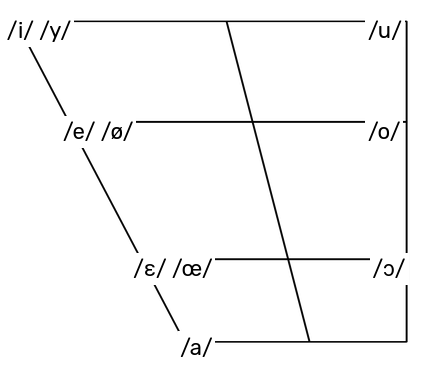
In practice, the vowel /a/ may actually vary between /a/, /ä/ and /ɑ/.
Merging of /ø/ and /œ/ is fairly common, especially in more informal contexts, as these two vowels mostly don't occur as minimal pair (except in a couple cases).
Consonants
Dahur consonants are as follows:
| Bilabial | Labiodental | Alveolar | Postalveolar | Palatal | Velar | Glottal | |
|---|---|---|---|---|---|---|---|
| Nasal | m | n | |||||
| Plosive | p b | t d | k g | ||||
| Sibilant fricative | s z | ʃ ʒ | |||||
| Non-sibilant fricative | f v | h | |||||
| Approximant | j | ||||||
| Tap/Flap/Trill | ɾ r | ||||||
| Lateral Approx. | l |
The rhotic consonant (r) is in free variation and may be realised either as a tap, a flap or a trill. The trill pronunciation (/r/) is more common at the beginning of a syllable, and even more so at the beginning of a word. The tap/flap pronunciation (/ɾ/) is more common in consonant clusters, especially after a plosive.
In Dahur phonology, the combinations tr and kʃ count as single, independent consonants.
Phonotactics
A syllable in Dahur must contain one vowel, which may be preceded and/or followed by any number of consonants. In practice, consonant clusters don't usually go beyond four consonants. For that account, kʃ and tɾ are always considered as single consonants.
All consonant sequences are possible. However, in practice, some consonant combinations (ex. -hm-, -tɾkʃ- &c.) are rare.
Some studies consider the existence of a glottal stop when a proper consonant is absent. This view is reflected in the writing, which has a special sign for the glottal stop / lack of a consonant. The last consonant of a syllable can be doubled.
Examples of valid syllables:
| a | tɛ | en | wi | koj | gjɔ | pɾujn | kʃtɾa | fʃtlœmbz |
Stress
In the standard pronunciation, words are stressed on the next-to-last syllable. However, if the last syllable contains the consonant /tɾ/, it will be stressed.
Ex.:
| kanar
/ˈka.nar/ |
ostrøndɛl
/os.ˈtɾøn.dɛl/ |
tefʃiv
/ˈtef.ʃiv/ |
dasutɾ
/daˈsutɾ/ |
maʃkintɾod
/maʃ.kinˈtɾod/ |
Doubled vowels in the last syllable may sound as a long, stressed vowel; however, they are actually two separate vowels, each one in a different syllable, with stress falling on the first one (or on the last, in case that syllable contains the consonant tr). It is not uncommon to hear an epenthetic h, j or w between the two vowels.
Ex.:
| kajnaar
/kaj.ˈna.ar/, |
pakisaatr
/pa.ki.sa.ˈatr/, |
tøndelliin
/tøn.del.ˈli.in/, |
taldesyys
/tal.de.ˈsy.ys/, |
Writing
Dahur script consists in an alphasyllabary consisting in separate letters indicating consonants, a combination of separate letters and diacritics to indicate vowels, as well as certain special letters for individual syllables.
Morphology
Dahur is a highly flexional language, with a strong presence of irregular forms.
Nouns inflect for number, which is basically singular and plural, but there are also occurrences of dual (for things normally occurring in pairs) and singulative (for individual items of things usually found collectively).
Nouns also inflect for case, usually: nominative, accusative, dative, genitive, locative, instrumental, ergative and ablative. Instances of partitive and vocative are also found. The case called ergative is used basically for the agent of the passive voice.
Adjectives show no agreement to nouns, and inflect for degree (comparatives of superiority, equality, inferiority; relative and absolute superlative).
Nouns
Class
Dahurian nouns are divided in five classes, which can be compared to Latin or Greek declensions, as they consist in different inflection patterns, but may also be seen as a form of gender, as class is usually (but not always necessarily) related to the meaning of a noun.
| Class 1 | Living beings |
|---|---|
| Class 2 | General objects |
| Class 3 | Natural elements; insects |
| Class 4 | Parts of human body; clothing |
| Class 5 | Abstract nouns; traditional imaginary beings |
There are no morphological indications related to noun classes in the nominative singular. The differences appear along the inflection of nouns.
Number
Nouns in Dahur have a singular and a plural. The plural ending varies according to noun class and to case. There is also a dual number, which is valid only for nouns normally occurring in pairs. Mass or collective nouns have a singulative inflection, but this is not very systematically indicated.
So, for example:
| Class | Singular | Plural | Dual | Singulative |
|---|---|---|---|---|
| class 1 | grats
"boy" |
gratsen
"boys" |
- | - |
| class 2 | kɛʃev
"hammer" |
kɛʃevlin
"hammers" |
kɛʃevs
"pair of hammers" (traditionally used by blacksmiths) |
- |
| class 3 | halajn
"water" |
halejnn
"waters" (i.e. in a flood) |
halajns
"The Two Waters" (the river Okanuma and the lake Kassanjas) |
halajny
"a drop of water" |
| class 4 | kanar
"eye" |
kanarni
"many eyes" (mostly figuratively) |
kanaris
"(two/both) eyes" |
- |
| class 4 | kʃalim
"hair" |
kʃalimni
"(types of) hair" |
- | kʃalimy
"a (single) hair" |
| class 5 | astrønɛl
"idea" |
astrønɛljan
"ideas" |
astrønɛls
"a couple ideas" |
- |
The plural in classes 1, 2 and 5 is usually regular, obtained with the respective suffixes (-en, -lin, -jan).
Ex.:
| Class | Singular | Plural |
|---|---|---|
| class 1 | katlaj
"girlfriend" |
katlajen |
| dukʃatr
"boss" |
dukʃatren | |
| egastɛv
"farmer" |
egastɛven | |
| class 2 | takoj
"pin" |
takojlin |
| uhpsan
"paper" |
uhpsanlin | |
| dasutr
"document, file" |
dasutrlin | |
| class 5 | pɛktegal
"angel" |
pɛktegaljan |
| ostrøndɛl
"interruption" |
ostrøndɛljan | |
| piktaraʃ
"problem" |
piktaraʃjan |
In classes 3 and 4, besides the suffixes (-n, -ni), most nouns suffer some sort of mutation, usually affecting only one vowel but non uncommonly consisting of more significative changes.
Ex.:
| Class | Singular | Plural |
|---|---|---|
| class 3 | pakpaki
"louse" |
pakpɛkin |
| pahalis
"leaf" |
pahaljen | |
| tʃeptal
"cloud" |
tʃapatlin, tʃaptlin | |
| class 4 | kraus
"ear" |
krojsni |
| ɛmblew
"hat" |
ɛmbalni | |
| krikter
"helmet" |
kruktni |
Case
Dahur nouns inflect for the following cases:
- nominative (subject, predicative)
- accusative (direct object, motion towards)
- dative (indirect object)
- genitive (possession, partitive, origin)
- locative (location, placement)
- instrumental (instrument, means, company)
- ablative (adverbial)
- ergative (agent of the passive voice)
All cases except the nominative and the ergative can be used with prepositions.
Certain nouns, mostly nouns indicating human beings, also show a vocative form, mostly formed with the ending -e, but usually irregular.
Certain nouns, for example nouns indicating mass or food, show a partitive case, usually formed with the ending -(i)t.
Inflection
Noun declension in Dahur is quite regular, in terms of case and the less usual numbers, viz. the dual and the singulative.
| Class 1 | Class 2 | Class 3 | Class 4 | Class 5 | |||||||||||||||
|---|---|---|---|---|---|---|---|---|---|---|---|---|---|---|---|---|---|---|---|
| Sing. | Dual | Pl. | Sing. | Dual | Pl. | Sing. | Dual | Pl. | Sing. | Dual | Pl. | Sing. | Dual | Pl. | |||||
| Nominative | - | -s | -en | - | -s | -lin | - | -s | -n | - | -is | -ni | - | -s | -jan | ||||
| Accusative | -a | -as | -an | -a | -as | -lajn | -a | -as | -an | -a | -jas | -nja | -a | -as | -jan | ||||
| Dative | -u | -us | -un | -u | -us | -lun | -u | -us | -wan | -u | -ujs | -nu | -u | -us | -ujn | ||||
| Genitive | -ak | -ask | -ken | -ik | -isk | -link | -aʃ | -ʃas | -ʃan | -iʃ | -siʃ | -niʃ | -ik | -isk | -jank | ||||
| Locative | -ebb | -eps | -emb | -ebb | -eps | -limb | -ebb | -eps | -emb | -ebb | -bis | -nibb | -ebb | -eps | -jamb | ||||
| Instrumental | -om | -oms | -nom | -om | -oms | -lom | -om | -oms | -nom | -om | -joms | -njom | -om | -oms | -njom | ||||
| Ablative | -ɛv | -ɛfs | -nɛv | -ɛv | -ɛfs | -lɛnv, -lɛv | -ɛv | -ɛfs | -nɛv | -ɛv | -jɛfs | -njɛv | -ɛv | -ɛfs | -njɛv | ||||
| Ergative | -øtr | -søtr | -trøn | -øtr | -søtr | -løtr | -øtr | -søtr | -trøn | -øtr | -sjøtr | -trøjn | -øtr | -søtr | -trøjn | ||||
When an ending starting with a vowel is applied, a final -i becomes -j-, and a final -u becomes -w-; otherwise, an -h- is added. Ex.:
- dula "babysitter", dulahen "babysitters"
- agdari "prisoner", agdarjen "prisoners"
- pakpaki "louse", pakpakja "louse (accus.)", pakpakjaʃ "of a louse", pakpakjom "by a louse"
In the following tables, you have some examples of nouns of the various classes, fully inflected for number and case.
- Class 1: grats "boy"
- Class 2: kɛʃev "hammer"
- Class 3: tʃeptal "cloud"
- Class 4: kraus "ear"
- Class 5: astrønɛl "idea"
| Class 1: grats "boy" | |||
| Singular | Dual | Plural | |
|---|---|---|---|
| Nominative | grats | gratss | gratsen |
| Accusative | gratsa | gratsas | gratsan |
| Dative | gratsu | gratsus | gratsun |
| Genitive | gratsak | gratsask | gratsken |
| Locative | gratsebb | gratseps | gratsemb |
| Instrumental | gratsom | gratsoms | gratsnom |
| Ablative | gratsɛv | gratsɛfs | gratsnɛv |
| Ergative | gratsøtr | gratssøtr | gratsetrøn |
| Vocative | gratse | gratses | gratsen |
| Class 2: kɛʃev "hammer" | |||
| Singular | Dual | Plural | |
|---|---|---|---|
| Nominative | kɛʃev | kɛʃevs | kɛʃevlin |
| Accusative | kɛʃeva | kɛʃevas | kɛʃevlajn |
| Dative | kɛʃevu | kɛʃevus | kɛʃevlun |
| Genitive | kɛʃevik | kɛʃevisk | kɛʃevlink |
| Locative | kɛʃevebb | kɛʃeveps | kɛʃevlimb |
| Instrumental | kɛʃevom | kɛʃevoms | kɛʃevlom |
| Ablative | kɛʃevɛv | kɛʃevɛfs | kɛʃevlɛnv, kɛʃevlɛv |
| Ergative | kɛʃevøtr | kɛʃevsøtr | kɛʃevløtr |
| Class 3: tʃeptal "cloud" | |||
| Singular | Dual | Plural | |
|---|---|---|---|
| Nominative | tʃeptal | tʃeptals | tʃaptlin |
| Accusative | tʃeptala | tʃeptalas | tʃaptlijan, tʃaptljan |
| Dative | tʃeptalu | tʃeptalus | tʃaptliwan |
| Genitive | tʃeptalaʃ | tʃeptalʃas | tʃaptliʃan |
| Locative | tʃeptalebb | tʃeptaleps | tʃaptlijemb, tʃaptljemb |
| Instrumental | tʃeptalom | tʃeptaloms | tʃaptlinom |
| Ablative | tʃeptalɛv | tʃeptalɛfs | tʃaptlinɛv |
| Ergative | tʃeptaløtr | tʃeptalsøtr | tʃaptlitrøn |
| Partitive | tʃeptalt | tʃeptalts | tʃaptlint |
| Class 4: kraus "ear" | |||
| Singular | Dual | Plural | |
|---|---|---|---|
| Nominative | kraus | krausis | krojsni |
| Accusative | krausa | krausjas | krojsnja |
| Dative | krausu | krausujs | krojsnu |
| Genitive | krausiʃ | kraussiʃ | krojsniʃ |
| Locative | krausebb | krauseps | krojsnibb |
| Instrumental | krausom | krausoms | krojsnjom |
| Ablative | krausɛv | krausɛfs | krojsnjɛv |
| Ergative | krausøtr | krausjøtr | krojstrøjn |
| Class 5: astrønɛl "idea" | |||
| Singular | Dual | Plural | |
|---|---|---|---|
| Nominative | astrønɛl | astrønɛls | astrønɛljan |
| Accusative | astrønɛla | astrønɛlas | astrønɛljan |
| Dative | astrønɛlu | astrønɛlus | astrønɛlujn |
| Genitive | astrønɛlik | astrønɛlisk | astrønɛljank |
| Locative | astrønɛlebb | astrønɛleps | astrønɛljamb |
| Instrumental | astrønɛlom | astrønɛloms | astrønɛlnjom |
| Ablative | astrønɛlɛv | astrønɛlɛfs | astrønɛlnjɛv |
| Ergative | astrønɛløtr | astrønɛlsøtr | astrønɛltrøjn |
| Partitive | astrønɛlt | astrønɛlts | astrønɛljant |
Articles
Definite Article
The definite article inflects for case and number, and is quite irregular.
| Singular | Dual | Plural | Singulative | |
|---|---|---|---|---|
| Nominative | tru | gas | tann | try |
| Accusative | na | ga | ta | ny |
| Dative | kʃu | gu | tun | kʃu |
| Genitive | kis | gak | tak | kis |
| Locative | debb | gebb | tebb | debb |
| Instrumental | trom | gom | tom | trom |
| Ablative | dɛv | gɛv | tɛv | dɛv |
| Ergative | trø | gøtr | tøtr | trø |
Indefinite Article
Dahur has no proper indefinite article.
If it's really necessary to mark a noun phrase as indefinite, an indefinite pronoun may be used. The most common is lum (invariable), meaning "some", "a certain" &c.
Prepositions
Prepositions in Dahur require the noun in one of the following cases:
- accusative
- dative
- genitive
- ablative
- instrumental
- locative
The nominative and the ergative are never used with prepositions.
In the table below you have the most common Dahur prepositions:
| Preposition | Case | Meaning |
|---|---|---|
| dun | locative, accusative of movement | inside |
| yin | dative | for, in behalf of |
| accusative | towards | |
| ari, ar | genitive | from, out of |
| yuʃ | genitive, ablative | because of |
| vøj | locative | through |
| syn | locative; accusative of movement | near |
| kʃe | genitive | since, ago |
| pɛn | locative; accusative of movement | besides, next to |
| lujg | locative; accusative of movement | in front of |
| mœh | ablative | without |
| sto | locative; accusative of movement | on, on top of |
| krɔj | locative; accusative of movement | under |
| tjɛs | genitive | before (time) |
| gwaj | accusative | after (time) |
| fyj | ablative | during |
| vlen | instrumental | despite |
| uhk | genitive | except |
| uzd | dative | instead of |
| blas | locative; accusative of movement | behind |
Examples:
- yin na hedana "towards the house"
- dun na hedana "into the house"
- ar kis hedanik "from the house", "out of the house"
- syn debb hedanebb "near the house"
- syn na hedana "going near of the house"
- pɛn debb hedanebb "besides the house", "next to the house"
- pɛn na hedana "going next to the house"
- lujg debb hedanebb "in front to the house"
- lujg na hedana "going to the front of the house"
- mœh dɛv hedanɛv "without the house"
- sto debb hedanebb "on top of the house"
- sto na hedana "going onto (the top of) the house"
- krɔj debb hedanebb "under the house"
- uzd kʃu hedanu "instead of the house"
- blas debb hedanebb "behind the house"
- blas na hedana "going behind the house"
Adjectives
Attributive Adjectives
Attributive adjectives in Dahur are invariable and come before the noun. Ex.:
- fɛren grats "a smart boy"
- duʃ halajn "clean water"
- selak kanaris "pretty eyes"
A few attributes may be expressed by affixes to the noun, instead of the separate adjective. The most common ones are:
| Adjective | Affix | Meaning |
|---|---|---|
| nahar | -os
(usually deleting the last vowel of the original noun) |
"big", "large" |
| kitr | -in-
(before the last vowel of the or. noun) |
"small", "little" |
| suwani | -(t)ta-
(before the second vowel of the or. noun) |
"good" |
| daggus, daggussa | -aar | "bad" |
Examples:
| With Adjective | With Affixed Form | Meaning |
|---|---|---|
| nahar piktaraʃ | piktarʃos | "a big problem" |
| kitr piktaraʃ | piktarinaʃ | "a little problem" |
| suwani astrønɛl | attastrønɛl | "a good idea" |
| daggus astrønɛl, daggussa astrønɛl | astrønɛlaar | "a bad idea" |
Certain adjectives have a special, shortened form, which is prefixed to nouns when used attributively.
The most common ones are:
| Adjective | Affix | Meaning |
|---|---|---|
| nahar | nah- | "big", "large" |
| kitr | ki-
(doubles the initial consonant of the noun) |
"small", "little" |
| suwani | suw- (suww- before vowels) | "good" |
| daggus, daggussa | dag- (dagg- before vowels) | "bad" |
| sulin | sin- | "new" |
| dotrɛ | dom- | "old" |
| mahhalis | mah- | "ancient" |
| makʃølen, makʃølin | møkʃ- | "important", "great" |
| tossan | tos-, tan- | "beautiful" |
| abliki | killi- | "false", "fake" |
Examples:
| With Adjective | With Prefix | Meaning |
|---|---|---|
| nahar piktaraʃ | nahpiktaraʃ | "a big problem" |
| kitr piktaraʃ | kippiktaraʃ | "a small problem" |
| suwani astrønɛl | suwwastrønɛl | "a good idea" |
| daggus astrønɛl, daggussa astrønɛl | daggastrønɛl | "a bad idea" |
| sulin dasutr | sindasutr | "a new document" |
| dotrɛ hedan | domhedan | "an old house" |
| mahhalis kataʃtevan | mahkataʃtevan | "an ancient civilization" |
| makʃølen dasutr, makʃølin dasutr | møkʃdasutr | "an important document" |
| makʃølen astrønɛl, makʃølin astrønɛl | møkʃastrønɛl | "a great idea" |
| tossan dummal | tosdummal, tandummal | "a beautiful song" |
| abliki bɔrakʃ | killibɔrakʃ | "false news", "fake news" |
Predicative Adjectives
An adjective used in predicative function is invariable. Only the full forms of adjectives can be used predicatively.
Usually a linking verb is employed. Ex.:
| Tru astrønɛl laje makʃølen. | The idea is great. |
| Tru grats alanje befitra. | The boy is tired. |
There is also the possibility of turning adjectives into verbs. Ex.:
| Tru astrønɛl makʃølnaje. | The idea is great. |
| Tru grats abefitranje. | The boy is tired. |
The most common way to make an adjective into a verb, implying the idea of "be", is the suffix -a-, which may cause some change in the last syllable of the original adjective. If the adjective already ends in -a, there is no change. Ex.:
| Adjective | Verb |
|---|---|
| makʃølen
"great" |
makʃølna
"be great" |
| befitra
"tired" |
befitra
"be tired" |
| suwani
"good" |
suwanja
"be good" |
| daggus
"bad" |
daggusa
"be bad" |
| sulin
"new" |
sulna, sinna
"be new" |
| dotrɛ
"old" |
dɛtra
"be old" |
| tossan
"beautiful" |
tossana, tosna
"be beautiful" |
| trapter
"unique" |
traptra
"be unique" |
| ʃɔtma
"sure", "certain" |
ʃɔtama
"be sure", "be certain" |
| kanikli
"appropriate" |
kankilja
"be appropriate" |
| tubbar
"white" |
tubabra
"be white" |
| kindis
"clear" |
kinitsa
"be clear" |
| turu
"wrong" |
turva, terva
"be wrong" |
| divlaas
"sick, ill" |
dulaasa
"be sick, be ill" |
| tadʒon
"pleased" |
todʒna
"be pleased" |
| eskataʃi
"acquainted" |
eskataʃʃa, eskatʃa
"be acquainted" |
Another suffix is -(a)st(a)-, meaning "to get" or "to become". The first optional -a- appears when necessary, to avoid unsuitable consonant clusters, while the final -a is only used in the infinitive form of the verb - i.e., without any suffixes. There are some irregular formations.
Ex.:
| Adjective | Verb |
|---|---|
| makʃølen
"great" |
makʃølnasta
"become great" |
| befitra
"tired" |
befitrasta
"get tired" |
| nahar
"big, large" |
nahasta, narasta
"get big", "increase" |
| kitr
"little, small" |
kitrasta, katrasta, kirrasta
"get smaller", "decrease" |
| suwani
"good" |
suwanasta
"become good" suwasta, sawasta, suwnasta "get better", "improve" |
| daggus , daggussa
"bad" |
daggusasta, daggussasta
"become bad" daggasta "get worse" |
| dotrɛ
"old" |
dotrɛsta
"become old" dotrasta "get older", "to age" |
| tossan
"beautiful |
tossanasta
"become beautiful" tossasta, tosnasta "get prettier", "beautify" |
| abliki
"false", "fake" |
ablikasta
"become invalid" |
| divlaas
"sick, ill" |
dulaasta
"be sick, be ill" |
| eskataʃi
"acquainted" |
eskatʃasta
"get acquainted" |
A few other suffixes perform similar tasks, with more specific meanings. These are usually quite regular. The most productive among these suffixes are:
| -we | "to remain", "still be" |
| -kas | "to seem", "to appear" |
| -ʃyn | "to pretend to be" |
| -dobb(a)- | "to cease to be", "to be no longer" |
| -guj | "to be a little bit" |
Ex.:
| Adjective | Verb |
|---|---|
| nøssar
"calm" |
nøssarwe "remain calm", "keep calm"
nøssarkaʃ "seem/appear calm" nøssarʃyn "pretend to be calm" nøssardobba "cease to be calm" nøssarguj "be a little calm" |
| dotrɛ
"old" |
dotrɛkaʃ "seem/appear old"
dotrɛguj "be a little old" |
Comparative
The comparative of superiority of an adjective can be made by adding the suffix -ju to the stem. This suffix doubles a preceeding consonant, or becomes -jju when preceeded by a vowel. Ex.:
- fɛrennju grats "a smarter boy"
- duʃʃju halajn "cleaner water"
- selakkju kanaris "prettier eyes"
- naharrju piktaraʃ "a bigger problem"
- kittrju piktaraʃ "a smaller problem"
- suwanijju astrønɛl "a better idea"
- daggussju / daggussajju astrønɛl "a worse idea"
- dotrɛjju pɛten "an older book"
Comparative adjectives may be turned into verbs regularly with the suffix -a, which then becomes -wa. Ex.:
| Adjective | Verb |
|---|---|
| makʃølennju
"greater" |
makʃølennjuwa
"be greater" |
| befitrajju
"more tired" |
befitrajjuwa
"be more tired" |
| suwanijju
"better" |
suwanijjuwa
"be better" |
| sulinnju
"newer" |
sulinnjuwa
"be newer" |
| dotrɛjju
"older" |
dotrɛjjuwa
"be older" |
| tossannju
"more beautiful" |
tossannjuwa
"be more beautiful" |
The complement of a comparison, corresponding to the conjunction "than", is placed in the ablative case. Ex.:
- Nuv pɛten laej suwanijju tuhafɛv. "This book is better than that one"
- Nuv pɛten suwanijjuwaej tuhafɛv. (idem)
- Tru dukʃatr laej dotrɛjju dɛv egastɛvɛv. "The boss is older than the farmer"
- Tru dukʃatr dotrɛjjuwaej dɛv egastɛvɛv. (idem)
Numerals
The basic cardinal numbers are:
| 0 | kal, kahtral |
| 1 | mihen |
| 2 | dahas |
| 3 | travis |
| 4 | gazen |
| 5 | kɛʃav |
| 6 | pinjan |
| 7 | høtak |
| 8 | magɛl |
| 9 | donwaʒ |
| 10 | zɛhɛv |
| 11 | zɛhɛv mihen, zɛvhen |
| 12 | zɛhɛv dahas, zɛvdas |
| 13 | zɛhɛv travis, zɛvtras |
| 14 | zɛhɛv gazen, zɛvzen |
| 15 | zɛhɛv kɛʃav, zɛvkʃav |
| 16 | zɛhɛv pinjan, zɛvpan |
| 17 | zɛhɛv høtak,zɛvhøk |
| 18 | zɛhɛv magɛl, zɛvmal |
| 19 | zɛhɛv donwaʒ, zɛvdaʒ |
| 20 | dahassɛv |
| 30 | travissɛv |
| 40 | gazennɛv |
| 50 | kɛʃavvɛv |
| 60 | pinjannɛv |
| 70 | høtakkɛv |
| 80 | magɛllɛv |
| 90 | donwaʒʒɛv |
| 100 | lakin |
| 1,000 | tatrimi |
| 10,000 | zɛhɛv tatrimi |
Numbers are composed by joining the base units above, from bigger to lower. Ex.:
| 23 | dahassɛv travis |
| 45 | gazennɛv kɛʃav |
| 67 | pinjannɛv høtak |
| 89 | magɛllɛv donwaʒ |
| 123 | lakin dahassɛv travis |
| 456 | gazen lakin kɛʃavvɛv pinjan |
| 789 | høtak lakin magɛllɛv donwaʒ |
| 1,234 | tatrimi dahas lakin travissɛv gazen |
| 5,678 | kɛʃav tatrimi pinjan lakin høtakkɛv magɛl |
| 12,345 | zɛvdas tatrimi travis lakin gazennɛv kɛʃav |
| 678,910 | pinjan lakin høtakkɛv magɛl tatrimi donwaʒ lakin zɛhɛv |
Ordinal numbers are created with the suffix -iki. Ex.:
| 1st | miheniki |
| 2nd | dahasiki |
| 3rd | travisiki |
| 4th | gazeniki |
| 5th | kɛʃaviki |
| 6th | pinjaniki |
| 7th | høtakiki |
| 8th | magɛliki |
| 9th | donwaʒiki |
| 10th | zɛhɛviki, zɛhviki |
| 11th | zɛvheniki |
| 12th | zɛvdasiki |
| 13th | zɛvtrasiki |
| 14th | zɛvzeniki |
| 15th | zɛvkʃaviki |
| 16th | zɛvpaniki |
| 17th | zɛvhøkiki |
| 18th | zɛvmaliki |
| 19th | zɛvdaʒiki |
| 20th | dahassɛviki |
| 30th | travissɛviki |
| 40th | gazennɛviki |
| 50th | kɛʃavvɛviki |
| 60th | pinjannɛviki |
| 70th | høtakkɛviki |
| 80th | magɛllɛviki |
| 90th | donwaʒʒɛviki |
| 100th | lakiniki |
| 1,000th | tatrimiiki |
Pronouns
Personal Pronouns
Personal Pronouns in Dahur indicate person (1st, 2nd, 3rd) and number (singular, dual, plural).
| 1st Person | dɛ "I" , "me" | ʃes "we both" | ʃɛn "we", "us" |
| Singular | Dual | Plural | |
|---|---|---|---|
| Nominative | dɛ | ʃes | ʃɛn |
| Accusative | dɛa, da | ʃeas, ʃas | ʃan |
| Dative | dɛw, du | ʃeus, ʃews, ʃus | ʃɛun, ʃɛwn, ʃun |
| Genitive | dɛk | ʃesk | ʃɛkɛn, ʃkɛn |
| Locative | dɛbb | ʃeps | ʃɛmb |
| Instrumental | dɛm | ʃems | ʃɛom, ʃom |
| Ablative | dɛv | ʃɛfs | ʃɛɛv, ʃɛv |
| Ergative | dɛjøtr, dɛtr | ʃesøtr | ʃɛtrøn, ʃtrøn |
| Partitive | dɛt | ʃets | ʃɛnt |
| 2nd Person | hej "you (sg.), thou" | kwes "you both" | kwɛn "you (pl.)" |
| Singular | Dual | Plural | |
|---|---|---|---|
| Nominative | hej | kwes | kwɛn |
| Accusative | heja, ja | kweas, kwas | kwɛan, kwan |
| Dative | heju, ju | kweus | kwɛun, kun |
| Genitive | heik, hejik | kwesk | kwɛnek, kwɛnk |
| Locative | heibb, hibb | kweps | kwɛmb |
| Instrumental | heim, him | kwems | kwɛom, kwɛm, kwom |
| Ablative | hejɛv, jɛv | kwɛfs | kwɛɛv, kwɛv |
| Ergative | hejøtr, hjøtr | kwesøtr | kwɛtrøn |
| Vocative | heje | kwejes | kwɛjɛn |
| Partitive | hɛt | kwets | kwɛnt |
| 3rd Person | nar "he", "she", "it" | ras "they both" | ren "they", "them" |
| Singular | Dual | Plural | |
|---|---|---|---|
| Nominative | nar | ras | rɛn |
| Accusative | nara, ra | ras | rɛan, ran |
| Dative | naru, ru | raus, raws, rus | rɛun, rɛwn, run |
| Genitive | narɛk, rɛk | resk | rɛkɛn, ɛrken |
| Locative | narebb, rebb | reps | rɛmb |
| Instrumental | narom, rom | rems | rɛnom, rom |
| Ablative | narɛv, rɛv | rɛfs | rɛɛv, rɛv |
| Ergative | narøtr, røtr | resøtr | rɛtrøn, ɛrtrøn |
| Partitive | rɛt | rets | rɛnt |
The genitive forms work as possessive pronouns. In that case, the definite article is optional. Ex.:
- tru dɛk astrønɛl, dɛk astrønɛl "my idea"
- na heik kʃalima, heik kʃalima "your hair (accus.)"
- trom narɛk kɛʃevom, narɛk kɛʃevom "with his/her hammer (instr.)"
- tu dɛk menirun, dɛk menirun "to my children (dat.)"
Object pronouns usually come before the verb. The shorter, unstressed version is preferred. Ex.:
- Ja angenus. "I can see you (sing.)."
- Kwas angenus. "I can see you two."
- Kwan angenus. "I can see you (pl.)."
- Ra angenus. "I can see it/him/her."
- Ras angenus. "I can see them both."
- Ran angenus. "I can see them."
- Da angenej. "He/she can see me."
- ʃas angenej. "He/she can see us both."
- ʃan angenej. "He/she can see us."
An object pronoun may also appear after the verb. In that case, the preference is for the longer, stressed versions. Ex.:
- Angenus ja/heja. "I can see you (sing.)."
- Angenus kweas/kwas. "I can see you two."
- Angenus kwɛan/kwan. "I can see you (pl.)."
- Angenus nara/ra. "I can see it/him/her."
- Angenus ras. "I can see them both."
- Angenus rɛan/ran. "I can see them."
- Angenej dɛa/da. "He/she can see me."
- Angenej ʃeas/ʃas. "He/she can see us both."
- Angenej ʃan. "He/she can see us."
The most common case for a verb complement is the accusative. However, verbs may require different cases. Ex.:
- Kun dagsuttoj! "It will harm you!" / "It will be harmful to you!" (dagusta "harm, be harmful" + dat.)
- Ja/Ju darʃinɔn. "We trust you." (darʃin "trust" + acc./dat.)
- Poglattindsa narɛv/rɛv "I didn't use it." (poglar "use" + abl.)
- Ra twiʃnettmis. "You drank it (all)." / Rɛt twiʃnettmis. "You drank (some of) it." twiʃin "drink" +acc. (whole), +part. (specific amount)
Demonstrative Pronouns
The main demonstrative pronouns are:
- nuv "this, these"
- tuhaf "that, those"
When accompanying a noun, they behave as adjectives and are not inflected.
When used on their own, they stand as nouns and are inflected according to the class of the intended noun. Ex.:
- Nuv grats laej fɛrennju nuvɛv. "This boy is smarter than this one."
Interrogative Pronouns
Indefinite Pronouns
Relative Pronoun
The main relative pronoun in Dahur is jao, as shown in the following table.
| Singular | Dual | Plural | |
|---|---|---|---|
| Nominative | jao | jes | jen |
| Accusative | jaa, ja | jeas, jas | jaan, jan |
| Dative | jau, jaw | jeus, jews | jeun, jewn |
| Genitive | jak | jesk | jenk |
| Locative | jaebb | jaeps | jaemb |
| Instrumental | jaom | jaoms | jaom |
| Ablative | jaɛv | jaɛfs | janɛv |
| Ergative | jaøtr | jasøtr | jatrøn |
| Partitive | - | jets | jent |
The pronoun agrees in number with the antecedent, but its case is determined by its function in the subordinate clause. Ex.:
- tru grats jao ateʃfanej "the boy (nom.) who (nom.) is running away"
- na gratsa jao ateʃfanej "the boy (accus.) who (nom.) is running away"
- kʃu gratsu jao ateʃfanej "to the boy (dat.) who (nom.) is running away"
- kis gratsak jao ateʃfanej "of the boy (gen.) who (nom.) is running away"
- trø gratsøtr jao ateʃfanej "by the boy (erg.) who (nom.) is running away"
- tann gratsen jen ateʃfanɛw "the boys (nom.) who (nom.) are running away"
- ta gratsan jen ateʃfanɛw "the boys (accus.) who (nom.) are running away"
- tun gratsun jen ateʃfanɛw "to the boys (dat.) who (nom.) are running away"
- tak gratsken jen ateʃfanɛw "of the boys (gen.) who (nom.) are running away"
- tøtr gratsetrøn jen ateʃfanɛw "by the boys (erg.) who (nom.) are running away"
- tru grats jaa kahettsa "the boy (nom.) whom (acc.) I saw"
- na gratsa jaa kahettsa "the boy (acc.) whom (acc.) I saw"
- kʃu gratsu jaa kahettsa "to the boy (dat.) whom (acc.) I saw"
- kis gratsak jaa kahettsa "of the boy (gen.) whom (acc.) I saw"
- trø gratsøtr jaa kahettsa "by the boy (erg.) whom (acc.) I saw"
- tann gratsen jaan kahettsa "the boys (nom.) whom (acc.) I saw"
- ta gratsan jaan kahettsa "the boys (acc.) whom (acc.) I saw"
- tun gratsun jaan kahettsa "to the boys (dat.) whom (acc.) I saw"
- tak gratsken jaan kahettsa "of the boys (gen.) whom (acc.) I saw"
- tøtr gratsetrøn jaan kahettsa "by the boys (erg.) whom (acc.) I saw"
Besides this pronoun, relative clauses may also be formed with participles.
Ex.:
- tru ateʃfanur grats "the boy (nom.) who is running away"
- na ateʃfanur gratsa "the boy (accus.) who is running away"
- tak ateʃfanur gratsken "of the boys (gen.) who are running away"
- tru dɛtr kahettek grats, tru grats dɛtr kahettek "the boy (nom.) whom I saw"
- tøtr dɛtr kahettek gratsetrøn, tøtr gratsetrøn dɛtr kahettek "by the boys (erg.) whom I saw"
Verbs
Finite Forms
Verbs in Dahur have different stems indicating aspect. The conjugation uses different sets of endings to indicate tense or time.
The basic verb stems are:
| Aspect | Meaning | Form |
|---|---|---|
| Generic | verbal idea without a specific context, time or aspect | the basic stem of the verb |
| Cursive (Progressive; Continuous) | action ongoing at the moment of reference | prefix a- and suffix -(a)n- |
| Aorist | a complete or punctual action | suffix -(e)tt- |
| Perfect | the result of an action that happened before the reference time | suffix -(l)l(a)- |
| Unrealised (Future) | action as not realised in relation to the reference time | prefix u- and suffix -(u)ʃ- |
| Conditional | irrealis, usually an action depending on another | prefix i- (doubling the initial consonant) and suffix -i- |
Stem formation is often irregular.
Ex.:
| Generic | Cursive | Aorist | Perfect | Unrealised | Conditional | |
|---|---|---|---|---|---|---|
| kaʃmal "take" | kaʃmal- | akʃmalan- | kaʃmalett- | kaʃmalla- | ukaʃmaluʃ- | ikkaʃmali- |
| la "be" | la- | alan- | latt- | lalla- | ulauʃ- | illai- |
| wennin "live" | wennin- | awann- | wennett- | wennilla- | uwenninʃ- | iwennini- |
| gadra "write" | gadra- | agandran- | gadrett- | gadralla- | ugadruʃ- | iggadri- |
| tefʃiv "flee" | tefʃiv- | ateʃfan- | tefʃivett- | tefʃivla- | utefʃivuʃ- | ittefʃivi- |
| maʃkintɾod "represent" | maʃkintɾod- | amaʃkintɾon- | maʃkintɾott- | maʃkintɾolla- | umaʃkintɾotʃ- | immaʃkintɾodi- |
| kajnaar "jump" | kajnaar- | akajnaan- | kajnerett- | kajnaalla- | ukajnaaruʃ- | ikkajnaari- |
| taldesyys "take care of" | taldesyys- | ataldesyyn- | taldesyyst- | taldesyyll- | utaldesyyʃ- | ittaldesyysi- |
| kota "eat" | kota- | ankon- | kotatt- | kekolla- | ukotuʃ- | ikkoti- |
| hussi "hear, listen" | hussi- | ahsejn- | hust- | huzilla- | uhussuʃ- | ihusseji- |
| ken, kena "see" | ken-, kena- | angen- | kahett- | kenalla-, kralla- | ukunuʃ- | ikkeni- |
| mend "become" | mend- | amdan- | menett- | mendla- | umenduʃ- | immendi- |
| ustaj, ustaji "come" | ustaj-, ustaji- | anstajn-, anstajin- | ustatt-, ustitt- | ustalla-, ustilla- | ustajuʃ- | istaji- |
| maj "go" | maj- | amann- | menett- | mjalla- | umujuʃ- | immaji- |
| trak "do, make" | trak- | atrakan- | tetrakett- | ketralla- | utrakʃ- | ittraggi- |
| pakt "understand" | pakt- | ampakn- | pakett- | paktalla- | upaktuʃ- | ippakti- |
| durʃin "seem, appear" | durʃin- | adurʃan- | durʃint- | durʃilla- | udurʃinʃ- | iddurʃini- |
| ʃaka "hunt" | ʃaka- | aʃkan- | ʃakkatt- | ʃakalla- | uʃakkuʃ- | iʃakki- |
| kʃa [passive voice auxiliary] | kʃa- | akʃan- | kʃatt- | kʃalla- | ukʃuʃ- | ikkʃi- |
The personal endings are :
| Present | Past | Future | |
|---|---|---|---|
| 1s | -us | -sa | -os |
| 2s | -im | -mis | -om |
| 3s | -ej | -jes | -oj |
| 1p | -ɔn | -sɔn | -on |
| 2p | -ib | -ips | -ob |
| 3p | -ɛw | -sɛw | -ow |
The following combinations of stem + ending set occur:
| Present | Past | Future | |
| Generic | Simple
Present |
Habitual
Past ("used to") |
Indefinite
Future |
|---|---|---|---|
| Cursive | Present
Continuous |
Past
Continuous |
Future
Progressive |
| Aorist | Simple
Past (Aorist) |
Definite Future
(Specific, Punctual) | |
| Perfect | Present
Perfect |
Past
Perfect |
Future
Perfect |
| Unrealised | Near
Future |
Unrealised
Past ("would") |
Future
(Remote) |
| Conditional | Conditional
Present |
Conditional
Past |
For the imperative, the base form of the verb is used. Optionally, the particle a can be used before the verb. Ex.:
- Kaʃmal! / A kaʃmal! "Take!"
- Hussi! / A hussi! "Listen!"
- Spa kajnaar! / A spa kajnaar! "Don't jump!"
While the formation of aspect stems is often irregular, the combination of stem + endings is usually quite regular and predictable. The usual epenthetic phonemes occur, mostly the semivowels (j and w), when two vowels come together, but these are more an artifact of speech and aren't usually indicated in writing. Ex.:
- kaʃmallaus, kaʃmallawus
- kaʃmallaim, kaʃmallajim
- kaʃmallaej, kaʃmallajej, kaʃmallahej
- kaʃmallaɔn, kaʃmallawɔn
- iggadriips, iggadrijips
- iggadrius, iggadrijus
- &c.
Negative
The infix -(i)nd-, placed before the personal endings, makes a verb negative. Ex.:
- landus "I am not"
- lattindsɛw "they weren't"
- hussindoj "he/she won't listen"
- ateʃfanindips "you weren't running away"
The emphatic negative particle spa may be used before the verb, always in the negative form. Ex.:
- spa landus "I am most certainly not"
- spa lattindsɛw "they definitely weren't"
- spa hussindoj "he/she will not listen at all"
- spa ateʃfanindips "you really weren't running away"
This particle spa is also used in a negative command, with the base form of the verb. In that case, it doesn't necessarily have an emphatic meaning. Ex.:
- Spa hussi! / A spa hussi! "Don't listen!"
Nominal Forms
Infinitive
The Dahur verb has infinitives for the Generic, Cursive, Aorist, Perfect and Unrealised aspects. They are formed by adding the ending -eh to the corresponding stem. The prefix u- of the Unrealised aspect is optional in the infinitive. Ex.:
| Generic | Cursive | Aorist | Perfect | Unrealised | |
|---|---|---|---|---|---|
| kaʃmal "take" | kaʃmaleh | akʃmalaneh | kaʃmaletteh | kaʃmallaeh | ukaʃmaluʃeh, kaʃmaluʃeh |
| la "be" | laeh | alaneh | latteh | lallaeh | (u)lauʃeh |
| gadra "write" | gadraeh | agandraneh | gadretteh | gadrallaeh | (u)gadruʃeh |
| kota "eat" | kotaeh | ankoneh | kotatteh | kekollaeh | (u)kotuʃeh |
| hussi "hear, listen" | hussieh | ahsejneh | husteh | huzillaeh | (u)hussuʃeh |
| ken, kena "see" | keneh | angeneh | kahetteh | kenallaeh, krallaeh | (u)kunuʃeh |
| ustaj, ustaji "come" | ustajeh | anstajneh | ustatteh, ustitteh | ustallaeh, ustillaeh | (u)stajuʃeh |
| maj "go" | majeh | amanneh | menetteh | mjallaeh | (u)mujuʃeh |
| trak "do, make" | trakeh | atrakaneh | tetraketteh | ketrallaeh | (u)trakʃeh |
The infinitive may be used as a noun, but also with certain auxiliary verbs. When a participle is used as a noun, usually the definite article may be omitted. Ex.:
- (Tru) kotaeh laej suwani. / (Tru) kotaeh suwanjaej. "Eating is good."
Participle
Participles are built by adding specific suffixes to the corresponding stems of the verb:
- -ur (active participle)
- -ek (passive participle)
The prefix u- of the unrealised stem is dropped.
Ex.:
| Generic | Cursive | Aorist | Perfect | Unrealised | ||||||
|---|---|---|---|---|---|---|---|---|---|---|
| Act. | Pass. | Act. | Pass. | Act. | Pass. | Act. | Pass. | Act. | Pass. | |
| kaʃmal "take" | kaʃmalur | kaʃmalek | akʃmalanur | akʃmalanek | kaʃmalettur | kaʃmalettek | kaʃmallaur, kaʃmallur | kaʃmallaek, kaʃmallek | kaʃmaluʃur | kaʃmaluʃek |
| la "be" | laur | alanur | lattur | lallaur, lallur | lauʃur | |||||
| gadra "write" | gadraur | gadraek | agandranur | agandranek | gadrettur | gadrettek | gadrallur | gadrallek | gadruʃur | gadruʃek |
| kota "eat" | kotaur | kotaek | ankonur | ankonek | kotattur | kotattek | kekollur | kekollek | kotuʃur | kotuʃek |
| hussi "hear, listen" | hussiur | hussiek | ahsejnur | ahsejnek | hustur | hustek | huzillaur | huzillaek | hussuʃur | hussuʃek |
| ken, kena "see" | kenur | kenek | angenur | angenek | kahettur | kahettek | kenallur, krallur | kenallek, krallek | kunuʃur | kunuʃek |
| ustaj, ustaji "come" | ustajur | anstajnur | ustattur, ustittur | ustallur, ustillek | ustajuʃur | |||||
| maj "go" | majur | amannur | menettur | mjallur | mujuʃur | |||||
| trak "do, make" | trakur | trakek | atrakanur | atrakanek | tetrakettur | tetrakettek | ketrallur | ketrallek | trakʃur | trakʃek |
| ʃaka "hunt" | ʃakaur | ʃakaek | aʃkanur | aʃkanek | ʃakkattur | ʃakkattek | ʃakallur | ʃakallek | ʃakkuʃur | ʃakkuʃek |
The corresponding negative versions of these participles are formed regularly with the suffix -(i)nd-. Ex.:
- landur "not being"
- angenindur "not seeing"
- gradrettindek "not written"
- ketrallindur "who/which had not done"
- aʃkanindek "which isn't being hunted"
Passive Voice
The passive voice is built with the auxiliary kʃa, conjugated regularly, followed by the base form of the verb. Ex.:
- akʃanus taldesyys "I'm being taken care of"
- akʃanindmis ken "you were not being seen"
- kʃallaɔn kaʃmal "we have been taken"
- kʃattsɛw kota "they were eaten"
- ikkʃindej trak "if it's not done"
Conjugation
Next you have a few verbs, conjugated in all its forms.
| Verb la "be" | ||||||||||||
| Simple Present | Present Continuous | Present Perfect | Near Future | Conditional Present | ||||||||
|---|---|---|---|---|---|---|---|---|---|---|---|---|
| Affirm. | Neg. | Affirm. | Neg. | Affirm. | Neg. | Affirm. | Neg. | Affirm. | Neg. | |||
| 1s | laus | landus | alanus | alanindus | lallaus | lallandus | ulauʃus | ulauʃindus | illaius | illaindus | ||
| 2s | laim | landim | alanim | alanindim | lallaim | lallandim | ulauʃim | ulauʃindim | illaiim | illaindim | ||
| 3s | laej | landej | alanej | alanindej | lallaej | lallandej | ulauʃej | ulauʃindej | illaiej | illaindej | ||
| 1p | laɔn | landɔn | alanɔn | alanindɔn | lallaɔn | lallandɔn | ulauʃɔn | ulauʃindɔn | illaiɔn | illaindɔn | ||
| 2p | laib | landib | alanib | alanindib | lallaib | lallandib | ulauʃib | ulauʃindib | illaiib | illaindib | ||
| 3p | laɛw | landɛw | alanɛw | alanindɛw | lallaɛw | lallandɛw | ulauʃɛw | ulauʃindɛw | illaiɛw | illaindɛw | ||
| Habitual Past | Past Continuous | Simple Past | Past Perfect | Unrealised Past | Conditional Past | |||||||
| Affirm. | Neg. | Affirm. | Neg. | Affirm. | Neg. | Affirm. | Neg. | Affirm. | Neg. | Affirm. | Neg. | |
| 1s | lasa | landsa | alansa | alanindsa | lattsa | lattindsa | lallasa | lallandsa | ulauʃsa | ulauʃindsa | illaisa | illaindsa |
| 2s | lamis | landmis | alanmis | alanindmis | lattmis | lattindmis | lallamis | lallandmis | ulauʃmis | ulauʃindmis | illaimis | illaindmis |
| 3s | lajes | landjes | alanjes | alanindjes | lattjes | lattindjes | lallajes | lallandjes | ulauʃjes | ulauʃindjes | illaijes | illaindjes |
| 1p | lasɔn | landsɔn | alansɔn | alanindsɔn | lattsɔn | lattindsɔn | lallasɔn | lallandsɔn | ulauʃsɔn | ulauʃindsɔn | illaisɔn | illaiindsɔn |
| 2p | laips | landips | alanips | alanindips | lattips | lattindips | lallaips | lallandips | ulauʃips | ulauʃindips | illaiips | illaindips |
| 3p | lasɛw | landsɛw | alansɛw | alanindsɛw | lattsɛw | lattindsɛw | lallasɛw | lallandsɛw | ulauʃsɛw | ulauʃindsɛw | illaisɛw | illaindsɛw |
| Indefinite Future | Future Progressive | Definite Future | Future Perfect | Remote Future | ||||||||
| Affirm. | Neg. | Affirm. | Neg. | Affirm. | Neg. | Affirm. | Neg. | Affirm. | Neg. | |||
| 1s | laos | landos | alanos | alanindos | lattos | lattindos | lallaos | lallandos | ulauʃos | ulauʃindos | ||
| 2s | laom | landom | alanom | alanindom | lattom | lattindom | lallaom | lallandom | ulauʃom | ulauʃindom | ||
| 3s | laoj | landoj | alanoj | alanindoj | lattoj | lattindoj | lallaoj | lallandoj | ulauʃoj | ulauʃindoj | ||
| 1p | laon | landon | alanon | alanindon | latton | lattindon | lallaon | lallandon | ulauʃon | ulauʃindon | ||
| 2p | laob | landob | alanob | alanindob | lattob | lattindob | lallaob | lallandob | ulauʃob | ulauʃindob | ||
| 3p | laow | landow | alanow | alanindow | lattow | lattindow | lallaow | lallandow | ulauʃow | ulauʃindow | ||
| Verb hussi "hear, listen" | ||||||||||||
| Simple Present | Present Continuous | Present Perfect | Near Future | Conditional Present | ||||||||
|---|---|---|---|---|---|---|---|---|---|---|---|---|
| Affirm. | Neg. | Affirm. | Neg. | Affirm. | Neg. | Affirm. | Neg. | Affirm. | Neg. | |||
| 1s | hussius | hussindus | ahsejnus | ahsejnindus | huzillaus | huzillandus | uhussuʃus | uhussuʃindus | ihussejius | ihussejindus | ||
| 2s | hussiim | hussindim | ahsejnim | ahsejnindim | huzillaim | huzillandim | uhussuʃim | uhussuʃindim | ihussejiim | ihussejindim | ||
| 3s | hussije | hussindje | ahsejnje | ahsejnindje | huzillaje | huzillandje | uhussuʃje | uhussuʃindje | ihussejije | ihussejindje | ||
| 1p | hussiɔn | hussindɔn | ahsejnɔn | ahsejnindɔn | huzillaɔn | huzillandɔn | uhussuʃɔn | uhussuʃindɔn | ihussejiɔn | ihussejindɔn | ||
| 2p | hussiib | hussindib | ahsejnib | ahsejnindib | huzillaib | huzillandib | uhussuʃib | uhussuʃindib | ihussejiib | ihussejindib | ||
| 3p | hussiɛw | hussindɛw | ahsejnɛw | ahsejnindɛw | huzillaɛw | huzillandɛw | uhussuʃɛw | uhussuʃindɛw | ihussejiɛw | ihussejindɛw | ||
| Habitual Past | Past Continuous | Simple Past | Past Perfect | Unrealised Past | Conditional Past | |||||||
| Affirm. | Neg. | Affirm. | Neg. | Affirm. | Neg. | Affirm. | Neg. | Affirm. | Neg. | Affirm. | Neg. | |
| 1s | hussisa | hussindsa | ahsejnsa | ahsejnindsa | hustsa | hustindsa | huzillasa | huzillandsa | uhussuʃsa | uhussuʃindsa | ihussejisa | ihussejindsa |
| 2s | hussimis | hussindmis | ahsejnmis | ahsejnindmis | hustmis | hustindmis | huzillamis | huzillandmis | uhussuʃmis | uhussuʃindmis | ihussejimis | ihussejindmis |
| 3s | hussijes | hussindjes | ahsejnjes | ahsejnindjes | hustjes | hustindjes | huzillajes | huzillandjes | uhussuʃjes | uhussuʃindjes | ihussejijes | ihussejindjes |
| 1p | hussisɔn | hussindsɔn | ahsejnsɔn | ahsejnindsɔn | hustsɔn | hustindsɔn | huzillasɔn | huzillandsɔn | uhussuʃsɔn | uhussuʃindsɔn | ihussejisɔn | ihussejindsɔn |
| 2p | hussiips | hussindips | ahsejnips | ahsejnindips | hustips | hustindips | huzillaips | huzillandips | uhussuʃips | uhussuʃindips | ihussejiips | ihussejindips |
| 3p | hussisɛw | hussindsɛw | ahsejnsɛw | ahsejnindsɛw | hustsɛw | hustindsɛw | huzillasɛw | huzillandsɛw | uhussuʃsɛw | uhussuʃindsɛw | ihussejisɛw | ihussejindsɛw |
| Indefinite Future | Future Progressive | Definite Future | Future Perfect | Remote Future | ||||||||
| Affirm. | Neg. | Affirm. | Neg. | Affirm. | Neg. | Affirm. | Neg. | Affirm. | Neg. | |||
| 1s | hussios | hussindos | ahsejnos | ahsejnindos | hustos | hustindos | huzillaos | huzillandos | uhussuʃos | uhussuʃindos | ||
| 2s | hussiom | hussindom | ahsejnom | ahsejnindom | hustom | hustindom | huzillaom | huzillandom | uhussuʃom | uhussuʃindom | ||
| 3s | hussioj | hussindoj | ahsejnoj | ahsejnindoj | hustoj | hustindoj | huzillaoj | huzillandoj | uhussuʃoj | uhussuʃindoj | ||
| 1p | hussion | hussindon | ahsejnon | ahsejnindon | huston | hustindon | huzillaon | huzillandon | uhussuʃon | uhussuʃindon | ||
| 2p | hussiob | hussindob | ahsejnob | ahsejnindob | hustob | hustindob | huzillaob | huzillandob | uhussuʃob | uhussuʃindob | ||
| 3p | hussiow | hussindow | ahsejnow | ahsejnindow | hustow | hustindow | huzillaow | huzillandow | uhussuʃow | uhussuʃindow | ||
Incorporation
Besides complementing a verb with a noun phrase in the accusative (or some other) case, complements may be incorporated in the verb. This resource is particularly common with more frequent verb + complement combinations. Common verbs, especially indicating more fundamental actions such as "eat", "drink", "take", "speak", "make", "kill" &c. are more prone to this type of constructions, while more abstract verbs, as well as less frequently used verbs, tend to follow the more conventional verb + complement approach.
When a complement is incorporated to a verb, it receives the prefix s- and is placed before the verb root. Irregularities are not uncommon. Ex.:
| Regular Construction | Incorporation | Meaning |
|---|---|---|
| kota ʃøga | sʃøgkota | "eat meat" |
| kota dabasa | sdabaskota | "eat bread" |
| kota drupala | sdrupalkota | "eat vegetables" |
| kota pinim | spinimkota | "eat fruit" |
| twiʃin halajna | shalantwiʃin | "drink water" |
| twiʃin myndra | smyndtwiʃin | "drink alcoholic beverage" |
| taldesyys menira | smeniraldesyys | "take care of a child" |
| taldesyys apsala | sapsaldesyys | "take care of everything" |
| hussi tuglaa | stuglussi | "hear a noise" |
| ʃaka pœrakʃa | spœrakʃaka | "hunt a beast" |
| trak tilmara | stilmatrak | "make a mistake" |