Conlangs/Dahur: Difference between revisions
No edit summary |
|||
| Line 7: | Line 7: | ||
The diagram below shows the 10 vowels of Dahur. | The diagram below shows the 10 vowels of Dahur. | ||
[[File:dahurvowels.png]] | [[File:dahurvowels.png|link=]] | ||
In practice, the vowel /a/ may actually vary between /a/, /ä/ and /ɑ/. | In practice, the vowel /a/ may actually vary between /a/, /ä/ and /ɑ/. | ||
| Line 346: | Line 346: | ||
|- | |- | ||
|class 2 | |class 2 | ||
|''' | |'''kɛʃev''' | ||
"hammer" | "hammer" | ||
|''' | |'''kɛʃevlin''' | ||
"hammers" | "hammers" | ||
|''' | |'''kɛʃevas''' | ||
"pair of hammers" (traditionally used by blacksmiths) | "pair of hammers" (traditionally used by blacksmiths) | ||
| - | | - | ||
| Line 467: | Line 467: | ||
|'''tʃeptal''' | |'''tʃeptal''' | ||
"cloud" | "cloud" | ||
|''' | |'''tʃaptlin''' | ||
|- | |- | ||
|rowspan="3"|class 4 | |rowspan="3"|class 4 | ||
| Line 554: | Line 554: | ||
{| class="wikitable" | {| class="wikitable" | ||
|- | |- | ||
|colspan="3"|Class 2: ''' | |colspan="3"|Class 2: '''kɛʃev''' "hammer" | ||
|- | |- | ||
! | ! | ||
| Line 561: | Line 561: | ||
|- | |- | ||
!Nominative | !Nominative | ||
|''' | |'''kɛʃev''' | ||
|''' | |'''kɛʃevlin''' | ||
|- | |- | ||
!Accusative | !Accusative | ||
|''' | |'''kɛʃeva''' | ||
|''' | |'''kɛʃevlina''' | ||
|- | |- | ||
!Dative | !Dative | ||
|''' | |'''kɛʃevsi''' | ||
|''' | |'''kɛʃevlinsi''' | ||
|- | |- | ||
!Genitive | !Genitive | ||
|''' | |'''kɛʃevis''' | ||
|''' | |'''kɛʃevlinis''' | ||
|- | |- | ||
!Locative | !Locative | ||
|''' | |'''kɛʃevus''' | ||
|''' | |'''kɛʃevlinus''' | ||
|- | |- | ||
!Instrumental | !Instrumental | ||
|''' | |'''kɛʃevum''' | ||
|''' | |'''kɛʃevlinum''' | ||
|- | |- | ||
!Ergative | !Ergative | ||
|''' | |'''kɛʃevøtr''' | ||
|''' | |'''kɛʃevlinøtr''' | ||
|- | |- | ||
!Ablative | !Ablative | ||
|''' | |'''kɛʃevɛjv''' | ||
|''' | |'''kɛʃevlinɛjv''' | ||
|} | |} | ||
| Line 604: | Line 604: | ||
!Nominative | !Nominative | ||
|'''tʃeptal''' | |'''tʃeptal''' | ||
|''' | |'''tʃaptlin''' | ||
|- | |- | ||
!Accusative | !Accusative | ||
|'''tʃeptala''' | |'''tʃeptala''' | ||
|''' | |'''tʃaptlina''' | ||
|- | |- | ||
!Dative | !Dative | ||
|'''tʃeptalsi''' | |'''tʃeptalsi''' | ||
|''' | |'''tʃaptlinsi''' | ||
|- | |- | ||
!Genitive | !Genitive | ||
|'''tʃeptalis''' | |'''tʃeptalis''' | ||
|''' | |'''tʃaptlinis''' | ||
|- | |- | ||
!Locative | !Locative | ||
|'''tʃeptalus''' | |'''tʃeptalus''' | ||
|''' | |'''tʃaptlinus''' | ||
|- | |- | ||
!Instrumental | !Instrumental | ||
|'''tʃeptalum''' | |'''tʃeptalum''' | ||
|''' | |'''tʃaptlinum''' | ||
|- | |- | ||
!Ergative | !Ergative | ||
|'''tʃeptaløtr''' | |'''tʃeptaløtr''' | ||
|''' | |'''tʃaptlinøtr''' | ||
|- | |- | ||
!Ablative | !Ablative | ||
|'''tʃeptalɛjv''' | |'''tʃeptalɛjv''' | ||
|''' | |'''tʃaptlinɛjv''' | ||
|} | |} | ||
| Line 676: | Line 676: | ||
|'''krojsnjɛjv''' | |'''krojsnjɛjv''' | ||
|} | |} | ||
== Adjectives == | |||
Attributive adjectives in Dahur are invariable and come before the noun. Ex.: | |||
* '''fɛren grats''' "a smart boy" | |||
* '''duʃ halajn''' "clean water" | |||
* '''selak kanaris''' "pretty eyes" | |||
== Verbs == | == Verbs == | ||
| Line 691: | Line 700: | ||
The aorist tense corresponds to the bare stem, to which the personal endings are added. It indicates the verbal action as a complete event. In a main clause, it usually refers to the past, and is so translated. Ex.: | The aorist tense corresponds to the bare stem, to which the personal endings are added. It indicates the verbal action as a complete event. In a main clause, it usually refers to the past, and is so translated. Ex.: | ||
''' | '''kaʃmal''' "take" | ||
* 1s: '''kaʃmalus''' "I took" | * 1s: '''kaʃmalus''' "I took" | ||
* 2s: '''kaʃmalim''' "you took" | * 2s: '''kaʃmalim''' "you took" | ||
Revision as of 21:33, 2 July 2026
Phonology
Vowels
Dahur vowels are usually short. Double vowels (ex.: aa, ee &c.) may happen, but they are considered as simple vowel sequences.
The diagram below shows the 10 vowels of Dahur.
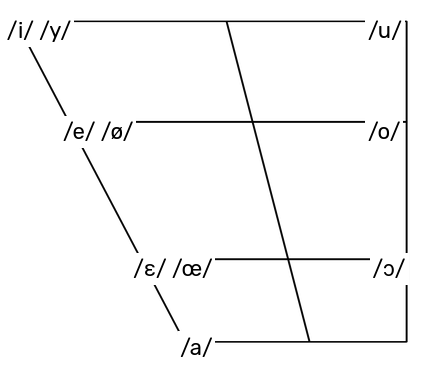
In practice, the vowel /a/ may actually vary between /a/, /ä/ and /ɑ/.
There are speakers that tend to merge /ø/ and /œ/, especially in more informal contexts.
Consonants
Dahur consonants are as follows:
| Bilabial | Labiodental | Alveolar | Postalveolar | Palatal | Velar | Glottal | |
|---|---|---|---|---|---|---|---|
| Nasal | /m/ | /n/ | |||||
| Plosive | /p/ /b/ | /t/ /d/ | /k/ /g/ | ||||
| Sibilant fricative | /s/ /z/ | /ʃ/ /ʒ/ | |||||
| Non-sibilant fricative | /f/ /v/ | /h/ | |||||
| Approximant | /j/ | ||||||
| Tap/Flap/Trill | /ɾ/ /r/ | ||||||
| Lateral Approx. | /l/ |
The rhotic consonant ("r") is in free variation and may be realised either as a tap, a flap or a trill. The trill pronunciation (/r/) is more common at the beginning of a syllable, and even more so at the beginning of a word. The tap/flap pronunciation (/ɾ/) is more common in consonant clusters, especially after a plosive.
In Dahur phonology, the combinations /tɾ/ and /kʃ/ count as single, independent consonants.
Phonotactics
A syllable in Dahur must contain one vowel, which may be preceded and/or followed by any number of consonants. In practice, consonant clusters don't usually go beyond four consonants. For that account, /kʃ/ and /tɾ/ are always considered as single consonants.
All consonant sequences are possible. However, in practice, some consonant combinations (ex. -hm-, -tɾkʃ- &c.) are rare.
Examples of valid syllables:
| a | tɛ | en | wi | koj | gjɔ | pɾujn | kʃtɾa | fʃtlœmbz |
Stress
In the literary dialect, considered official, words are stressed on the next-to-last syllable. However, if the last syllable contains the consonant /tɾ/, it will be stressed.
Ex.:
| kanar
/ˈka.nar/ |
ostrøndɛl
/os.ˈtɾøn.dɛl/ |
tefʃiv
/ˈtef.ʃiv/ |
dasutɾ
/daˈsutɾ/ |
maʃkintɾod
/maʃ.kinˈtɾod/ |
Morphology
Dahur is a highly flexional language, with a strong presence of irregular forms.
Nouns inflect for number, which is basically singular and plural, but there are also occurrences of dual (for things normally occurring in pairs) and singulative (for individual items of things usually found collectively).
Nouns also inflect for case, usually: nominative, accusative, dative, genitive, locative, instrumental, ergative and ablative. Instances of partitive and vocative are also found. The case called ergative is used basically for the agent of the passive voice.
Adjectives show no agreement to nouns, and inflect for degree (comparatives of superiority, equality, inferiority; relative and absolute superlative).
Nouns
Class
Dahurian nouns are divided in five classes, which can be compared to Latin or Greek declensions, as they consist in different inflection patterns, but may also be seen as a form of gender, as class is usually (but not always necessarily) related to the meaning of a noun.
| Class 1 | Living beings |
|---|---|
| Class 2 | General objects |
| Class 3 | Natural elements; insects |
| Class 4 | Parts of human body; clothing |
| Class 5 | Abstract nouns; traditional imaginary beings |
There are no morphological indications related to noun classes in the nominative singular. The differences appear along the inflection of nouns.
Number
Nouns in Dahur have a singular and a plural. The plural ending varies according to noun class and to case. There is also a dual number, which is valid only for nouns normally occurring in pairs. Mass or collective nouns have a singulative inflection.
So, for example:
| Class | Singular | Plural | Dual | Singulative |
|---|---|---|---|---|
| class 1 | grats
"boy" |
gratsen
"boys" |
- | - |
| class 2 | kɛʃev
"hammer" |
kɛʃevlin
"hammers" |
kɛʃevas
"pair of hammers" (traditionally used by blacksmiths) |
- |
| class 3 | halajn
"water" |
halejnn
"waters" (i.e. in a flood) |
halajns
"The Two Waters" (the river Okanuma and the lake Kassanjas) |
halajny
"a drop of water" |
| class 4 | kanar
"eye" |
kanarni
"many eyes" (mostly figuratively) |
kanaris
"(two/both) eyes" |
- |
| class 4 | kʃalim
"hair" |
kʃalimni
"(types of) hair" |
- | kʃalimy
"a (single) hair" |
| class 5 | astrønɛl
"idea" |
astrønɛljan
"ideas" |
astrønɛls
"a couple ideas" |
- |
The plural in classes 1, 2 and 5 is usually regular, obtained with the respective suffixes (-en, -lin, -jan).
Ex.:
| Class | Singular | Plural |
|---|---|---|
| class 1 | fatlaj
"girlfriend" |
fatlajen |
| dukʃatr
"boss" |
dukʃatren | |
| egastɛv
"farmer" |
egastɛven | |
| class 2 | takoj
"pin" |
takojlin |
| upsan
"paper" |
upsanlin | |
| dasutr
"document, file" |
dasutrlin | |
| class 5 | pɛktegal
"angel" |
pɛktegaljan |
| ostrøndɛl
"interruption" |
ostrøndɛljan | |
| piktaraʃ
"problem" |
piktaraʃjan |
In classes 3 and 4, besides the suffixes (-n, -ni), most nouns suffer some sort of mutation, usually affecting only one vowel but non uncommonly consisting of more significative changes.
Ex.:
| Class | Singular | Plural |
|---|---|---|
| class 3 | pakpaki
"louse" |
pakpɛkin |
| pahalis
"leaf" |
pahalejn | |
| tʃeptal
"cloud" |
tʃaptlin | |
| class 4 | kraws
"ear" |
krojsni |
| ɛmblew
"hat" |
ɛmbalni | |
| krikter
"helmet" |
kruktni |
Inflection
Noun declension in Dahur is quite regular, in terms of case and the less usual numbers, viz. the dual and the singulative.
- The nominative case is the basic form of nouns.
- The accusative case is indicated by the enging -a.
- The dative case is indicated by the enging -si.
- The genitive case is indicated by the enging -ak for animate intelligent beings, -iʃ for animals, -is for concrete objects and -ɔn for abstract things.
- The locative case is indicated by the enging -us. With animate nouns, the locative can mean "on", or "with", as in "carrying with".
- The instrumental case is indicated by the enging -em for animate intelligent beings, -om for animals, -um for things.
- The ergative case is indicated by the enging -øtr.
- The ablative case is indicated by the enging -ɛjv.
When an ending starting with a vowel is applied, a final -i becomes -j-, and a final -u becomes -w-; otherwise, an -h- is added. Ex.:
- dula "babysitter", dulahen "babysitters"
- agdari "prisoner", agdarjen "prisoners"
- kanarni "eyes", kanarnja "eyes (accus.)", kanarnjus "in the eyes", kanarnjɛjv "from the eyes"
- pakpaki "louse", pakpakja "louse (accus.)", pakpakjiʃ "of a louse", pakpakjom "by a louse"
Case endings are added to the plural ending.
In the following tables, you have some examples of nouns of the various classes, fully inflected for number and case.
| Class 1: grats "boy" | ||
| Singular | Plural | |
|---|---|---|
| Nominative | grats | gratsen |
| Accusative | gratsa | gratsena |
| Dative | gratssi | gratsensi |
| Genitive | gratsak | gratsenak |
| Locative | gratsus | gratsenus |
| Instrumental | gratsem | gratsenem |
| Ergative | gratsøtr | gratsenøtr |
| Ablative | gratsɛjv | gratsenɛjv |
| Class 2: kɛʃev "hammer" | ||
| Singular | Plural | |
|---|---|---|
| Nominative | kɛʃev | kɛʃevlin |
| Accusative | kɛʃeva | kɛʃevlina |
| Dative | kɛʃevsi | kɛʃevlinsi |
| Genitive | kɛʃevis | kɛʃevlinis |
| Locative | kɛʃevus | kɛʃevlinus |
| Instrumental | kɛʃevum | kɛʃevlinum |
| Ergative | kɛʃevøtr | kɛʃevlinøtr |
| Ablative | kɛʃevɛjv | kɛʃevlinɛjv |
| Class 3: tʃeptal "cloud" | ||
| Singular | Plural | |
|---|---|---|
| Nominative | tʃeptal | tʃaptlin |
| Accusative | tʃeptala | tʃaptlina |
| Dative | tʃeptalsi | tʃaptlinsi |
| Genitive | tʃeptalis | tʃaptlinis |
| Locative | tʃeptalus | tʃaptlinus |
| Instrumental | tʃeptalum | tʃaptlinum |
| Ergative | tʃeptaløtr | tʃaptlinøtr |
| Ablative | tʃeptalɛjv | tʃaptlinɛjv |
| Class 4: kraws "ear" | ||
| Singular | Plural | |
|---|---|---|
| Nominative | kraws | krojsni |
| Accusative | krawsa | krojsnja |
| Dative | krawssi | krojsnisi |
| Genitive | krawsis | krojsnjis |
| Locative | krawsus | krojsnjus |
| Instrumental | krawsum | krojsnjum |
| Ergative | krawsøtr | krojsnjøtr |
| Ablative | krawsɛjv | krojsnjɛjv |
Adjectives
Attributive adjectives in Dahur are invariable and come before the noun. Ex.:
- fɛren grats "a smart boy"
- duʃ halajn "clean water"
- selak kanaris "pretty eyes"
Verbs
The personal endings for all verb forms are as follows:
- 1s: -us
- 2s: -im
- 3s: -ej
- 1p: -tron
- 2p: -trib
- 3p: -trɛw
Aorist
The aorist tense corresponds to the bare stem, to which the personal endings are added. It indicates the verbal action as a complete event. In a main clause, it usually refers to the past, and is so translated. Ex.:
kaʃmal "take"
- 1s: kaʃmalus "I took"
- 2s: kaʃmalim "you took"
- 3s: kaʃmalej "he/she took"
- 1p: kaʃmaltron "we took"
- 2p: kaʃmaltrib "you took"
- 3p: kaʃmaltrɛw "they took"