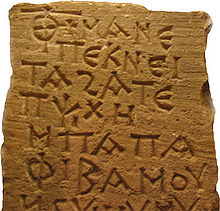
- Οι γυναίκες ζουν περισσότερο από τους άνδρες. – Women live longer than men.
- Οι άνθρωποι μένουν σε σπίτια. – People live in houses.
Nuevas Palabras:
Most frequent characters (46-50)
| 46 | 能 (ㄋㄥˊ) [néng] can, be able; 能够 be capable of; 可能 maybe [tái] (星名) 台; 胎; 態; 治 [nái] 螚: 三足鼈 [nài] 耐 [xióng] 熊 [tāi] 胎? |
| 47 | 里 (ㄌㄧˇ) [lǐ] village; 市里 half kilometer, 公里 kilometer; (F裡) inside; 那里 there; 哪里 where? |
| 48 | 多 (ㄉㄨㄛ) [duō] many, much; how |
| 49 | 小 (ㄒㄧㄠˇ) [xiǎo] small; 大小 dàxiǎo size; (radical 42, 小部) |
| 50 | 而 (ㄦˊ) [ér] (而且 érqiě) and, furthermore; (然而 rán’ér) yet; (radical 126, 而部) [néng] 能; cf. 耐 |
o Duolingo:
Regular Thematic Verb: λέγω
3rd person plural
| Active Indicative Present | λέγουσι(ν) | they say |
| Active Subjunctive Present | λέγωσι(ν) | (that) they say |
| Active Optative Present | λέγοιεν | may they say |
| Middle/Passive Indicative Present | λέγονται | they say to themselves |
| Middle/Passive Subjunctive Present | λέγωνται | (that) they say to theyrselves |
| Middle/Passive Optative Present | λέγοιντο | may they say to theyrselves |
General rules:
From Wikipedia:
| Question (“What”) |
Indication (“This/that”) |
Indefinite (“Some”) |
Universal (“Each, every”) |
Negative (“No”) |
||
|---|---|---|---|---|---|---|
| ki– | ti– | i– | ĉi– | neni– | ||
| Quality | –a | kia (what a) |
tia (such a) |
ia (some kind/sort/type of) |
ĉia (every kind/sort/type of) |
nenia (no kind/sort/type of) |
| Reason | –al | kial (why) |
tial (for that reason, therefore) |
ial (for some reason) |
ĉial (for all reasons) |
nenial (for no reason) |
| Time | –am | kiam (when) |
tiam (then) |
iam (sometime) |
ĉiam (always) |
neniam (never) |
| Place | –e | kie (where) |
tie (there) |
ie (somewhere) |
ĉie (everywhere) |
nenie (nowhere) |
| Manner | –el | kiel (how, as) |
tiel (thus, as) |
iel (somehow) |
ĉiel (in every way) |
neniel (no-how, in no way) |
| Association | –es | kies (whose) |
ties (this/that one’s) |
ies (someone’s) |
ĉies (everyone’s) |
nenies (no one’s) |
| Thing | –o | kio (what) |
tio (this/that) |
io (something) |
ĉio (everything) |
nenio (nothing) |
| Amount | –om | kiom (how much) |
tiom (that much) |
iom (some, a bit) |
ĉiom (all of it) |
neniom (none) |
| Individual | –u | kiu (who, which one; which [horse]) |
tiu (that one; that [horse]) |
iu (someone; some [horse]) |
ĉiu (everyone; each [horse], all [horses]) |
neniu (no one; no [horse]) |