

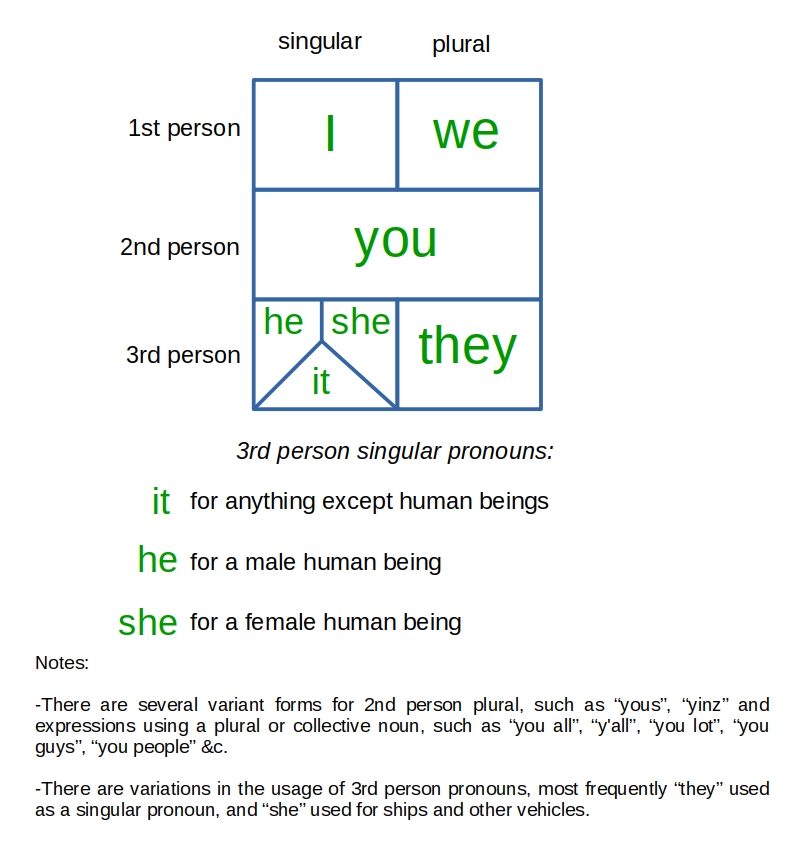
Tag Archives: pronoun
తెలుగు – 2018-02-14
The personal pronouns for 1st and 2nd persons in Telugu are:
| singular | plural | |
|---|---|---|
| 1st person |
నేను | మేము (exclusive) మనము (inclusive) |
| 2nd person |
నువ్వు (low formality) నీవు (mid-level formality) మీరు (high formality) |
మీరు (high formality) తమరు (highest formality) |
The 2nd person pronouns differ in level of formality.
The 1st person plural pronoun మేము, called “exclusive”, means “I and someone else [but not you]”.
The 1st person plural pronoun మనము, “inclusive”, means “I and you [and possibly others]”.
Telugu 3rd person pronouns account for several factors, such as the nature of the referent (human male, human female, non-human), number (singular, plural) and proximity.
| distal | proximal | ||||||
|---|---|---|---|---|---|---|---|
| singular | plural | singular | plural | ||||
| male | వాడు అతను /అతడు ఆయన వారు |
వాళ్లు వారు |
వీడు ఇతను ఈయన వీరు |
వీళ్లు వీరు |
|||
| female | అది ఆమె ఆవిడ వారు |
వాళ్లు వారు |
ఇది ఈమె ఈవిడ వీరు |
వీళ్లు వీరు |
|||
| non-human | అది | అవి | ఇది | ఇవి | |||
| reflexive | తాను | తాము | – | – | |||

Slovenčina – 2016-02-02
In Slovak, indefinite & demonstrative pronouns may be used like some sort of articles (indefinite & definite, respectively).
- To je nejaký muž. / To je muž.
- Ten muž je vysoký. / Muž je vysoký.
- To je nejaká kniha. / To je kniha.
- Tá kniha je veľmi dobrá. / Kniha je veľmi dobrá.
- To je nejaké auto. / To je auto.
- To auto je nové. / Auto je nové.